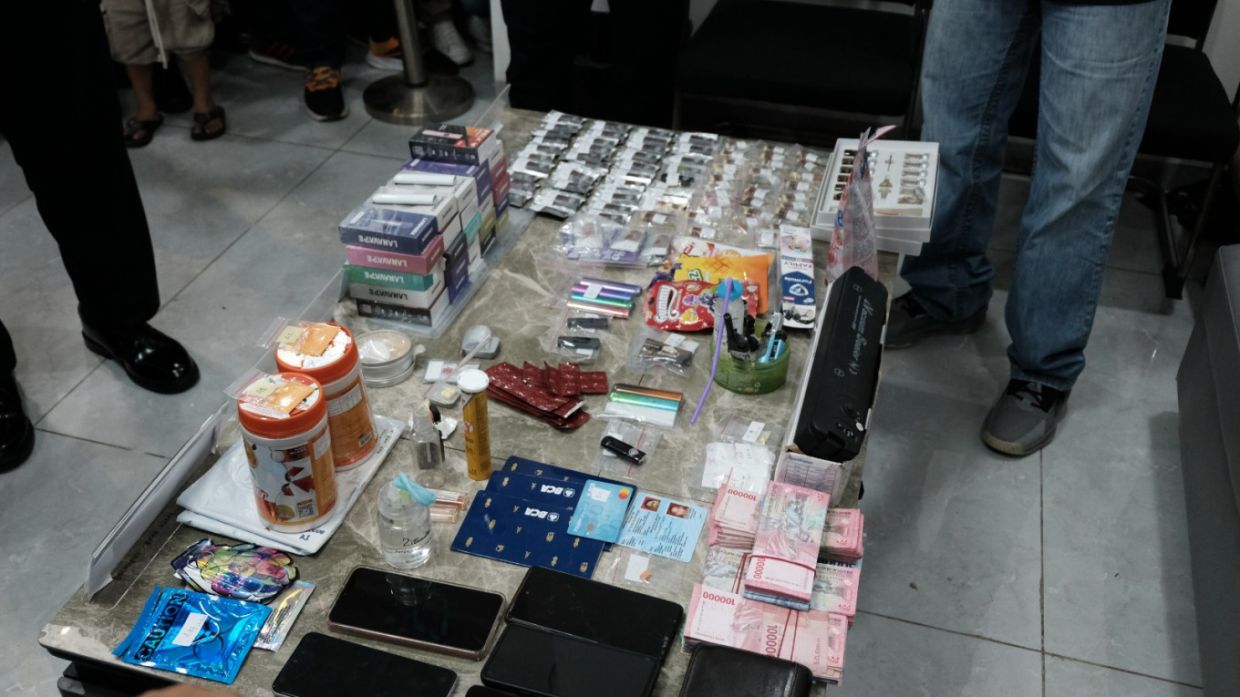
Indonesian authorities have successfully dismantled a sophisticated cross-border drug trafficking organisation, with the National Narcotics Agency (BNN) and Customs officials announcing the operation's success following a press conference held at one of the raided locations in Batam on Friday. The joint enforcement action resulted in the arrest of six Indonesian nationals, though investigators are still pursuing two Malaysian individuals identified as SL and WKC, who are suspected of serving as the primary suppliers to the network operating across the Riau Islands.
The investigation began when Customs officers at Soekarno-Hatta International Airport intercepted a suspicious parcel arriving from Malaysia that had been deliberately mislabelled as Orange Fiber Xtra food supplement. Laboratory analysis conducted at the Customs and Excise Laboratory in Jakarta revealed the package contained substantial quantities of MDMA, ketamine, and other controlled substances—prompting authorities to launch a coordinated tracking operation that would ultimately expose the entire smuggling apparatus.
Insp. Gen. Aswin Sipayung, the BNN's deputy for enforcement, described the syndicate as operating with considerable organisational sophistication, managing a complete supply chain that encompassed smuggling through unsanctioned maritime entry points, repackaging operations, and systematic distribution networks throughout the archipelago. The level of coordination demonstrated by the network suggested experienced operators with established infrastructure, a pattern increasingly common among transnational drug rings seeking to exploit Southeast Asia's porous borders and maritime vulnerabilities.
The enforcement operation unfolded rapidly once the initial package was secured. Officers arrested a suspect identified as BAP in Batam on Wednesday as he attempted to collect the intercepted shipment. His subsequent testimony proved instrumental in identifying additional conspirators, leading authorities to quickly apprehend three further suspects—ED, NC, and TFS—at a hotel in Baloi. ED was identified as the individual who had originally ordered the narcotic-laden package, establishing a clear link in the supply chain.
Officers subsequently conducted raids at multiple locations connected to the network, including an apartment in Teluk Tering owned by one suspect and a boarding house in Batu Ampar's Sakura Garden area where two additional suspects, AJ and DA, were apprehended. These residences yielded extensive drug stocks, including dozens of electronic cigarette pods containing etomidate, crystallised methamphetamine, Happy Five tablets, and Happy Water drinks—indicative of a distribution operation prepared to serve street-level markets across Batam and surrounding regions.
The sophistication of the smuggling methodology underscored the network's operational maturity. Aswin noted that the syndicate deliberately disguised narcotics and etomidate cartridges by concealing them inside dried food packages and nutritional supplement sachets, then resealing containers with specialised plastic devices to present authentic appearances on casual inspection. This deceptive packaging strategy represents a common technique among transnational smuggling groups seeking to bypass routine border screening protocols that typically prioritise pharmaceutical and controlled substance declarations.
In a separate but related enforcement action, Customs personnel stationed at Batam Centre International Ferry Terminal prevented another attempted smuggling incident. Officers intercepted a Malaysian passenger identified as PS arriving from Stulang Laut International Ferry Terminal in Johor Bahru with 48 cartridges containing etomidate concealed on their person. This interdiction suggests the network had established regular supply routes between Johor Bahru and Batam, exploiting the routine passenger ferry traffic between the two jurisdictions.
The total quantity of narcotics and precursor chemicals recovered reveals the scale of the operation. Authorities confiscated 1,076.18 grams of MDMA, 50 grams of methamphetamine, 25.6 grams of ketamine powder, 86 H5 tablets, ten ecstasy pills, 170 vape cartridges containing etomidate, 12 vials of etomidate weighing 226 grams, 88 vape devices, nine water pipes used for methamphetamine consumption, plastic sealing equipment, and six digital scales. Officers also seized four vehicles—a Toyota Alphard van, Toyota Agya hatchback, Chery sport utility vehicle, and two motorcycles—indicating asset accumulation from drug proceeds.
Batam Customs and Excise Office head Agung Widodo framed the enforcement initiative as an extension of routine border monitoring protocols, emphasising the preventive public health dimensions of the operation. Widodo estimated that authorities had effectively protected approximately 6,770 potential users from exposure to these dangerous substances and prevented estimated state healthcare rehabilitation expenditures approaching Rp10.8 billion, equivalent to approximately US$599,000. Such calculations, while somewhat speculative, underscore Indonesian authorities' commitment to quantifying the societal benefits derived from narcotics interdiction operations.
The two Malaysian fugitives, SL and WKC, have been formally placed on Indonesia's wanted list in connection with their alleged role as the primary narcotics suppliers to the dismantled syndicate. Their status as the network's chief suppliers suggests they likely operated from Malaysian territory, coordinating shipments and maintaining communication with Indonesian distributors across digital platforms. Law enforcement coordination between Indonesian and Malaysian authorities will prove essential to apprehending these individuals and disrupting any successor smuggling arrangements they may attempt to establish.
The detained suspects face prosecution under Indonesia's narcotics legislation, specifically Articles 114(2) and 112(2) in conjunction with Article 132(1) of Law No. 35/2009 on Narcotics. These provisions carry penalties ranging from mandatory five-year minimum imprisonment through to capital punishment, with additional financial penalties reaching Rp10 billion. The severity of potential sentences reflects Jakarta's zero-tolerance approach toward narcotics trafficking, particularly regarding international smuggling networks that pose systemic threats to regional drug control efforts.
This enforcement action assumes particular significance for Malaysian observers given the prominent role of Malaysian nationals as alleged supply-chain organisers. The incident illustrates how geographic proximity and established trade corridors between Malaysian Johor and Indonesian Riau Islands create trafficking vulnerabilities that both nations must jointly address through enhanced border cooperation, intelligence sharing, and coordinated interdiction protocols along maritime transit routes.

