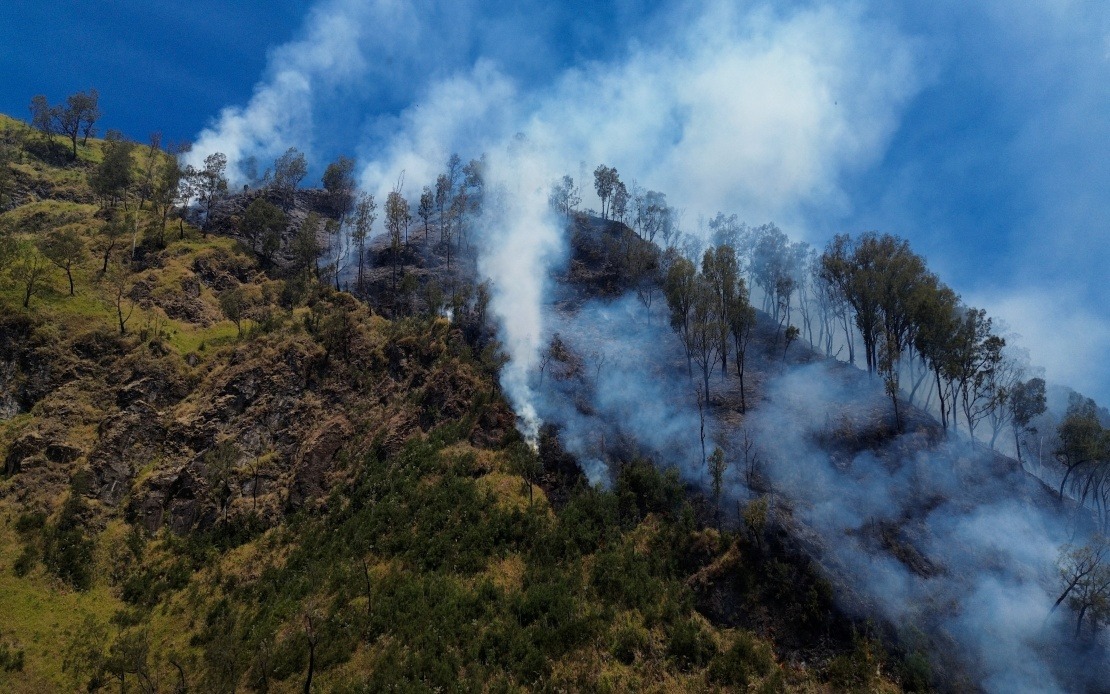
Indonesia has suspended all access to Mount Bromo, one of Southeast Asia's most recognisable natural landmarks, after a spreading forest fire forced authorities to shut down the entire tourist complex at Bromo Tengger Semeru National Park in East Java. The decision to close all five main entrances took effect at 10pm on Saturday, marking a significant disruption to regional tourism operations and reflecting the severity of conditions on the ground.
The wildfire, which ignited on Monday, has already scorched approximately 176.20 hectares across Probolinggo and Malang regencies by the time authorities issued the closure order. Officials from the National Disaster Management Agency emphasised that while firefighting efforts continued through the weekend, smoke-emitting hotspots remained active as of Saturday evening, with weather conditions complicating suppression activities. The closure encompasses all designated entry points, including Cemorolawang in Probolinggo, Wonokitri in Pasuruan, Jemplang and Coban Trisula in Malang, and Senduro in Lumajang, effectively preventing access from multiple approach routes across the region.
For Malaysian and other regional tourists who have already committed to visiting the volcano through online ticket purchases, the park authority has established provisions allowing either rescheduling of trips or full refunds once the crisis subsides. This accommodation reflects an effort to minimise financial impact on the tourism sector whilst maintaining safety as the paramount concern. Mount Bromo attracts significant numbers of international visitors annually, and the closure represents a substantial economic disruption not only for the national park but for surrounding communities dependent on visitor expenditure.
The response from Indonesian emergency services has involved mobilising specialist equipment to combat the expanding blaze. Two helicopters, each equipped with 1,000-litre water capacity, have been deployed in support of ground-based firefighting teams, indicating the scale of resources committed to containing the situation. This aerial support proves critical in reaching terrain inaccessible by road and in achieving the rapid suppression necessary to prevent further advancement of the fire front across the caldera landscape.
The meteorological conditions have added complexity to firefighting operations. Authorities noted that moderate winds were continuing to influence the fire's behaviour and spread pattern, requiring teams to adapt their strategies accordingly. The persistence of active hotspots even as official firefighting efforts intensified suggested that the blaze had established multiple combustion zones across the affected terrain, each requiring targeted attention and resources.
While the Bromo incident captured headlines, neighbouring Mount Rinjani in East Lombok also experienced a significant forest fire during the same period, underscoring a broader pattern of wildfire activity across the region. The Rinjani blaze, which began on Friday evening in the Sembalun Resort area, consumed approximately 30 hectares before being brought under control early Saturday morning around 1.30am. The parallel occurrence of these major fires suggests potential climatic factors favouring combustion across a wider geographic area in East Java and neighbouring provinces.
Investigations into the origins of both fires remain ongoing, with authorities yet to determine whether the blazes resulted from natural causes such as lightning strikes, human activities including uncontrolled burning, or other triggers. Understanding causation proves essential not only for accountability purposes but for developing preventative strategies that might reduce the frequency of such incidents in Indonesia's protected natural areas. The investigation process typically requires gathering evidence from the fire perimeter and interviewing local communities and workers who may have observed activity preceding ignition.
The closure of Mount Bromo carries implications extending beyond immediate tourism disruption. The volcano sits within a UNESCO-designated biosphere reserve and represents critical habitat for numerous endemic plant and animal species found nowhere else globally. Fires of this magnitude can cause ecological damage requiring years to recover, affecting forest regeneration and wildlife populations that depend on specific vegetation communities. The caldera's unique ecosystems, shaped by volcanic geography and high-altitude conditions, face particular vulnerability to disturbance and slow recovery rates.
For Malaysian travellers planning visits to Mount Bromo in the near term, the development underscores the unpredictability of natural events in tropical volcanic regions. Airlines and tour operators serving Malaysian tourists have likely already begun managing bookings and expectations, though the absence of a defined timeline for park reopening creates ongoing uncertainty. Regional tourism operators catering to Malaysian clientele may need to activate contingency itineraries featuring alternative attractions while monitoring official announcements regarding access restoration.
The incident also highlights Indonesia's ongoing challenges with forest fire management across its extensive national park system. Climate variability, agricultural pressures on forest boundaries, and the administrative complexities of coordinating emergency responses across multiple regencies strain resources available for rapid incident containment. As Southeast Asia faces increasing incidence of large-scale wildfires linked to broader environmental changes, the experiences at Bromo provide instructive lessons regarding preparedness, inter-agency coordination, and the protection of iconic natural heritage sites upon which regional tourism economies partially depend.
Authorities have indicated that the park will remain closed until firefighting efforts achieve substantial progress and safety assessments confirm that hazardous conditions no longer threaten visitor wellbeing. Until that determination materialises, Mount Bromo—normally welcoming thousands of visitors daily—stands isolated, its dramatic volcanic landscape temporarily removed from the regional tourism circuit and its ecological integrity threatened by one of the region's more significant recent fire incidents.

