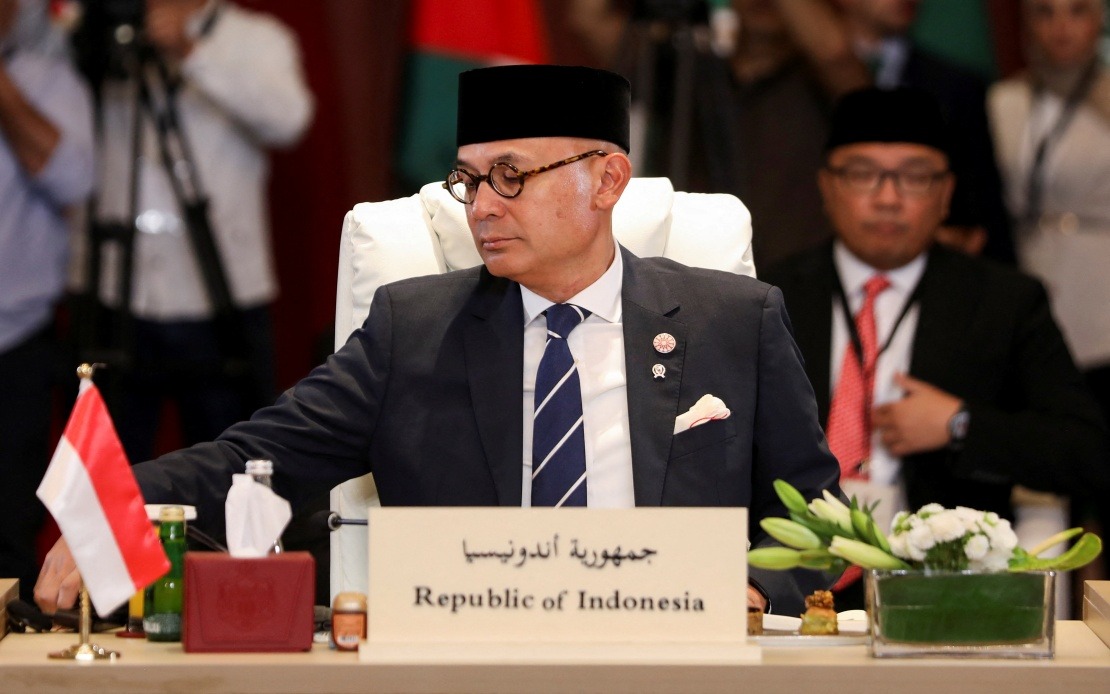
Indonesia has made an impassioned appeal for the international community to unite behind Palestine, warning that divided efforts have consistently allowed Israel to exploit divisions and pursue its own agenda unchecked. Speaking at the Ministerial Meeting on Jerusalem in Amman on Wednesday, Deputy Foreign Minister Arrmanatha Nasir, representing Foreign Minister Sugiono, stressed that the Palestinian struggle transcends religious boundaries and should command universal support grounded in international law and human rights principles.
Nasir's central argument challenges the notion that Middle Eastern conflicts remain regional concerns, instead positioning Palestine as a matter of global significance requiring coordinated diplomatic action. He explicitly cautioned against allowing the current state of fragmented international responses to persist, contending that such disunity creates exploitable gaps that benefit the Israeli government. This framing reflects Indonesia's long-standing position as a leading voice in the Non-Aligned Movement and a champion of developing nations' interests within the United Nations system.
To translate rhetoric into tangible outcomes, Indonesia unveiled a five-point framework designed to strengthen the international response architecture. The proposal begins with forging a unified strategic approach anchored in cohesion, recognising that scattered efforts undermine negotiating power and moral authority. The second pillar emphasises rigorous adherence to international law and respect for International Court of Justice rulings, addressing concerns that selective enforcement weakens the global legal order. Indonesia's third measure calls for expanded formal recognition of Palestine as a sovereign state, a symbolic yet consequential step that enhances the Palestinian Authority's standing within international institutions.
The remaining two components address specific on-the-ground concerns: protecting the Al Aqsa Mosque compound and facilitating Gaza's reconstruction following military operations. By linking spiritual sanctity with practical development needs, Indonesia's proposal acknowledges both the religious and humanitarian dimensions of the Palestinian cause. The framework also advocates strengthening Palestinian national unity and preserving the mandate of UNRWA, recognising that institutional capacity and social cohesion are prerequisites for sustainable statehood.
Nasir's assessment of the regional landscape painted a portrait of escalating tensions fundamentally altering the geopolitical calculus across West Asia. He identified the unchecked expansion of Israeli settlements in occupied Palestinian territories, ongoing military campaigns affecting Gaza, Syria and Lebanon, and the deteriorating US-Iran relationship as interconnected developments demanding unified international attention. This contextual analysis matters significantly for Malaysian policymakers, as regional instability reverberates through trade routes, energy markets and security arrangements affecting Southeast Asia's broader strategic interests.
Indonesia's consistent reaffirmation of the Hashemite Custodianship over Jerusalem's holy sites, particularly Al Haram Al Sharif, reflects diplomatic recognition of Jordan's historical and spiritual role while reinforcing commitment to the two-state solution framework. This careful positioning balances multiple constituencies: Muslim-majority nations, Arab states, Organisation of Islamic Cooperation members, and Western partners increasingly concerned about Middle East destabilisation. For Malaysia, Indonesia's leadership on this issue provides diplomatic cover for similarly positioned nations seeking to advance Palestinian interests without isolating themselves from broader international consensus.
The Amman summit itself represented a significant concentration of diplomatic weight, drawing participation from foreign ministers and senior officials from Malaysia, Algeria, Saudi Arabia, Iraq, Egypt, Türkiye, Tunisia, Somalia, Pakistan, Morocco, Palestine and Qatar, alongside the League of Arab States' secretary-general. This roster demonstrates the breadth of support for coordinated Palestinian advocacy, though notably absent were representatives from most Western powers and Israel's regional allies. The meeting's composition underscores a fundamental geopolitical division regarding Palestine, where most developing nations and Muslim-majority countries maintain steadfast support despite Western governments' more cautious positioning.
The summit's adopted joint statement reinforced several critical principles that Indonesia championed. Participants explicitly rejected unilateral relocation of diplomatic missions to Jerusalem as violations of international law, directly addressing recent initiatives by a handful of countries. The statement's emphasis on coordinated media campaigns reflects recognition that information warfare and narrative control shape international opinion as decisively as formal diplomacy. By calling for unified awareness-raising about Israeli actions and their destabilising regional and global implications, participants acknowledged that public opinion increasingly influences government decision-making.
For Southeast Asian nations like Malaysia and Indonesia, this diplomatic initiative carries particular significance as both countries balance commercial interests with principled positions on Palestinian rights. Indonesia's proposal for structured international coordination provides a template for other developing nations seeking to amplify their advocacy without appearing obstructionist. The emphasis on international law rather than religious identity broadens the coalition's potential appeal while anchoring Palestinian rights within the universal rules-based order that most nations theoretically endorse.
The strategic timing of this gathering, amid heightened tensions across the Middle East and periodic escalations in Israeli-Palestinian violence, suggests deliberate diplomatic effort to prevent regional crises from disappearing from international agendas. Indonesia's five-point framework, if adopted by other nations, could establish concrete mechanisms for translating solidarity into policy outcomes. Whether these aspirations materialise depends partly on whether major powers and Security Council permanent members embrace unified approaches or continue pursuing narrower geopolitical calculations.
Looking forward, Indonesia's Amman initiative sets expectations for consistent follow-up among participating nations. The proposed measures require sustained commitment and resource allocation, from supporting Palestinian institution-building to funding reconstruction efforts. For Malaysia and other Southeast Asian countries, this summit provides both opportunity and obligation to translate verbal endorsements into substantive policy actions that advance Palestinian self-determination while maintaining principled engagement with the broader international community.

