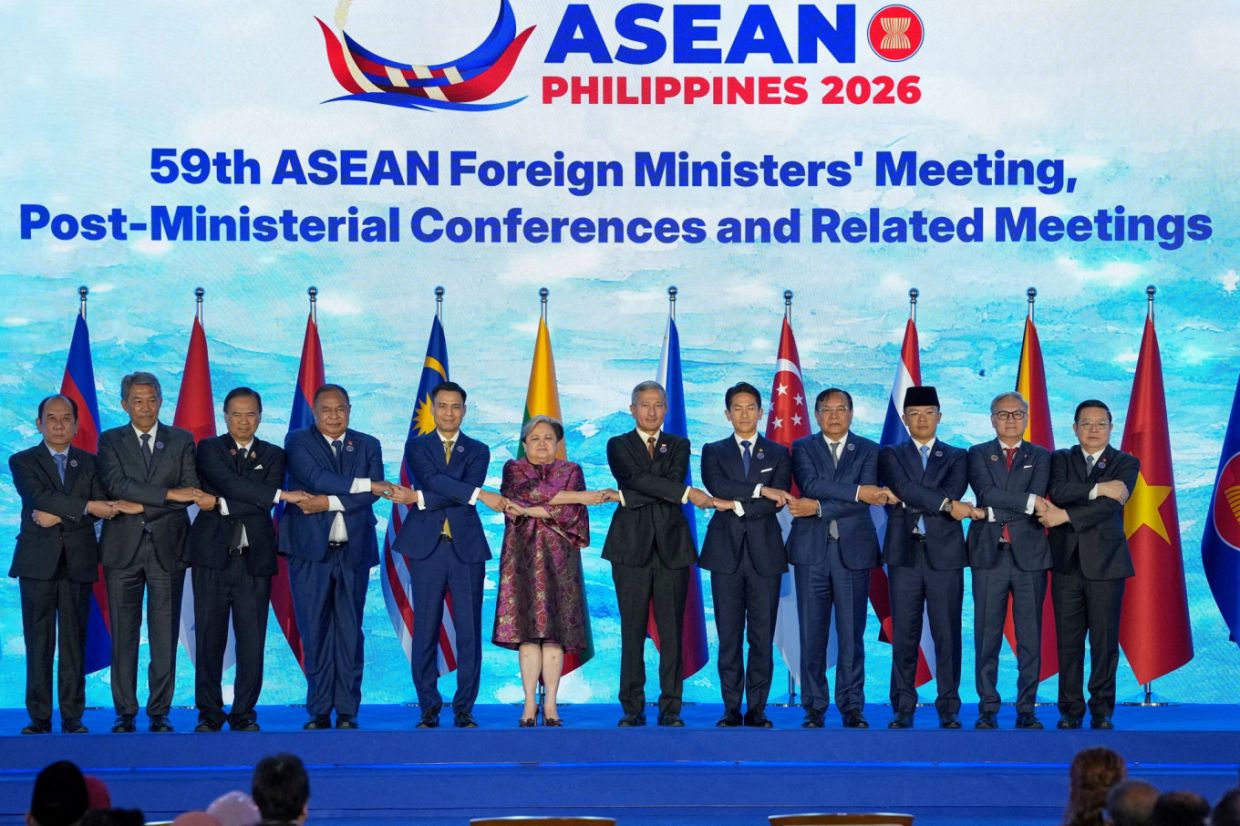
The Association of Southeast Asian Nations faces mounting pressure to transform its carefully crafted agreements into measurable outcomes, according to Indonesian Foreign Minister Sugiono, who sounded an alarm Tuesday about the organisation's ability to navigate an increasingly turbulent global landscape. Speaking at the 59th Asean Foreign Ministers Meeting in Manila, Sugiono articulated a fundamental challenge confronting the ten-member bloc: whether its leaders can move beyond ceremonial pledges to demonstrate genuine regional cohesion when faced with interconnected crises spanning the Middle East, maritime disputes and internal conflicts. The Indonesian call for action reflects deepening anxieties within the region that Asean risks irrelevance if it cannot harness its collective diplomatic weight to shape outcomes that protect member states' interests.
The Manila gathering brought together top diplomats from all eleven Asean nations on Tuesday for intensive discussions designed to establish unified positions before engaging external powers on Wednesday. The agenda encompassed several interlocking challenges: the economic consequences of Middle Eastern instability, competing maritime claims in the South China Sea, and the deteriorating humanitarian situation in Myanmar. Each issue individually commands attention; their convergence threatens to overwhelm Asean's notoriously consensus-driven decision-making apparatus. Sugiono's intervention signalled that Indonesia, traditionally one of the bloc's most influential voices, views this moment as a potential inflection point determining whether Asean retains agency over its regional future or becomes increasingly beholden to external powers.
The Middle East conflict emerged as an immediate and concrete concern for Southeast Asian economies heavily dependent on energy imports and maritime trade flows through vulnerable waterways. Asean ministers jointly expressed worry about the geopolitical spillover effects, potential disruptions to commerce and energy supplies, and the welfare of Southeast Asian nationals working in conflict-affected zones. Beyond these humanitarian and economic preoccupations, however, the Middle East crisis carries subtle but significant implications for Asean's negotiating position within the region. Preliminary trade data suggests that some member states, facing energy shortages triggered by disruptions near the Strait of Hormuz, have begun deepening their reliance on Chinese energy solutions. The Philippines, serving as this year's Asean chair, more than doubled solar panel imports from China during the first five months of 2024 compared with the equivalent 2023 period.
This shift in energy sourcing patterns illuminates a broader strategic vulnerability that transcends simple commercial transactions. As member states scramble to secure alternative energy supplies, their negotiating leverage regarding contested maritime boundaries and resource rights potentially diminishes. China, the dominant power in the region and a primary claimant in the South China Sea disputes, simultaneously offers energy security solutions that member states urgently require. This dynamic creates a form of asymmetrical pressure whereby economic dependence gradually erodes the unified diplomatic position necessary for Asean to meaningfully shape negotiations over maritime conduct rules. Sugiono's emphasis on completing the Code of Conduct for the South China Sea therefore carries heightened urgency; delaying its finalisation risks allowing fundamental asymmetries to crystallise into permanent arrangements.
The unresolved Code of Conduct represents perhaps the most visible symbol of Asean's struggle to convert institutional commitment into operational reality. Since 2000, member states have engaged in protracted negotiations designed to establish binding rules governing conduct in one of the world's most economically vital and militarily sensitive waterways. Two decades of incremental progress have produced a non-binding framework, but the legally binding code that would provide genuine regulatory clarity remains perpetually beyond reach. Sugiono's declaration that regional populations have waited twenty-four years for maritime rules, and should not wait another year, reflects not merely diplomatic frustration but a recognition that prolonged delay itself constitutes a form of strategic failure. Without established rules, maritime disputes remain susceptible to unilateral assertion of control by the region's most powerful actor.
Myanmar's ongoing political implosion featured prominently in Tuesday's discussions, with ministers devoting specific attention to implementing Asean's Five-Point Consensus, the organisation's roadmap for national reconciliation. This initiative encapsulates Asean's methodological approach to regional crises: extensive engagement, gradual consensus-building, and preference for dialogue over coercive measures. Yet the Myanmar situation has consistently tested the limits of this approach. Profound divisions persist among member states regarding appropriate engagement with the ruling military council, particularly between nations maintaining substantial strategic ties with Naypyidaw and those prioritising humanitarian concerns. Philippine Foreign Secretary Theresa P. Lazaro indicated that ministers agreed to review metrics for measuring progress under the Five-Point Consensus and to examine potential reforms to the annual special envoy mechanism, with a comprehensive assessment expected before the leaders' meeting scheduled for November.
These procedural adjustments suggest that Asean recognises the inadequacy of its existing Myanmar strategy, yet structural obstacles to consensus remain formidable. Some members maintain significant economic and security interests in preserving constructive relations with Myanmar's military administration, while others face domestic pressure from civil society and parliamentary constituencies demanding stronger criticism of alleged human rights violations. The bloc's foundational commitment to non-interference in member states' internal affairs, historically a strength in preventing external intervention, now complicates efforts to address situations where internal governance failures generate serious regional consequences. The proposed changes to the special envoy role and progress measurement frameworks represent incremental evolution rather than fundamental reorientation, reflecting Asean's characteristic preference for gradual adjustment over dramatic recalibration.
Indonesia's more assertive diplomatic posture may signal broader recognition that incremental adaptation no longer suffices given the magnitude of contemporary regional challenges. The expansion of Asean membership to include Timor-Leste in May represented a significant institutional evolution, the first expansion in nearly a generation. Yet admitting a new member, while symbolically important, addresses neither the mechanism question of how the bloc makes decisions nor the substance question of how it influences outcomes on matters where member interests diverge. Sugiono's emphasis on demonstrating Asean's capacity to uphold its charter and safeguard regional stability implicitly acknowledges that the organisation's credibility depends on visible achievement on concrete issues, not merely institutional processes.
The diplomatic meetings scheduled for Wednesday, when Asean engages its eleven dialogue partners including the United States, China and Russia, will test whether the bloc can present unified positions on critical matters. This external engagement carries particular significance given the strategic competition between Washington and Beijing over regional influence. Both powers maintain official dialogue relationships with Asean, yet their underlying geopolitical objectives often diverge markedly. The bloc's effectiveness in these conversations depends partly on demonstrating internal cohesion and partly on convincing external partners that Asean retains autonomous agency rather than functioning as a venue for great power competition. Indonesia's pre-emptive emphasis on delivering tangible results suggests concern that without demonstrated achievements, Asean risks being perceived as a talking shop incapable of influencing regional developments.
For Malaysian observers, the Indonesian exhortation carries particular resonance given Malaysia's complex position within the bloc and broader regional dynamics. Malaysia maintains substantial interests in South China Sea stability, energy security, and Myanmar's trajectory, yet often finds its diplomatic voice constrained by the requirement for consensus. The Asean model privileges unanimity, a principle that prevents exclusionary decision-making but simultaneously enables obstruction by individual members opposed to particular positions. Indonesia's apparent frustration with this dynamic reflects a pragmatic recognition that consensus-seeking institutions struggle to respond rapidly to fast-moving geopolitical challenges. Whether Asean can recalibrate sufficiently to demonstrate policy efficacy while preserving the inclusive principles defining its identity remains an unresolved question.
The convergence of multiple regional crises creates both imperative and opportunity for substantive action. The Middle East instability demonstrates immediate vulnerability to external shocks, the South China Sea disputes require resolution before present power imbalances calcify into permanent arrangements, and Myanmar's crisis demands sustained engagement lest regional instability metastasise. Indonesia's challenge to the bloc essentially poses this question: will Asean prove capable of shaping its collective future, or will it become increasingly buffeted by external forces and internal divergences? The answer emerging from Manila's deliberations will reverberate far beyond Southeast Asia's borders, signalling to regional and global powers whether this organisation of 700 million people possesses sufficient cohesion and capability to merit serious diplomatic engagement or whether bilateral and great power relationships will increasingly supersede multilateral channels.

