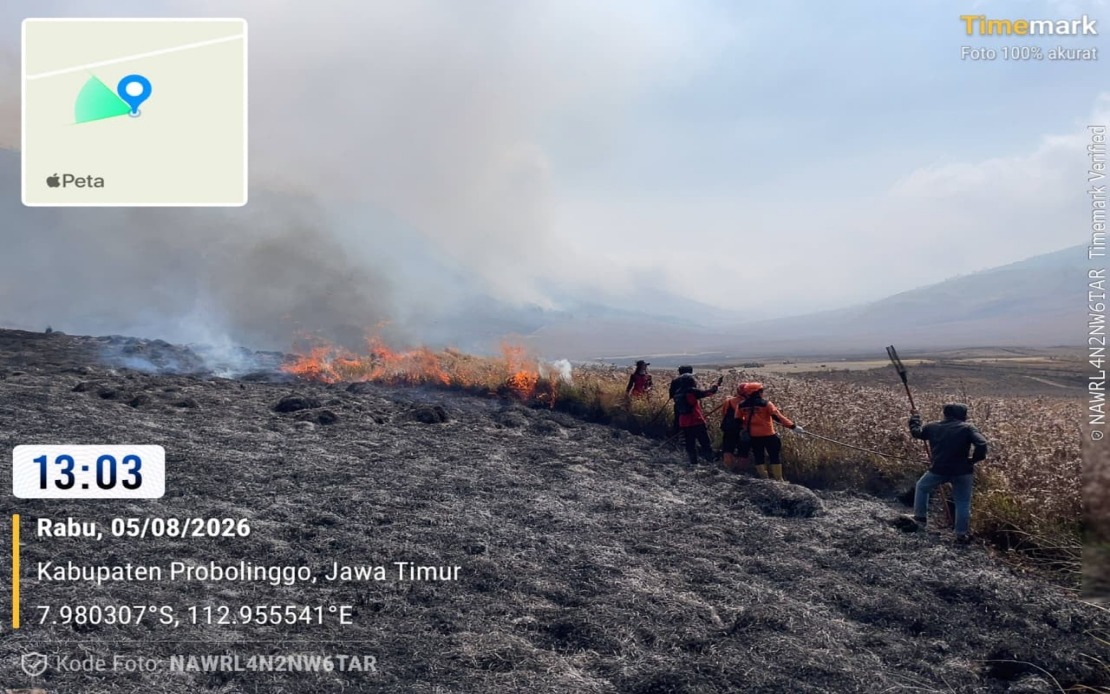
Indonesia's National Disaster Management Agency has escalated its response to a significant wildfire threatening the iconic Mount Bromo region, deploying aerial firefighting assets to tackle flames that have consumed roughly 60 hectares of terrain across East Java. The fire, which ignited on Monday, has affected both Probolinggo and Malang regencies, creating a challenging situation for ground-based emergency teams navigating the volcano's notoriously difficult topography.
According to Abdul Muhari, head of the National Disaster Management Agency's information division, the affected areas include approximately 10 hectares within Probolinggo Regency proper and a more substantial 50 hectares within the Bromo Tengger Semeru National Park located in neighbouring Malang Regency. The distribution of fire across two jurisdictions has required coordinated efforts between provincial and national authorities, with resources stretched across the volcanic landscape that presents formidable obstacles for conventional firefighting methods.
The deployment of two water-bombing helicopters represents a significant escalation in response measures, specifically targeting hotspots situated on precipitously steep slopes where ground personnel face severe access constraints. These aerial assets bring critical capability to reach fire locations that would require mountaineering expertise and extended supply lines if approached exclusively from below. The helicopters' water-dropping capacity addresses a fundamental limitation of terrestrial firefighting teams operating in mountainous terrain where positioning equipment and personnel becomes exponentially more difficult as elevation and gradient increase.
By Wednesday afternoon, authorities had achieved substantial containment of the primary fire body, yet the situation remained volatile with multiple hotspots continuing to burn in isolated and rugged locations. The persistence of these residual fire sources even after major suppression efforts illustrates the particular challenges posed by volcanic terrain, where complex ground features and varied vegetation types allow flames to persist in protected microclimates inaccessible to firefighting personnel. Emergency teams maintained continuous surveillance and engagement with these remaining hotspots throughout the week.
Beyond helicopter operations, Indonesian authorities prepared to implement Weather Modification Operations as a supplementary strategy, contingent upon atmospheric conditions proving suitable for the procedure. This approach reflects the agency's willingness to employ emerging technologies to combat the blaze, representing an increasingly common tactic in major fire suppression efforts across Asia. Weather modification programmes aim to induce precipitation that would naturally suppress fire spread while potentially reducing smoke impacts on surrounding communities.
The Mount Bromo area, which attracts significant tourism revenue and holds cultural significance for Indonesian communities, remains partially closed to visitors. The Bromo Tengger Semeru National Park Authority implemented temporary restrictions on tourist access to affected zones, prioritizing firefighting operations and safeguarding public safety. Such closures, while economically consequential for local tourism operators and guides dependent on visitor traffic, remain necessary given the unpredictable nature of mountainous fire behaviour and the risks posed to civilian populations in proximity to active burning.
Investigations into the fire's origin have focused on an unattended campfire allegedly abandoned by hikers, pointing to human negligence as the probable cause. This preliminary assessment, though still under formal investigation, underscores a persistent challenge facing Indonesia's national parks and protected areas: managing recreation and tourism while preventing accidental ignition sources. The voluminous foot traffic across Mount Bromo annually brings thousands of visitors whose activities, even when unintentionally careless, can trigger environmental emergencies affecting vast landscapes and disrupting regional operations.
The Mount Bromo wildfire reflects broader patterns of fire management challenges across Southeast Asia, where volcanic regions, dry seasons, and high visitor numbers create conditions conducive to rapid fire spread. Indonesia's experience managing this particular incident offers lessons applicable to similar protected areas throughout the region, particularly regarding pre-positioning of aerial resources, inter-agency coordination protocols, and protocols for managing popular tourist destinations during fire emergencies.
For Malaysian observers and regional stakeholders, Indonesia's response demonstrates both the effectiveness of coordinated emergency management involving multiple agencies and the persistent vulnerability of even heavily monitored natural heritage sites to accidental ignition. The incident reinforces the importance of visitor education programmes, strict enforcement of fire safety regulations in protected areas, and maintaining readiness with specialized equipment suited to difficult terrain. As Southeast Asia continues experiencing climate patterns potentially favouring increased fire frequency and intensity, the capacity to rapidly mobilize aerial firefighting resources becomes increasingly critical for protecting both natural ecosystems and regional economic interests dependent on tourism and forest preservation.

