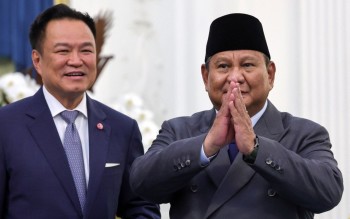
Indonesia has expressed confidence in reaching US$20 billion in annual bilateral trade with Thailand by 2030 following the formal adoption of a comprehensive strategic partnership roadmap spanning 2026 to 2030. The roadmap was endorsed during the second Leaders' Consultation between President Prabowo Subianto and Thai Prime Minister Anutin Charnvirakul at the Merdeka Palace in Jakarta on Monday, marking a significant escalation in economic cooperation between Southeast Asia's two largest economies by population.
The timing of Anutin's visit carries particular weight as it represents the first official trip by a Thai prime minister to Indonesia in 15 years—a gap that underscores how relations between the neighbouring nations had stalled despite their geographic proximity and economic complementarities. Anutin's tenure as Thailand's 32nd prime minister began in September 2025, making this visit his inaugural diplomatic engagement with Indonesia's leadership since assuming office. The visit followed President Prabowo's own trip to Bangkok the previous year, when the two countries first elevated their relationship to the status of Strategic Partnership, laying the groundwork for the more ambitious roadmap now in place.
Central to the new framework is the establishment of the Indonesia-Thailand Joint Trade Commission, which Prabowo described as the first such mechanism in the bilateral relationship's history. This institutional innovation addresses a critical gap in how the two countries have managed their economic ties, providing a dedicated platform at ministerial level for identifying commercial opportunities and systematically removing barriers that have historically impeded deeper market integration. By formalising trade negotiations through this permanent body, both governments signal their commitment to moving beyond episodic diplomatic exchanges toward sustained, structured engagement on business matters that directly affect their private sectors and consumers.
The ambitious trade target must be contextualised within the current bilateral relationship. Thailand currently ranks as Indonesia's fourth-largest trading partner within ASEAN, a position that falls short of what economic logic would suggest given the combined population and industrial capacity of the two nations. Anutin himself acknowledged this gap during his remarks, emphasising that the sheer scale of Indonesia and Thailand's economies ought to translate into considerably higher trade volumes than currently observed. This recognition reflects growing frustration on both sides that untapped potential remains due to structural barriers, tariff complications, and insufficient awareness of complementary production capabilities.
Food security emerged as a priority area within the roadmap, reflecting both countries' vulnerability to global supply chain disruptions and shared interests in regional self-sufficiency. The agreement encompasses agricultural technology transfer, logistics infrastructure, food processing capabilities, and supply chain resilience mechanisms designed to insulate the region from international volatility. Thailand has committed to remaining a dependable source of high-quality rice for Indonesia, a critical commitment given Indonesia's reliance on rice imports to feed its vast population. Simultaneously, Anutin signalled Thai appetite for expanded access to the Indonesian market for agricultural products, meat, dairy, and farm machinery—areas where Thai producers possess competitive advantages that have remained underutilised.
A particularly significant component of the food security initiative concerns urea fertiliser, where Thailand hopes to dramatically increase imports from Indonesia. The current annual volume of approximately 60,000 tonnes represents merely a fraction of potential demand, and Anutin explicitly flagged ambitions to expand this to several hundred thousand tonnes annually. This expansion would represent a substantial revenue opportunity for Indonesian producers while ensuring Thailand's access to competitively priced inputs essential for maintaining agricultural productivity and food export capacity. The fact that fertiliser features prominently in bilateral discussions reflects broader Southeast Asian concerns about agricultural input costs and supply security in an era of geopolitical uncertainty.
Energy cooperation constitutes another pillar of the strategic roadmap, with both nations committed to convening an Indonesia-Thailand Energy Forum designed to fortify energy security and accelerate transitions toward sustainable energy systems. This agenda reflects the dual pressure facing both countries: managing immediate energy demands whilst meeting international climate commitments and investor expectations regarding decarbonisation. By establishing a collaborative framework that engages both governments and private sector actors, the roadmap acknowledges that energy transitions cannot succeed through policy directives alone but require coordinated investment and technology deployment across borders.
The digital economy dimension of the partnership carries particular relevance for Malaysian readers and policymakers observing competitive dynamics across the region. Both Indonesia and Thailand have identified local currency transactions as a means to improve bilateral trade and investment efficiency, a decision that implicitly reduces dependence on US dollar intermediation and creates space for more flexible financial arrangements. This development occurs within a broader regional trend toward de-dollarisation and the strengthening of ASEAN-centric financial mechanisms, developments that carry implications for currency volatility and capital flows across Southeast Asia.
The halal industry represents an underexplored area of cooperation between the two Muslim-majority nations, and the roadmap explicitly addresses potential for developing regional and global halal value chains. Anutin underscored the urgency of renewing the mutual recognition agreement on halal certification before its expiration in November, preventing a regulatory cliff that would disrupt trade in halal-certified products. For Malaysia, a regional leader in halal standards and certification, the Indonesia-Thailand initiative to deepen halal industry cooperation offers both competitive opportunities and collaborative possibilities within the broader ASEAN ecosystem.
Beyond trade in goods, the Leaders' Consultation produced concrete agreements on education, tourism, and waste management. A memorandum of understanding on education aims to strengthen human capital development, acknowledging that bilateral prosperity depends on developing skilled workforces capable of competing in digital and advanced manufacturing sectors. Tourism partnerships between the Tourism Authority of Thailand and TransNusa, alongside organic waste processing agreements involving Bio-Axel and Pro Konsilium, demonstrate how the strategic roadmap extends beyond traditional bilateral state agreements into specific commercial arrangements that create immediate value for participating enterprises.
The roadmap's adoption represents a watershed moment in Indonesia-Thailand relations, transforming a partnership that had drifted into relative insignificance into a framework with concrete targets, institutional mechanisms, and sector-specific initiatives. For regional observers and particularly for Malaysian stakeholders engaged in ASEAN affairs, the bilateral momentum between these two giants carries consequences for regional trade flows, investment patterns, and the balance of economic influence within Southeast Asia. Success in implementing this roadmap could establish a model for deeper integration among ASEAN members, whilst setbacks might reinforce patterns of fragmented regional cooperation that have long constrained collective prosperity.

