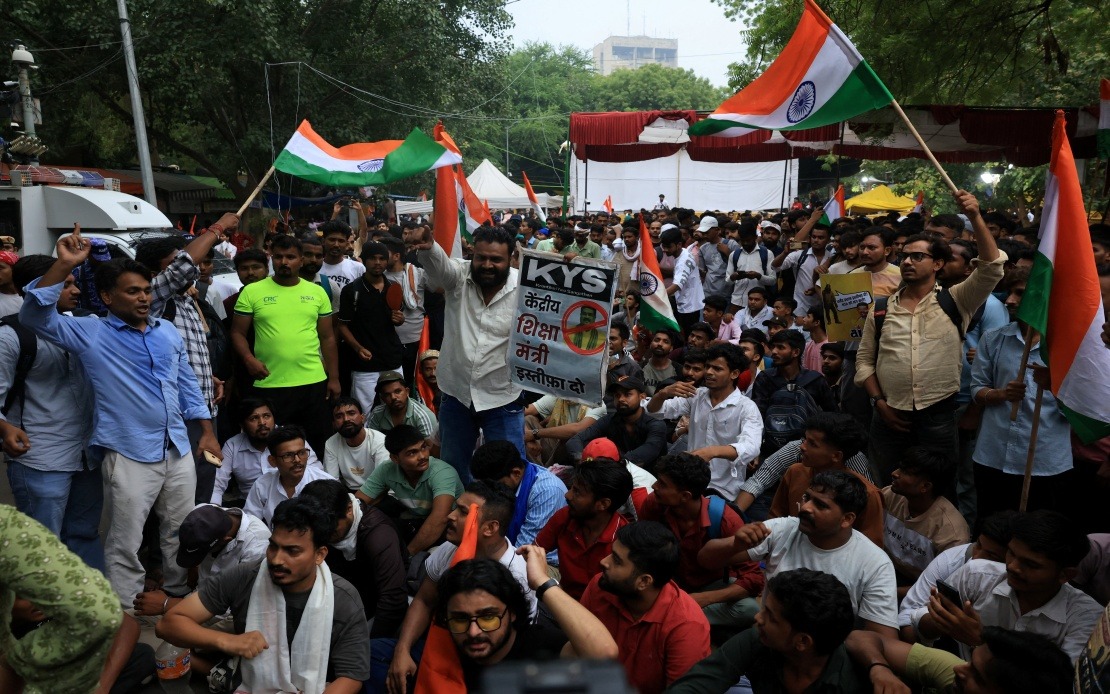
A newly mobilized youth movement brought thousands of demonstrators to the streets of New Delhi on Monday, seeking to press lawmakers for sweeping changes to India's academic system. The rally, branded as "Sansad Chalo" (march to parliament), quickly escalated into a tense standoff with police who had established barricades around the parliament complex as the monsoon session got underway. Local media documented police deploying crowd-control tactics as protesters attempted to breach the security perimeter, reflecting the intensity of sentiment among India's younger generation regarding educational reform.
The movement behind the demonstration represents a significant phenomenon in contemporary Indian politics: a digitally-native, youth-led campaign that has reportedly accumulated millions of followers across online platforms. This social media mobilization capacity signals a shift in how political activism is organized in India, bypassing traditional institutional channels and appealing directly to younger voters who feel alienated from conventional democratic participation. The scale of online support translating into street presence underscores genuine frustration with the educational establishment, suggesting this is not merely a flash protest but reflects deeper structural discontent.
Police restrictions on public gatherings had been in effect ahead of the march, yet the demonstration proceeded with considerable numbers, indicating the protesters' determination to make their voice heard despite official constraints. The timing proved significant, coinciding with Prime Minister Narendra Modi's attendance at parliament for the commencement of the monsoon session. Security forces managing the demonstration near the parliament complex required the Prime Minister to depart the building in a protected convoy, disrupting normal parliamentary operations and elevating the profile of the protest nationwide.
The core demands center on reforming India's academic system, though the specific grievances reflect broader concerns among India's student population. These typically include critiques of rote-learning pedagogies, inadequate vocational training infrastructure, limited career development pathways, exam-centric evaluation methods, and perceived disconnect between university curricula and labour market requirements. Educational reform has emerged as a rallying point for Indian youth who recognize that traditional degrees may no longer guarantee employment security in an increasingly competitive global economy.
For Malaysian observers, the Indian education protest carries instructive parallels. Southeast Asia's largest economy faces similar pressures around educational relevance and student employability. India's technical institutes and universities struggle with capacity and quality standards not dissimilar to challenges faced across the region. The emergence of digitally-coordinated youth activism demanding systemic change reflects demographic and technological shifts affecting all Southeast Asian societies, where younger populations increasingly expect governments to respond to their concerns through direct engagement rather than waiting for electoral cycles.
Security authorities responded to the demonstration by tightening measures across multiple districts in India's capital, reflecting concern about the movement's potential to mobilize further protests. The deployment of enhanced security protocols suggests officials view the youth movement as a credible organizing force capable of sustained mobilization. This elevated security posture also indicates the government's assessment that education policy has become sufficiently contentious to warrant serious attention from law enforcement and administrative agencies.
The monsoon session provides a strategic platform for parliamentary debate on policy matters, and the timing of this protest ensures educational reform will likely receive legislative attention. Indian opposition parties and independent legislators may seize the moment to raise student concerns during parliamentary sessions, potentially converting street pressure into legislative proposals. The demonstration thus functions as a pressure campaign designed to force the agenda-setting power of parliament toward education rather than other priorities.
International observers have noted that India's youth increasingly demonstrate through hybrid mechanisms combining online coordination with offline street presence. This protest exemplifies that pattern, mobilizing sympathizers identified through social media into coordinated action at politically significant locations. The approach proves particularly effective when targeting specific legislative sessions or constitutional occasions, as it creates concentrated pressure at moments when political decision-making capacity is concentrated and media attention is heightened.
The movement's success in drawing substantial crowds despite police restrictions suggests considerable underlying discontent. Students and young adults in India perceive their interests as systematically underrepresented in policy formation. Education remains a devolved responsibility in India's federal system, with state governments holding significant authority over curricula and quality standards. This fragmentation means coordinated national pressure from youth movements can highlight the need for central government leadership on education standards and reform priorities.
Regional governments across India will likely monitor the movement's evolution carefully, as education policy directly affects their electoral fortunes. Youth voter mobilization around education could reshape state-level political competition if sustained. For Malaysian policymakers, the Indian protest offers a cautionary lesson about delayed responsiveness to educational concerns—the longer governments ignore calls for reform from increasingly politically conscious youth populations, the greater the risk of mobilized opposition that disrupts normal governance.
The convergence of a youth movement, digital organizing capacity, and parliamentary timing created an unusually potent political moment in New Delhi. Whether this demonstration catalyzes substantive educational reform or remains a symbolic gesture will depend on whether political leadership demonstrates genuine commitment to addressing student concerns. The movement's future trajectory will also influence similar youth organizing efforts across South and Southeast Asia, where demographic and economic pressures on education systems remain broadly comparable to India's circumstances.

