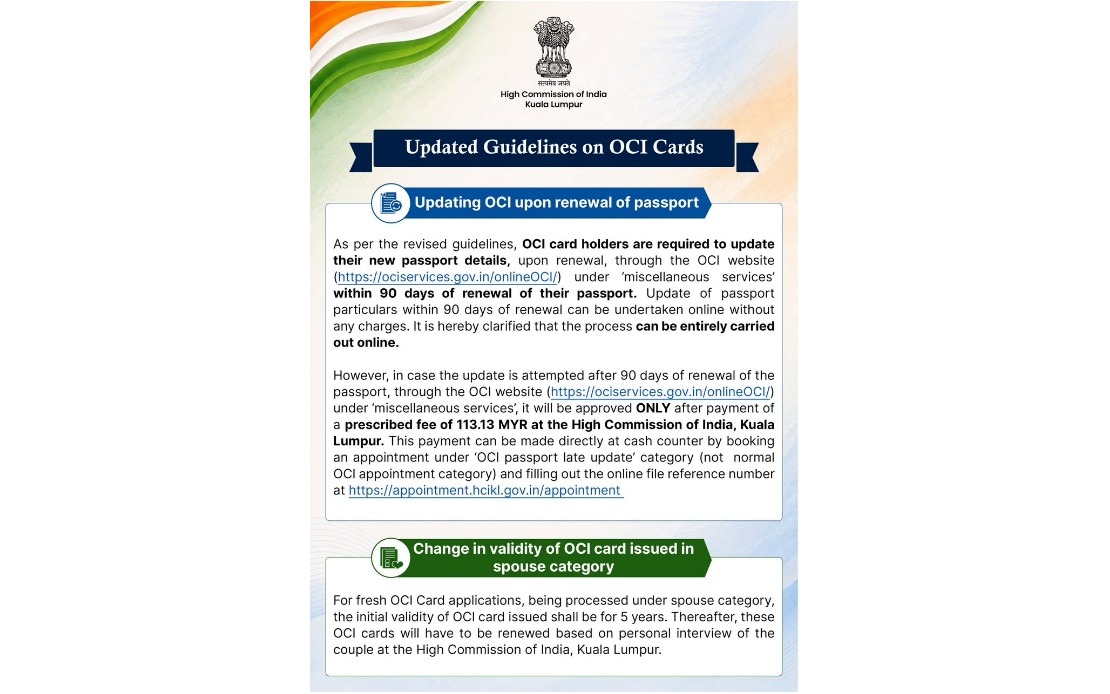
The High Commission of India in Kuala Lumpur has tightened administrative procedures governing Overseas Citizen of India cards, introducing a 90-day window for passport information updates and recalibrating eligibility terms for applicants pursuing the spouse category. The move reflects New Delhi's broader effort to streamline documentation processes across its diplomatic missions while ensuring compliance with revised federal citizenship protocols. For the estimated 200,000-strong Indian diaspora in Malaysia, the changes carry immediate operational implications, particularly for those renewing travel documents or planning family-based status applications.
Under the refreshed guidelines, OCI cardholders must promptly report changes to their passport particulars following any passport renewal. The High Commission has established a 90-day grace period during which this administrative update can be completed entirely through digital channels at no cost. This online mechanism, accessible via the official OCI portal under the miscellaneous services menu, represents a modernisation effort designed to reduce in-person visits and streamline workflow at the mission. For most cardholders, this represents a straightforward compliance requirement that aligns with broader trends toward digital governance across Indian government services.
The financial incentive structure becomes more punitive should applicants miss the deadline window. Any updates submitted beyond the initial 90-day period will require payment of a prescribed fee of RM113.13 at the High Commission's physical location in Kuala Lumpur. This tiered approach—free within the window, chargeable thereafter—effectively penalises administrative negligence while encouraging timely compliance. The late-update fee, while modest in absolute terms, introduces friction into what should theoretically be a straightforward administrative task, potentially affecting working professionals and frequent travellers who manage multiple documentation processes simultaneously.
The mechanics of the late-update process introduce additional procedural layers. Applicants seeking to pay the penalty fee must first secure an appointment specifically categorised as "OCI passport late update" rather than accessing the standard OCI appointment booking system. This segregation ensures the High Commission can prioritise and track these particular cases distinctly. Upon arrival at the mission, applicants must present their online file reference number alongside payment at the cash counter. This hybrid system—combining digital submission with physical payment—reflects a compromise between automation ambitions and the practical reality that consular transactions often require human verification.
Beyond the passport-update mechanism, the High Commission has also revised the framework governing OCI applications submitted under the spouse category. Previously, such applications followed the standard OCI renewal trajectory; under the new guidelines, they operate under materially different terms. Newly approved spouse-category OCI cards will now be issued with an initial validity period of five years rather than the standard ten-year duration applicable to other categories. This reduction in initial validity—effectively halving the standard tenure—effectively treats spouse-category cardholders as a distinct cohort requiring closer oversight during the formative years of their OCI status.
The rationale underlying this differentiation likely stems from compliance considerations specific to spousal applications. Spouse-category cases typically hinge upon the continuity and validity of the marriage relationship itself; imposing a shorter initial validity period allows the High Commission to reassess this foundational requirement midway through the cardholding tenure. The policy recognises that marital circumstances can change within a five-to-ten-year window, necessitating institutional mechanisms to periodically re-validate the underlying eligibility criteria upon which the original grant was premised.
Particularly notable is the requirement that renewal of spouse-category OCI cards becomes contingent upon a personal interview conducted jointly with the spouse at the High Commission of India in Kuala Lumpur. This in-person verification gate represents a significant departure from standard OCI renewal procedures, which are typically processed through documentation submission alone. The couple-interview requirement effectively transforms the five-year renewal cycle into a formal reaffirmation of marital status and continued eligibility, introducing a regulatory checkpoint that does not apply universally across the OCI population. For married couples where one partner holds Indian citizenship and the other has acquired OCI status through spousal linkage, this imposes explicit travel and scheduling obligations at renewal intervals.
The administrative centralisation reflected in these policies aligns with international best practices regarding citizenship and immigration documentation, particularly in jurisdictions seeking to prevent document abuse and ensure that recorded status accurately reflects on-the-ground reality. Malaysia's growing importance as a commercial and educational hub for Indian nationals has likely prompted New Delhi to strengthen verification procedures, particularly within categories presenting heightened potential for misuse. The spouse category, by its nature, warrants enhanced scrutiny given the financial and legal incentives surrounding fraudulent marital documentation in immigration contexts.
For Malaysian residents and Indian expatriates navigating these requirements, the practical implications demand careful calendar management. The 90-day window for free passport updates is neither generous nor punitive when measured against typical bureaucratic timelines, yet professionals occupied with work and family obligations may easily overlook this deadline. The fee structure effectively creates a compliance tax on administrative inattention, albeit calibrated at a level unlikely to generate significant revenue for the High Commission. The spouse-category changes, meanwhile, signal to prospective applicants that marital-status-dependent OCI claims now entail longer-term administrative engagement and periodic in-person verification commitments.
These revisions also warrant attention from a broader South Asian policy perspective. India's approach to diaspora citizenship management has increasingly emphasised documentation precision and periodic re-verification rather than assuming static eligibility once initially granted. This contrasts with some comparative models where granted status becomes essentially permanent absent explicit withdrawal mechanisms. By introducing validity periods, fee-based late updates, and couple interviews, New Delhi is fundamentally reconceptualising OCI status as a renewable entitlement requiring ongoing compliance rather than a perpetual right. For Malaysia-based Indian nationals, this philosophical reorientation demands proactive engagement with regulatory timelines rather than passive reliance upon institutional acquiescence.
The High Commission has published complete details regarding both the revised guidelines and the appointment-booking procedures on the official OCI portal and its dedicated appointment website, ensuring accessibility for affected populations. Applicants should prioritise understanding which category—standard renewal, late passport update, or spouse-based application—governs their particular situation, as misclassification during appointment booking may necessitate rescheduling. Given that the High Commission in Kuala Lumpur serves a geographically dispersed constituency across Malaysia and potentially neighbouring jurisdictions, ensuring clarity around these procedural distinctions reduces unnecessary administrative friction and supports orderly processing of documentation requests. Residents planning passport renewals or initial OCI applications through spousal channels should initiate inquiries well in advance of anticipated triggering events to avoid inadvertent non-compliance with the newly established timeframes.

