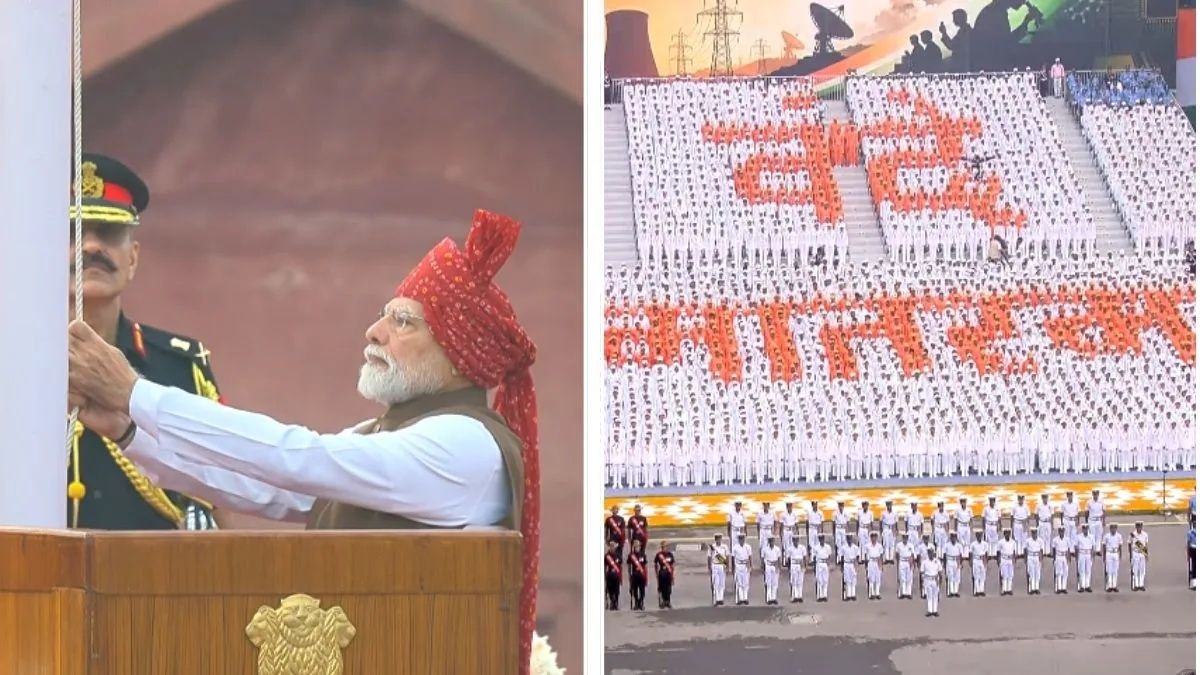
India has committed itself to a transformational national objective: transitioning into a developed economy by 2047. Prime Minister Narendra Modi made this declaration on Saturday during Independence Day festivities at the Red Fort, marking India's 80th year since gaining independence. Addressing the nation, Modi called for a collective endeavour grounded in ambitious thinking, unwavering determination, and collaborative effort to materialise the vision of a 'Viksit Bharat' (Developed India).
The announcement represents a significant articulation of India's trajectory and aspirations on the global stage. Modi emphasised that India is progressing with renewed purpose and strategic ambition, and suggested that the nation's resolve to achieve developed status would fundamentally reshape international perceptions of India. The framing of this goal reflects confidence in India's capacity and the determination of its 1.4 billion inhabitants to pursue transformation at scale. According to Modi, when a nation of India's demographic magnitude pledges to attain development, it demonstrates the collective self-belief and courage embedded within its population.
For Malaysian observers, India's development pathway carries significant implications. As a major economy within the South Asian region and a crucial partner in regional frameworks such as BIMSTEC and SAARC, India's economic trajectory directly influences regional dynamics, trade patterns, and geopolitical positioning. A developed India by mid-century would reshape regional economic hierarchies and potentially alter bilateral relationships across Southeast Asia. The vision also suggests India's commitment to strengthening its technological, industrial, and infrastructural capacities—areas where competition and collaboration with ASEAN nations, including Malaysia, will intensify.
Modi articulated a philosophical position regarding ambition, arguing that incremental thinking no longer serves national interests. He contended that limiting aspirations to modest targets constrains potential and prevents societies from realising genuine transformation. By contrast, he argued, expansive dreams broaden cognitive horizons and reshape collective vision for the future. This rhetorical positioning signals an ideological shift toward more aggressive developmental targets and suggests policy frameworks will increasingly emphasise scale and transformative rather than marginal improvements.
Examining India's recent economic performance, Modi pointed to substantial sectoral advances achieved over the preceding dozen years. Defence production capacity has quadrupled, reflecting India's strategic pivot toward military self-sufficiency and reduced import dependency. Khadi and traditional handicraft production has expanded fivefold, suggesting renewed emphasis on traditional industries and rural economic development. Electronic manufacturing output has expanded sevenfold, indicating successful policy implementation in attracting manufacturing investment and reducing reliance on imported electronics. Mobile phone production capacity has grown by approximately one-third, whilst digital transaction volumes have doubled, showcasing rapid technological adoption and financial digitalisation across the Indian economy.
These sectoral metrics reveal deliberate policy prioritisation across defence, manufacturing, and digital infrastructure—areas critical to middle-income to high-income transition. The expansion of indigenous defence production particularly resonates regionally, as India strengthens its capacity for independent military capability and reduces strategic vulnerability. Similarly, electronics manufacturing growth reflects India's attempt to reduce trade deficits and establish itself as a manufacturing alternative to China-dependent supply chains, a shift with implications for regional manufacturing geography and competition for FDI.
A notable ceremonial dimension underscored the Independence Day observance. The complete rendition of 'Vande Mataram', the national song, occurred at the Red Fort for the first time since independence in 1947. Modi characterised this moment as historically significant, emphasising the song's symbolic resonance within India's nationalist consciousness and independence movement. The gesture symbolises reclamation of pre-partition cultural narratives and represents a deliberate integration of historical continuity with contemporary nationalist sentiment.
The flag hoisting ceremony itself was conducted with indigenous military capability, utilising domestically-manufactured 105mm Light Field Guns operated by the 1721 Field Battery (Ceremonial). This operational choice underscores India's emphasis on indigenous defence manufacturing and self-reliance, with Major Pawan Singh Shekhawat commanding the ceremonial operation. Such decisions, whilst ceremonially symbolic, communicate substantive messaging regarding India's military-industrial progress and commitment to 'Atmanirbhar Bharat' (self-reliant India)—a policy framework centred on reducing import dependency across critical sectors.
Modified acknowledging the humanitarian challenges confronting India contemporaneously. Recent monsoon-related flooding has devastated multiple regions, displacing communities and necessitating substantial relief operations. Rather than treating this acknowledgment as tangential, Modi positioned national solidarity with affected populations as integral to India's development vision. By assuring affected families of comprehensive national support, Modi framed development not merely as abstract macroeconomic targets but as inclusive processes encompassing disaster resilience, social protection, and citizen welfare. This framing suggests 2047 targets incorporate humanitarian and climate adaptation dimensions alongside conventional development metrics.
The 2047 vision represents both continuity and departure within Indian political discourse. Whilst long-term developmental planning has characterised Indian governance since Jawaharlal Nehru's era, Modi's formulation emphasises aspirational rather than merely technical framing. The vision targets a psychological and motivational shift alongside policy implementation, seeking to mobilise national consciousness toward transformative rather than incremental change. For regional observers including Malaysia, India's declared ambitions carry both opportunities and competitive implications. Enhanced Indian competitiveness in manufacturing, defence, and technology sectors will reshape regional market dynamics. Simultaneously, India's development focus may strengthen regional cooperation frameworks and increase collaborative opportunities in areas including digital infrastructure, renewable energy, and supply chain diversification.
The 80th Independence Day address thus functioned simultaneously as historical commemoration, policy announcement, and aspirational messaging. Modi synthesised nationalist symbolism through the 'Vande Mataram' rendition with concrete economic achievements and forward-looking targets. The unified messaging—combining retrospective acknowledgment of progress, present-tense sectoral achievements, and ambitious 2047 projections—crafted a narrative wherein India's development represents inevitable trajectory grounded in demonstrated capacity and renewed collective resolve. Whether such targets prove achievable remains contingent upon sustained policy execution, global economic conditions, climate factors, and geopolitical stability. Nevertheless, the formal articulation of 2047 as India's development deadline establishes a framework within which regional and global observers will evaluate India's progress across subsequent decades.

