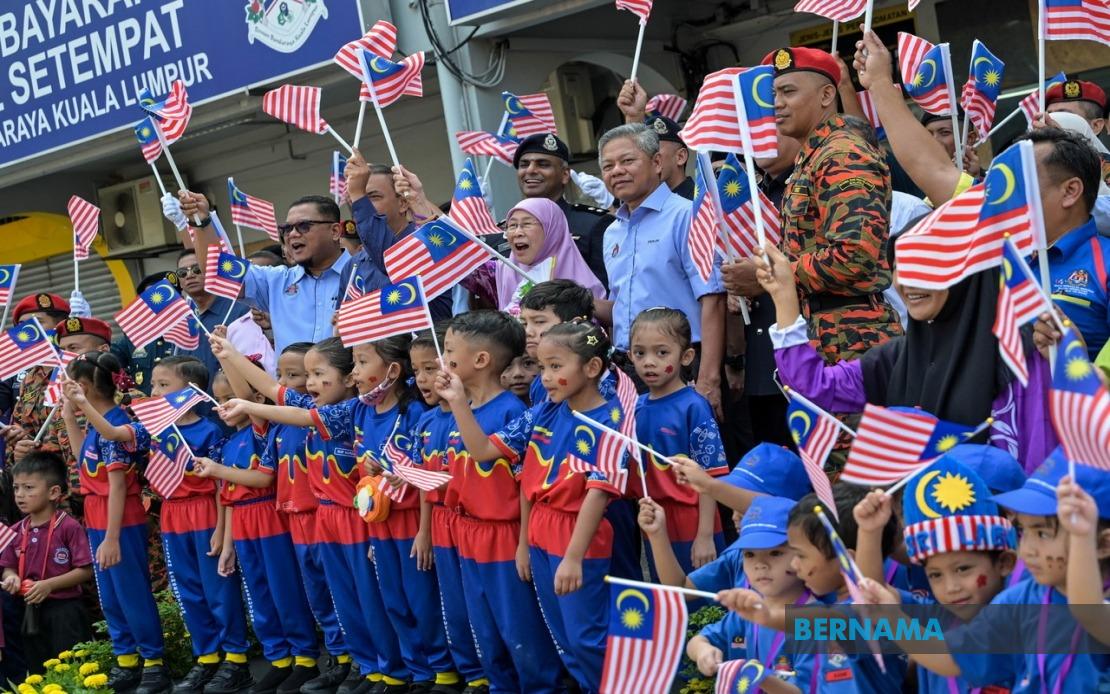
The meaning of independence extends far beyond ceremonial displays of patriotic fervour, Prime Minister's wife Datuk Seri Dr Wan Azizah Wan Ismail has stressed, calling on Malaysians to recognise the festival as a moment for reflecting on the deeper responsibilities that come with nationhood. Speaking at the Semarak Merdeka Programme in Bandar Tun Razak, Dr Wan Azizah—who also serves as the constituency's Member of Parliament—articulated a vision of Merdeka that transcends the traditional slogans and flag-waving that characterise Malaysia's annual National Day observance. Rather, she framed independence as a living commitment requiring the active participation and sacrifice of every generation, emphasising that the freedoms Malaysians enjoy today were hard-won through the struggles of those who came before.
The distinction Dr Wan Azizah drew between performative nationalism and substantive nation-building carries particular resonance in Malaysia's contemporary political landscape, where questions of national identity and social cohesion remain perpetually relevant. By elevating independence from a historical milestone to an ongoing obligation, she positioned this year's celebration within the government's broader "Malaysia Madani: Jiwa Merdeka" theme, which explicitly connects freedom to tangible improvements in citizens' living standards and opportunities. This framing suggests that authentic independence cannot be measured merely in symbols but must be evaluated through the lens of whether ordinary Malaysians—particularly those in vulnerable circumstances—experience genuine progress and dignity in their daily lives.
At the heart of Dr Wan Azizah's message lay an implicit acknowledgement of Malaysia's multicultural character as both its greatest strength and its most demanding challenge. She highlighted the composition of Bandar Tun Razak, a constituency comprising approximately 191,000 residents distributed across Malay (60 per cent), Chinese (24 per cent), and Indian (eight per cent) communities, as living evidence that harmony amid diversity is achievable. This demographic snapshot, sourced from the Malaysian Population and Housing Census, reflects the reality facing many urban parliamentary constituencies where neighbours of different backgrounds navigate shared spaces and competing interests. Dr Wan Azizah's invocation of these figures suggests that sustaining the peace and unity independence promises demands conscious effort and genuine respect for pluralism, not merely polite coexistence.
The practical dimension of this message emerged when Dr Wan Azizah ventured into the Seri Pulau Pinang and Desa Tun Razak People's Housing Projects to distribute assistance to families facing acute hardship. These visits transformed her independence address from abstract philosophy into concrete engagement with the lived experiences of ordinary Malaysians, particularly those whose economic vulnerability renders them most susceptible to social fracture. The decision to accompany distributions of support from the Social Security Organisation (PERKESO) and the Federal Territories Islamic Religious Council (MAIWP) underscored the government's assertion that independence for the disadvantaged remains incomplete without access to safety nets and dignified subsistence.
One beneficiary, K. Moganavalli, presented a poignant illustration of the precariousness facing Malaysian households lacking economic buffers. Following her husband Edwin Anthony Dass's sudden death on August 2, Moganavalli found herself as sole caregiver for three young children while managing the emotional and financial devastation of widowhood. The assistance she received—comprising a one-off Funeral Management Benefit of RM3,000 and a monthly Survivor's Pension of RM1,118.33 from PERKESO, supplemented by Kotak Prihatin aid—represented the difference between maintaining basic family stability and potential destitution. Her expression of gratitude illuminates how social security mechanisms, while often treated as bureaucratic footnotes, function as essential scaffolding for vulnerable families navigating catastrophic loss.
The case of Khalijah Binti Nazir, aged 64, further demonstrates the complexity of economic vulnerability in Malaysia's contemporary society. Having relinquished employment to provide full-time care for two children, one affected by hearing impairment, Khalijah had become entirely dependent on a patchwork of government assistance schemes. Her monthly support encompassed RM800 from Baitulmal assistance, RM300 transmitted through the Boost eWallet platform, and RM150 under the Sumbangan Asas Rahmah (SARA) initiative, with an additional RM100 monthly allocated to her son through the same SARA programme. The fractured nature of this support structure—distributed across multiple acronyms and delivery mechanisms—hints at potential inefficiencies even as it demonstrates governmental commitment to reach those most in need.
These distributions, facilitated by Dr Wan Azizah's constituency engagement, illuminate the gap between independence's promise and its experience for Malaysia's economically marginalised populations. While the nation celebrates its freedom as a sovereign state, millions of citizens grapple with the independence struggles of economic self-sufficiency, adequate healthcare, educational opportunity, and dignified housing. The government's Malaysia Madani agenda attempts to bridge this chasm by positioning social welfare not as charity but as components of comprehensive nation-building aligned with the deeper meaning Dr Wan Azizah articulated.
From a Southeast Asian perspective, Dr Wan Azizah's emphasis on responsibility and unity carries broader implications. Regional stability depends upon member nations managing internal diversity effectively and ensuring that economic development generates broadly-shared prosperity rather than deepening inequality. Malaysia's experience—having navigated multiple periods of communal tension—offers instructive lessons for neighbours likewise contending with religious, ethnic, and ideological pluralism. The commitment to translate independence into tangible improvements for disadvantaged communities represents not merely a social policy choice but a strategic investment in the social cohesion upon which durable nation-states depend.
The timing of these remarks, delivered as Malaysia approaches another annual independence commemoration, suggests an administration seeking to reframe nationalist celebration toward social solidarity. Rather than permitting Merdeka to remain primarily a historical retrospective, Dr Wan Azizah's intervention redirects focus toward prospective challenges: Can Malaysia genuinely preserve the peace and unity independence promised? Will the freedom symbolised by the Jalur Gemilang extend meaningfully to those struggling with economic insecurity? These questions animate contemporary Malaysian politics beneath the surface of ceremonial patriotism, and Dr Wan Azizah's articulation of independence as shared responsibility implicitly acknowledges that purely symbolic nationalism proves insufficient without corresponding commitment to material improvement in citizens' circumstances.

