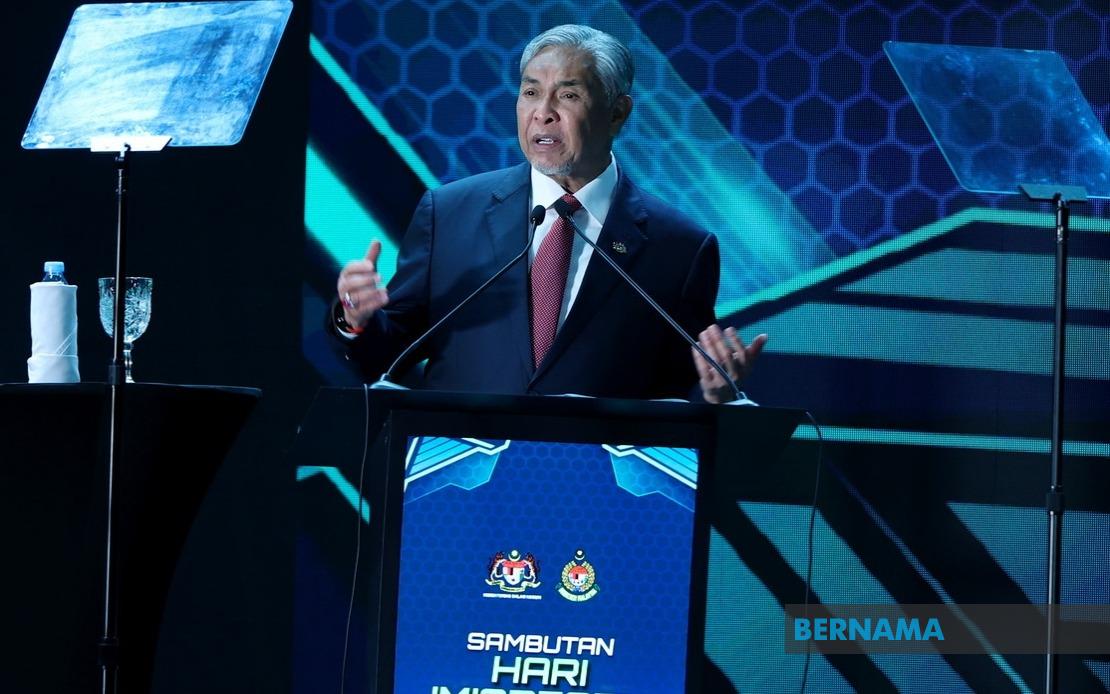
Deputy Prime Minister Datuk Seri Dr Ahmad Zahid Hamidi has thrown his weight behind proposals to revamp the Immigration Officer Service Scheme, underscoring the government's recognition of the department's outsized contribution to Malaysia's administrative and fiscal landscape. Speaking at the 2026 Immigration Day celebration in Cyberjaya on July 21, Zahid emphasised that immigration personnel warrant enhanced career prospects and improved working conditions commensurate with their critical role in safeguarding the nation.
Zahid's endorsement comes in response to Home Minister Datuk Seri Saifuddin Nasution Ismail's earlier call for comprehensive restructuring of the service scheme. The proposed improvements would involve reorganising key management positions and creating broader advancement opportunities for officers across the department. This move reflects growing political acknowledgement that frontline immigration staff have historically laboured under constrained career mobility and limited incentive structures compared to other civil service branches.
Crucially, Zahid highlighted the Immigration Department's standing as Malaysia's third-largest revenue-generating agency—a designation that underscores its economic significance beyond border management. This revenue generation capacity, drawn from visa processing, work permits, and various immigration-related fees, has positioned the department as a substantial contributor to federal coffers. Yet this fiscal importance has not traditionally translated into commensurate resource allocation or career development frameworks for serving officers, a disparity the recent proposals aim to rectify.
The deputy prime minister has directed the Chief Secretary to the Government Tan Sri Shamsul Azri Abu Bakar and Public Service director-general Tan Sri Wan Ahmad Dahlan Abdul Aziz to give serious consideration to the restructuring proposal. This intervention by a senior cabinet member signals high-level political commitment to advancing the scheme through Malaysia's typically rigid civil service channels, where such reforms typically encounter bureaucratic resistance. The explicit naming of key government officials responsible for implementation suggests Zahid intends to maintain momentum on the initiative beyond the commemorative occasion.
Beyond administrative reform, Zahid used the platform to reinforce expectations around professional conduct and institutional integrity. He reminded immigration personnel that their position as the nation's frontline protectors demands scrupulous ethical standards and unwavering commitment to sovereignty protection. This framing positions the service scheme enhancement not merely as compensation, but as part of a broader bargain wherein improved conditions are paired with elevated standards of conduct and public accountability.
The deputy prime minister's rhetoric about institutional courage and overcoming challenges appears directed at bolstering staff morale amid what observers characterise as chronic resource constraints and demanding working conditions at Malaysia's international checkpoints. His exhortation that officers should "serve not because someone is watching, but because every action is a trust bestowed upon us by the nation" reflects an attempt to inspire intrinsic motivation among personnel who have often felt undervalued relative to their responsibilities.
For Malaysian readers and regional observers, this development carries several implications. The service scheme enhancement could improve the Immigration Department's capacity to attract and retain skilled personnel, thereby strengthening border security and facilitating smoother processing of legitimate travellers and workers. Malaysia's position as a regional economic hub depends substantially on efficient immigration administration, as the sector handles millions of cross-border transactions annually involving tourists, migrant workers, and business travellers from across Southeast Asia and beyond.
The initiative also reflects broader recognition within Malaysian governance circles that frontline civil servants, particularly those managing sensitive security and revenue functions, require competitive compensation and career trajectories to mitigate attrition and maintain institutional knowledge. Immigration departments across the region have struggled with staffing challenges and burnout, issues that compromise service delivery and create vulnerabilities in border administration. Malaysia's acknowledgment of these pressures through senior political endorsement of reforms sets a potential precedent within ASEAN.
However, the real test of commitment will emerge during budget allocation deliberations and the detailed redesign of service conditions. Malaysian civil service reforms, while periodically announced with considerable fanfare, frequently face implementation delays and budgetary constraints. The involvement of both the Chief Secretary and Public Service director-general suggests the proposal has cleared preliminary hurdles, yet observers will monitor whether the promised restructuring materialises within reasonable timeframes or becomes another deferred initiative.
The timing of these announcements—at the 2026 Immigration Day celebration with the theme "Charting a New Face of Immigration"—suggests the government seeks to position immigration administration as a modernising, professionally valued sector. This rebranding effort may reflect recognition that Malaysia's immigration services require evolution to meet contemporary challenges including cybersecurity threats, transnational crime, and the complexities of managing regional labour mobility within a globalising Southeast Asian economy.

