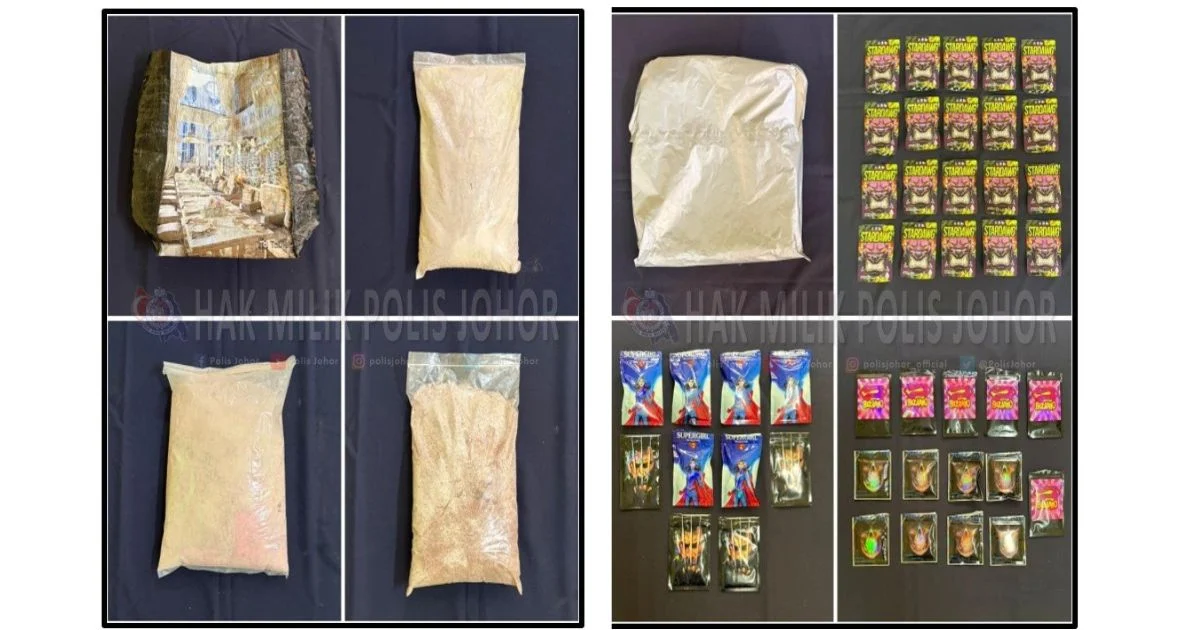
Law enforcement officials in Johor Baru have struck a significant blow against organised drug trafficking in the state, announcing the dismantling of a narcotics operation centred in Kulai. The operation culminated in the arrest of a married couple alongside the seizure of illicit substances estimated to be valued at RM3.59 million, representing a major success for the state's drug enforcement units.
The bust represents the kind of coordinated police action that has become increasingly common in Johor, which continues to grapple with organised drug syndicates operating across its industrial zones and residential areas. The Kulai district, strategically positioned along major transport corridors connecting Kuala Lumpur to the southern peninsula, has long been identified as a transit and distribution hub for trafficking networks moving substances throughout Malaysia and the wider region.
The arrest of a husband-and-wife team suggests the operation may have involved sophisticated domestic arrangements typical of higher-level trafficking organisations. Family-based drug networks often prove particularly resilient to detection, as they operate under cover of legitimate business activity and domestic routines while managing substantial quantities of narcotics. The couple's central roles in the operation indicate they may have served as key coordinators within a larger distribution structure.
For Malaysian law enforcement agencies, the seizure value of RM3.59 million underscores both the scale of illicit drug markets and the importance of persistent surveillance operations. Narcotics worth nearly 3.6 million ringgit could have supplied thousands of end users across Johor and neighbouring states, making the interception particularly significant in terms of preventing community harm. The street value of such quantities typically exceeds wholesale assessments, suggesting substantial retail market impact prevented by this operation.
Kulai's prominence in this drug bust reflects broader patterns of trafficking distribution in Johor. The district's proximity to major highways, manufacturing facilities, and port infrastructure makes it attractive to syndicates seeking logistics advantages. Furthermore, its mixed commercial and residential character provides operational flexibility for groups moving and storing contraband while maintaining ostensible legitimacy through small businesses or warehousing operations.
The involvement of a married couple also illustrates how drug syndicates exploit family structures and spousal trust to compartmentalise operations and evade detection. This operational model frequently complicates investigations, as law enforcement must carefully differentiate between genuine marital collaboration and coercive or manipulated participation by one spouse. The decision to arrest both partners suggests police gathered evidence indicating voluntary participation by each individual in trafficking activities.
This enforcement action arrives amid persistent efforts by Malaysian authorities to address supply-side drug challenges across the country. While police increasingly focus on interdicting major trafficking operations and dismantling supplier networks, drugs continue flowing into Malaysia through established smuggling routes. The regional context matters significantly—Malaysia sits positioned between major narcotics production regions and consumer markets, making it both a transit corridor and a distribution node for regional trafficking networks.
The RM3.59 million haul will likely feature in official statistics highlighting Johor police's enforcement achievements, though individual seizures represent just fragments of total narcotics flows. National drug strategy documents consistently emphasise that despite growing law enforcement success in intercepting major shipments, underlying demand in Malaysian society remains substantial and drives continued trafficking activity. Each successful bust thus represents progress within a larger, ongoing struggle against entrenched drug markets.
Malaysian police have increasingly utilised intelligence-sharing arrangements with international counterparts and neighbouring regional forces to track trafficking networks crossing borders. The capture of this Kulai-based operation likely benefitted from such cooperation, particularly given the transnational dimensions of modern drug smuggling. Intelligence regarding shipment patterns, financial movements, and personnel networks helps authorities anticipate and prevent major trafficking activities before contraband reaches street-level distribution channels.
The couple now face charges under Malaysia's drug laws, which impose progressively severe penalties depending on substance quantities and classifications. For trafficking rather than mere possession, sentencing guidelines reflect parliament's intent to deter large-scale narcotics distribution through substantial imprisonment. Conviction on trafficking charges typically results in mandatory minimum sentences, with possibilities for capital punishment in cases involving the largest quantities of the most dangerous substances, though circumstances vary significantly by drug type and quantity.
Beyond the immediate criminal proceedings, this bust carries implications for organised crime networks operating across Johor and the wider Klang Valley region. The dismantling of one distribution operation typically creates temporary market disruptions and supply constraints that can reshape competitive dynamics among rival syndicates. Such enforcement gaps, however, frequently prove temporary as alternative networks emerge to fill profitable void markets, underscoring the structural challenge police face in addressing demand-driven narcotics markets.
Community safety organisations and public health advocates in Johor will likely welcome this enforcement success as tangible evidence of police commitment to drug supply reduction. Nevertheless, complementary demand-reduction initiatives including treatment expansion, community education, and targeted prevention efforts targeting vulnerable populations remain essential for holistic drug control strategies. The arrest and seizure in Kulai, while significant, represents one operation within Malaysia's much broader and more complex drug policy environment.

