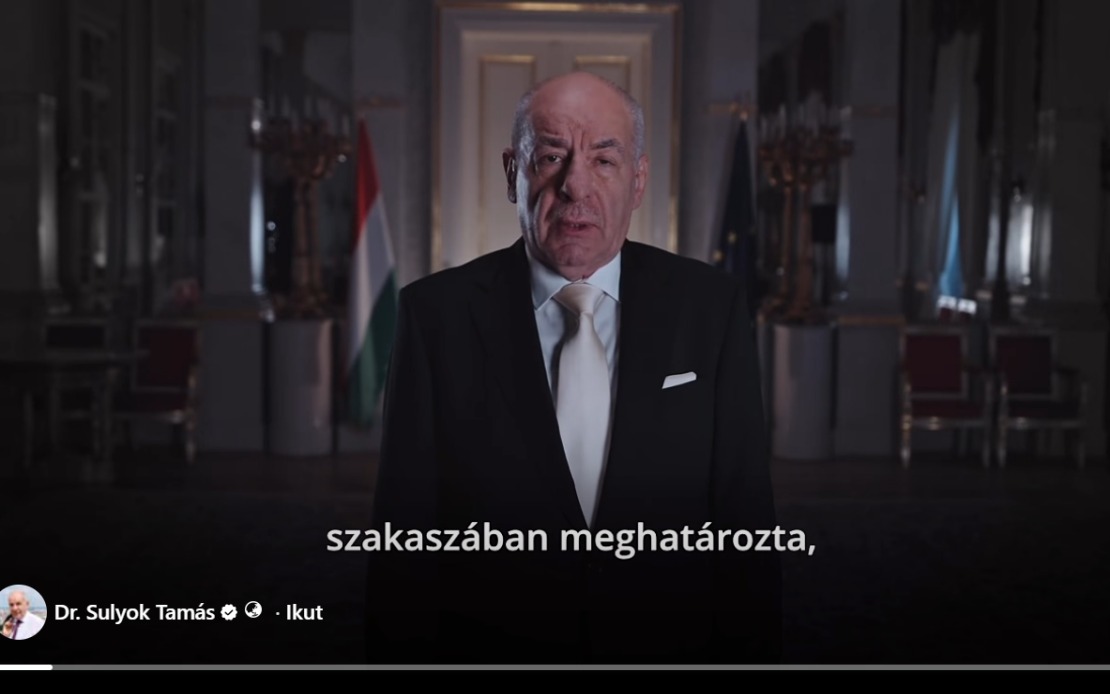
Hungarian President Tamás Sulyok has accepted his political fate, consenting to countersign a constitutional amendment that will strip him of office and effectively end his presidency. The decision follows an intense standoff between the head of state and Prime Minister Péter Magyar's newly reformed government, which has taken a hardline stance on dismantling the institutional structures built during Viktor Orbán's long tenure in power. Sulyok, who had wavered for several days before capitulating, now vacates the presidency on Monday, making way for the Hungarian parliament to elect a successor within the next month.
The constitutional amendment advanced by Magyar's administration represents a significant assertion of parliamentary authority over an entrenched presidency. Following the amendment's passage through parliament on Monday of last week, the prime minister issued Sulyok with an ultimatum: countersign the changes or face formal impeachment proceedings. This high-stakes gambit paid off when Sulyok relented, recognising that a legal battle would be both futile and damaging to the institution itself. Parliamentary Speaker Agnes Forsthoffer will assume presidential functions during the interim period, overseeing the nation's affairs until a new head of state takes the oath.
Sulyok's reluctant compliance masks deeper constitutional concerns about presidential independence and the balance of power within Hungary's political system. In a Facebook video address, the outgoing president articulated his fundamental objection to the amendment, contending that removing him through parliamentary decree violated constitutional norms and set a troubling precedent for future administrations. He lamented that Hungary's presidency has been progressively hollowed out, leaving the ceremonial office holder subordinate to executive whims rather than serving as a genuine check on governmental overreach. This observation strikes at the heart of institutional degradation that characterised the Orbán era, during which formal powers became less important than informal networks of influence.
The constitutional scholars who examined Hungary's legal architecture concurred that Sulyok's position was legally untenable, even if philosophically defensible. While the Constitutional Court might theoretically have raised procedural objections to the parliamentary manoeuvre on technical grounds, substantive intervention was deemed impossible under existing legal doctrine. This assessment essentially sealed Sulyok's fate, as any prolonged resistance would have consumed valuable institutional credibility without producing meaningful legal protection. The prospect of impeachment loomed as a more ignominious alternative than graceful exit.
Magyar's government has framed this constitutional intervention as essential remedial surgery on Hungary's political body politic. The prime minister utilised social media to articulate his administration's broader agenda, asserting that the removal of Sulyok enables the restoration of democratic safeguards that the Orbán regime systematically dismantled over its tenure. Magyar's rhetoric emphasises popular empowerment and reclamation of public assets, positioning these constitutional changes as liberation from years of autocratic consolidation. The messaging resonates with voters who experienced the progressive hollowing out of democratic institutions and the proliferation of oligarchic networks during the previous government's sixteen-year dominance.
The constitutional amendments represent only the opening salvo in Magyar's reform programme. By securing the presidency, the government can now advance legislation designed to restructure state institutions, reform the judiciary, and restore media pluralism—each area heavily compromised during the Orbán administration's grip on power. These changes signify a fundamental reorientation of Hungary's political trajectory, moving away from the centralised, personalised style that characterised recent decades toward something ostensibly more pluralistic and institutionally balanced. However, implementing such transformations whilst maintaining social cohesion remains a formidable challenge.
The Hungarian situation carries instructive lessons for Southeast Asian democracies grappling with similar institutional degradation. Nations confronting executive aggrandisement and parliamentary subordination may observe both the possibilities and perils of constitutional intervention. Hungary's experience demonstrates that formal mechanisms can be redirected toward democratic restoration, yet also reveals how vulnerable such instruments remain to manipulation if political will shifts. For Malaysian readers particularly, the Hungarian case illuminates the stakes involved in defending parliamentary independence and preventing any accumulation of unchecked executive authority.
Sulyok's departure closes a chapter defined by compromise and institutional weakness. His willingness to accept removal without mounting a credible constitutional challenge reflects his recognition that the legitimacy earned through parliamentary election could not withstand sustained pressure from a government commanding fresh popular support. This calculus underscores a crucial insight: nominal constitutional powers prove hollow without deep institutional commitment and public backing. The incoming president will inherit a diminished but potentially more defensible office, freed from association with the unpopular ancien régime.
The broader implications of this constitutional upheaval extend beyond Hungary's borders. The European Union has monitored Hungarian democratic backsliding with mounting concern, and Magyar's government signals a potential reversal of that trajectory. Constitutional amendments enabling democratic restoration may facilitate improved relations with Brussels and potentially unlock frozen EU funding streams. For Hungary's regional partners, including those in Southeast Asia concerned with democratic resilience, this episode demonstrates both the fragility and potential for renewal within contested democratic systems.

