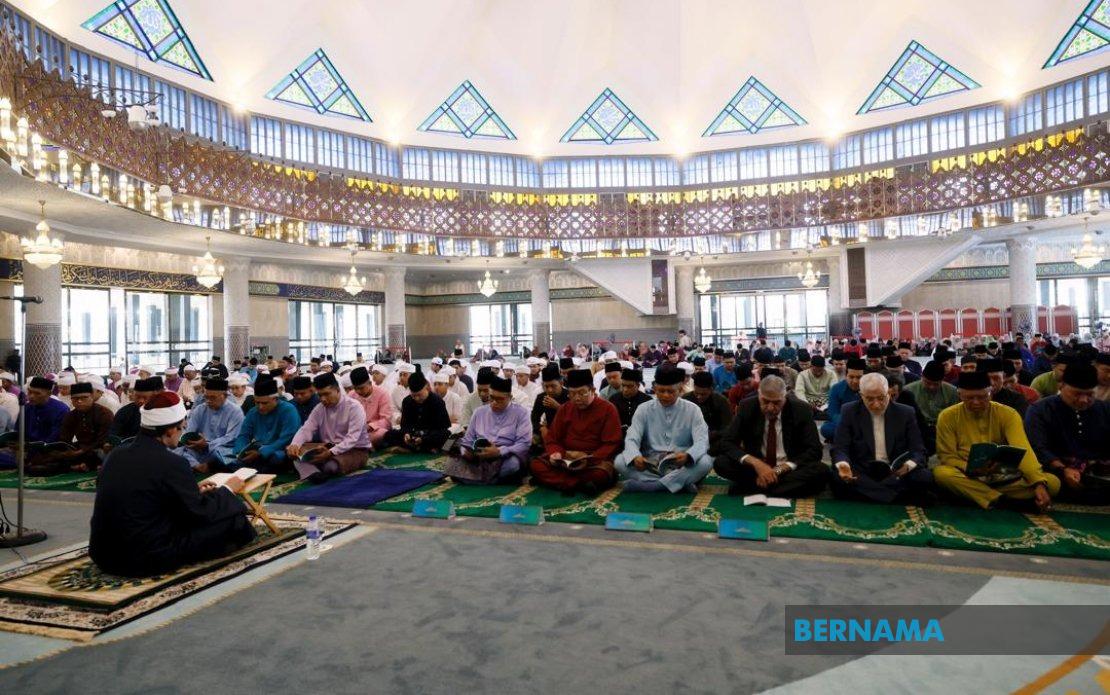
Malaysia's national observance of Warriors' Day gained momentum on Tuesday as about 500 congregants participated in a Yasin recitation and tahlil ceremony in Kuala Lumpur, reflecting the country's commitment to honouring those who have sacrificed for the nation's security and sovereignty. The event, coordinated by the Prime Minister's Department, brought together senior government officials and representatives from across the security establishment in a solemn tribute to both active-duty personnel and fallen heroes who have defended Malaysia.
Tan Sri Shamsul Azri Abu Bakar, the Chief Secretary to the Government, emphasised that the ceremony encompassed all branches of the nation's security apparatus, recognising each as integral to Malaysia's defence infrastructure. His remarks underscored a deliberate inclusivity that extended beyond the armed forces to encompass the Royal Malaysia Police, the Fire and Rescue Department, the Immigration Department, and numerous other security agencies operating throughout the country. This broader framing reflects contemporary understanding that national defence involves multiple layers of institutional protection and civic responsibility.
The spiritual dimension of the pre-celebration ceremony held particular significance within Malaysia's multicultural context. National Mosque Grand Imam Dr Amru Alhaz Adnan led the traditional Islamic observances, which included Yasin recitation followed by tahlil and doa selamat—ritual components that honour the deceased whilst invoking blessings for the living. This religious framework has become institutionalised within Malaysia's annual Warriors' Day proceedings, serving as a counterpoint to the secular military pageantry that will dominate official celebrations.
Shamsul Azri announced that the centrepiece of the 2026 Warriors' Day festivities would unfold at Dataran Pahlawan Negara in Putrajaya the following day, signalling the elevation of these commemorations to the national capital. The decision to stage the main celebration at this symbolic location—the Heroes' Square in the administrative centre—carries implications about how government seeks to frame national defence and sacrifice within the broader context of state identity and institutional continuity. Putrajaya's role as the seat of federal administration lends additional weight to official acknowledgement of security personnel's contributions.
The attendance of high-ranking military and civilian officials demonstrated the event's significance within government circles. Army Chief Gen Tan Sri Azhan Md Othman and Auditor-General Datuk Seri Wan Suraya Wan Mohd Radzi joined Shamsul Azri in participating in the ceremony, their presence affirming cross-institutional recognition of those who serve in defence capacities. Such coordinated attendance patterns are carefully choreographed to project unified government messaging regarding national values and institutional priorities, particularly around security and state preservation.
Warriors' Day, formally observed annually on July 31 since 1968, occupies a distinct niche within Malaysia's calendar of national commemorations. Unlike Independence Day celebrations that emphasise historical achievement and national founding, Warriors' Day maintains a solemn register focused on sacrifice and ongoing commitment to territorial integrity. The Malaysia Armed Forces and Royal Malaysia Police rotate responsibility for organising the main celebrations, a rotation system that ensures institutional parity whilst distributing ceremonial burden across the security establishment.
The timing of pre-celebration religious observances reflects Islamic practices of honouring the deceased through collective recitation and supplication. Within the Malaysian context, these ceremonies serve dual purposes—fulfilling religious obligations whilst providing official recognition of sacrifice framed through spiritual language. For Muslim-majority Malaysia, integrating Islamic ritual into state commemoration represents institutional normalcy, yet it also raises questions about inclusive representation for security personnel from other faith backgrounds, a tension that Malaysian multicultural governance continually navigates.
The participation of personnel from the Immigration Department and Fire and Rescue services alongside armed forces and police reflected an expansive conception of national defence that has evolved considerably since Warriors' Day's establishment in 1968. Modern security threats—ranging from border management to disaster response—have rendered the traditional military-police dichotomy insufficient for capturing the full spectrum of roles involved in safeguarding national interests. This conceptual evolution, evident in official participation patterns, suggests gradual recognition that national defence encompasses diverse institutional contributions beyond conventional military operations.
For Malaysian observers and the broader Southeast Asian region, sustained emphasis on institutional recognition of security personnel serves multiple functions beyond ceremonial remembrance. In a region where civilian-military relations remain delicate in several countries, Malaysia's emphasis on annual Warriors' Day commemoration and cross-institutional participation reflects conscious effort to maintain security sector cohesion and public appreciation for those in uniform. The event's embedding within religious and cultural frameworks—rather than purely political ones—may insulate it from partisan contestation whilst anchoring it within shared national values.
The scale of participation, with approximately 500 attendees at the preliminary ceremony alone, suggests that Warriors' Day enjoys sustained institutional commitment and public engagement. This attendance level indicates that the observance has successfully embedded itself within Malaysia's civic calendar, competing successfully with other national commemorations for official resources and public attention. The decision to conduct multiple ceremonial events—preliminary religious observances followed by main celebrations in Putrajaya—demonstrates how Warriors' Day has expanded ceremonially to sustain commemorative intensity throughout the observance period.
Looking forward, the Putrajaya celebration on July 31 will likely amplify the themes articulated at the Kuala Lumpur ceremony, expanding the intimate religious observance into large-scale public spectacle. The contrast between small-scale spiritual tribute and massive institutional display reflects how modern nation-states manage commemoration, balancing solemn recognition of sacrifice with public demonstrations of state capacity and military prowess. For Malaysia, maintaining this balance whilst ensuring genuinely inclusive participation from all security sectors remains an ongoing challenge in constructing national narratives around defence and sacrifice.

