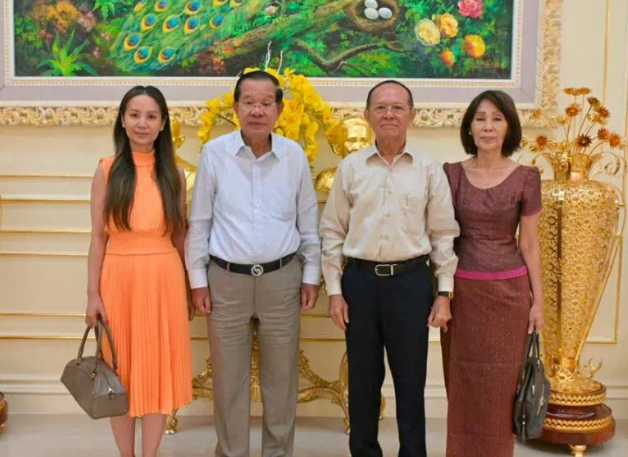
Senate president Hun Sen held a three-hour meeting with former opposition leader Kem Sokha at his residence on Sunday morning, underscoring an increasingly visible rapprochement between Cambodia's two most prominent political figures. The encounter, which ran from 9am until noon, included Sokha's wife and daughter, and has intensified speculation about the trajectory of Cambodian politics following years of acrimony and legal confrontation between the rivals.
The meeting represents the latest in a series of private encounters between the two leaders, who once stood at opposite poles of Cambodia's deeply polarised political arena. Hun Sen disclosed via social media that Sokha had visited him at home several weeks prior to the weekend gathering, a visit that preceded Sokha's journey to meet troops and civilians displaced by ongoing border tensions with Thailand. The venue and tone of these successive private meetings signal a departure from the antagonism that characterised their relationship during the peak of the Cambodian National Rescue Party's challenge to Hun Sen's dominance.
What has drawn particular scrutiny, however, is Hun Sen's explicit praise for Kem Monovithya, Sokha's daughter, whom he described as an "excellent human resource for the nation." Hun Sen noted during his public statement that he had spent a substantial portion of the three-hour discussion conversing with Monovithya, a comment laden with significance given her previous instrumental role within the CNRP before its dissolution by Cambodia's Supreme Court in 2017. The characterisation stops short of explicitly endorsing any future political role, yet the prominence accorded to his remarks about her suggests more than casual observation.
Sokha's political trajectory has undergone dramatic transformation over the past three years. In 2023, he received a 27-year prison sentence on charges related to alleged conspiracy with foreign powers—a conviction that the Phnom Penh Appeal Court upheld on April 30, 2026, additionally imposing a five-year restriction on overseas travel. His detention and house arrest effectively sidelined Cambodia's most credible opposition figure at a moment when the ruling Cambodian People's Party faced mounting international criticism over democratic governance and human rights concerns. The legal apparatus surrounding his case was widely interpreted across Southeast Asia as a mechanism for eliminating political opposition rather than administering justice.
Yet the past three months have witnessed a remarkable reversal of Sokha's circumstances. On May 25, a royal pardon terminated his remaining prison sentence and lifted his house arrest, though restrictions preventing him from engaging in political activities remained in force. Subsequently, a royal decree issued on July 24 removed the five-year ban on international travel, further relaxing the constraints that had confined the former CNRP leader. Notably, the prohibition on political participation persists, creating an ambiguous legal status that permits Sokha's public presence while theoretically preventing formal political engagement.
Sokha's public reappearance has been carefully calibrated. On July 28, merely days after the travel restriction was lifted, he journeyed to Banteay Meanchey province to visit communities affected by the Cambodia-Thailand border conflict, framing his intervention explicitly as a private citizen rather than a political actor or state representative. This distinction, while maintaining technical compliance with existing restrictions, nevertheless provides Sokha with a platform for public visibility and humanitarian engagement that had been entirely unavailable during his house arrest. His statements to international contacts regarding displaced Cambodians' circumstances signal continued interest in maintaining a public voice on national concerns.
The CNRP's dissolution in November 2017 represented a watershed moment in Cambodian politics. The party had achieved unprecedented electoral success in both the 2013 national election and the 2017 commune elections, establishing itself as a genuine challenger to the CPP's decades-long dominance. Sokha's arrest, occurring two months before the party's formal dissolution, was widely perceived internationally as political persecution designed to neutralise the opposition's momentum. The subsequent legal conviction and imprisonment effectively removed Cambodia's most recognisable opposition figure from the political stage entirely, leaving Hun Sen's governance unchallenged by organised alternatives.
Monovithya's prominence within her father's political circles cannot be separated from broader succession questions within Cambodian political families. Hun Sen's reference to her as a valuable national resource, particularly given her explicit association with the CNRP during its most assertive period, may reflect evolving calculations about how the CPP might position itself relative to residual opposition sentiments. Southeast Asian observers have noted that authoritarian systems frequently incorporate formerly excluded figures as a means of co-opting opposition constituencies without fundamentally redistributing power. Whether Hun Sen's remarks presage such a manoeuvre remains unclear.
The substance of the three-hour conversation between Hun Sen and Sokha remains undisclosed, with neither party offering specifics regarding topics discussed or agreements reached. This opacity is itself significant—had the meeting been purely ceremonial or celebratory, greater detail might have been publicly shared. The deliberate withholding of content suggests discussions of substance, possibly concerning political arrangements, reconciliation frameworks, or Sokha's future role. Hun Sen's emphasis on the extended duration of the meeting appears calculated to convey seriousness and engagement rather than perfunctory courtesy.
Cambodia's regional neighbours have maintained varying degrees of interest in the country's political evolution. Thailand, grappling with its own governance challenges and border management issues, has reasons to prefer stability in Cambodia regardless of who leads. Vietnam, which has historically influenced Cambodian affairs, maintains investment in understanding shifting political alignments. The international community more broadly has watched Cambodia's democratic trajectory with concern, particularly following the CNRP's elimination and the subsequent absence of meaningful electoral competition. A rehabilitation of Sokha or his family could be construed as addressing international criticism regarding democratic pluralism, though genuine power redistribution appears improbable.
For Malaysian and Southeast Asian observers, the Sokha-Hun Sen developments warrant attention as potential indicators of political evolution within Cambodia. The region has experienced waves of democratic contraction over the past decade, with Cambodia among the most pronounced examples. However, the gradual rehabilitation of opposition figures, even under restrictive conditions, suggests that even authoritarian consolidations may eventually require some accommodation of suppressed political forces. Whether Cambodia moves toward genuine pluralism, managed co-optation, or renewed confrontation will substantially influence regional political dynamics and Southeast Asia's broader democratic trajectory.
The absence of any announcement regarding formal political agreements or reconciliation processes is itself noteworthy. Hun Sen's careful framing of the meetings as personal encounters rather than official state business allows both leaders to maintain face while signalling improved relations. This approach permits flexibility—should political circumstances shift dramatically, both parties retain deniability regarding the nature and implications of their recent contact. For now, the meetings represent a visible warming between former adversaries, with Monovithya emerging as a focal point for international and regional attention regarding Cambodia's evolving political landscape.

