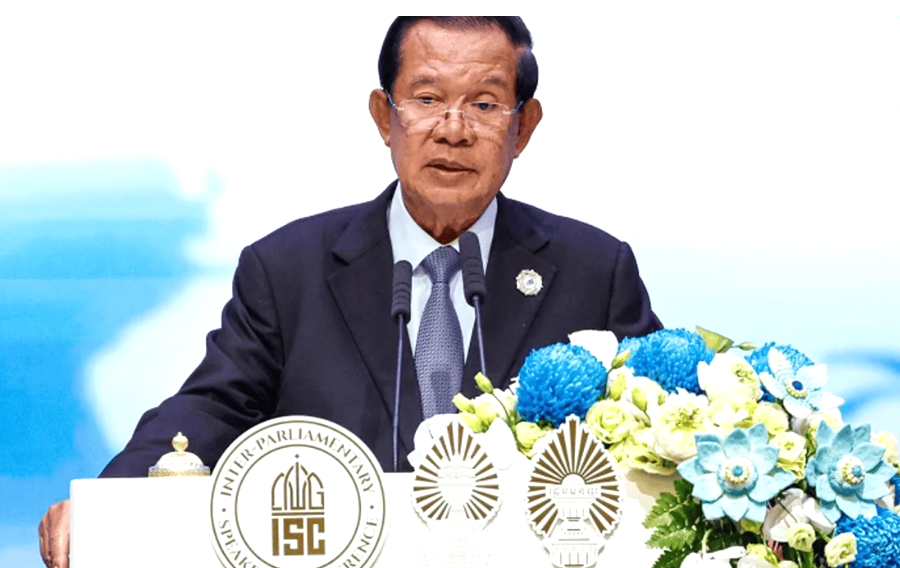
Cambodia's Senate president Hun Sen has launched a scathing critique of what he characterises as Thailand's misuse of transnational crime concerns to legitimise territorial encroachment, speaking during the 2nd Inter-Parliamentary Speakers' Conference in Phnom Penh on Thursday. Addressing a gathering of parliamentary leaders from Pakistan, Malaysia, Myanmar, Australia, Russia and several other nations, Hun Sen presented Cambodia's border tensions as emblematic of a broader deterioration in international norms and the weaponisation of global issues by powerful actors seeking short-term strategic advantage.
The Cambodian leader framed Thailand's actions as emblematic of contemporary conflict, wherein nations invoke international cooperation mechanisms—in this case, efforts to combat cross-border online scam networks—as diplomatic cover for annexing territory. Hun Sen asserted that Thailand has essentially violated ceasefire arrangements by treating such agreements as merely theoretical constructs lacking binding force. He characterised the situation as an abuse of legitimate security concerns, suggesting that online scam operations originating from border regions have become a convenient justification for territorial occupation that would otherwise lack legal or diplomatic foundation.
Hun Sen's remarks reflect deepening frustration within Cambodia over the Cambodia-Thailand border dispute, which has periodically flared into violence. The border demarcation remains contested in several areas, and both nations have traded accusations regarding military aggression. By reframing Thailand's actions within a broader analysis of how international law is selectively applied, Hun Sen appears to be seeking legitimacy for Cambodia's position among the international parliamentary community whilst also highlighting perceived double standards in how smaller nations are treated compared to major powers.
Extending his analysis beyond the bilateral dispute, Hun Sen outlined what he termed modern warfare's expanding scope and methods. Rather than conventional military confrontation, contemporary conflicts increasingly manifest through trade restrictions, technology competition, resource nationalism, and the selective application of international standards. He cited customs barriers, withdrawal of trade preferences, and competitive dynamics around semiconductors and cyber-security infrastructure as examples of how economic tools have become weaponised. This framework allows Hun Sen to position Cambodia not merely as a victim of Thailand's territorial ambitions but as a vulnerable developing nation caught within larger systemic pressures that threaten weaker economies disproportionately.
Particularly significant to Hun Sen's argument is his contention that powerful nations have begun abandoning the rules they themselves established when such rules no longer serve their interests. He argued that international legal frameworks, including those governing self-defence and non-proliferation, have been selectively interpreted by strong actors to justify unilateral action. This observation resonates across the developing world and carries particular weight in Southeast Asia, where anxieties about great power competition and the regional implications of great power conflict remain elevated following the tensions between the United States and China.
Hun Sen connected his analysis of territorial and economic conflicts to what he characterised as weaponised accusations regarding human rights, environmental standards, and transnational crime. He argued that wealthy nations apply stringent standards to developing countries whilst overlooking the structural limitations and post-conflict recovery needs that constrain Cambodia's institutional capacity. This framing is significant for regional politics, as it echoes criticisms voiced by several Southeast Asian governments regarding perceived Western hypocrisy in international norm-setting. By positioning Cambodia's challenges within this broader narrative, Hun Sen mobilises sympathy for nations struggling to simultaneously develop economically and meet international standards.
The Cambodian Senate president warned that systemic security insecurity generated by power asymmetries and the erosion of international law is triggering a dangerous global arms race among vulnerable nations. Facing limited confidence in international treaty protections, developing countries increasingly feel compelled to acquire advanced military capabilities independently. Hun Sen cautioned that this dynamic threatens the entire non-proliferation framework, which depends upon confidence that international commitments provide genuine security assurances. This concern holds particular relevance for Southeast Asia, where military modernisation among several regional powers has accelerated significantly over the past decade.
Hun Sen's broader message emphasises the collapse of predictability in international relations. He suggested that the rules-based order has become corrupted by selective application and that nothing can be guaranteed anymore when powerful actors reserve the right to reinterpret commitments to suit their interests. This speaks to anxieties felt across the developing world regarding the reliability of international institutions and agreements. For Malaysia and other Southeast Asian nations balancing relationships with major powers whilst attempting to maintain regional stability, such warnings resonate strongly.
The conference itself, bringing together parliamentary leaders from diverse regions and political systems, provided Hun Sen with a significant platform for advancing Cambodia's narrative regarding the border dispute and the broader international environment. By presenting Cambodia's specific territorial grievance as one manifestation of systemic challenges confronting the developing world, Hun Sen positioned Cambodia within a broader coalition of nations contesting the current international order. This diplomatic strategy seeks to shift framing away from bilateral dispute toward universal concerns about the erosion of international law and the selective application of international standards.
Hun Sen's call for restoration of the rules-based order, the UN Charter, and the ASEAN Charter suggests that Cambodia seeks validation for a more rigid, formalistic approach to international law that would constrain powerful actors' freedom to invoke security or law enforcement concerns as justification for territorial action. For Myanmar, Malaysia, and other ASEAN members navigating their own border sensitivities and anxious about great power interventionism, Hun Sen's arguments offer both a cautionary narrative and a framework for collective resistance to what they perceive as arbitrary norm-setting by the powerful. The implications extend beyond Cambodia-Thailand relations toward broader Southeast Asian stability and regional cohesion in confronting external pressure.

