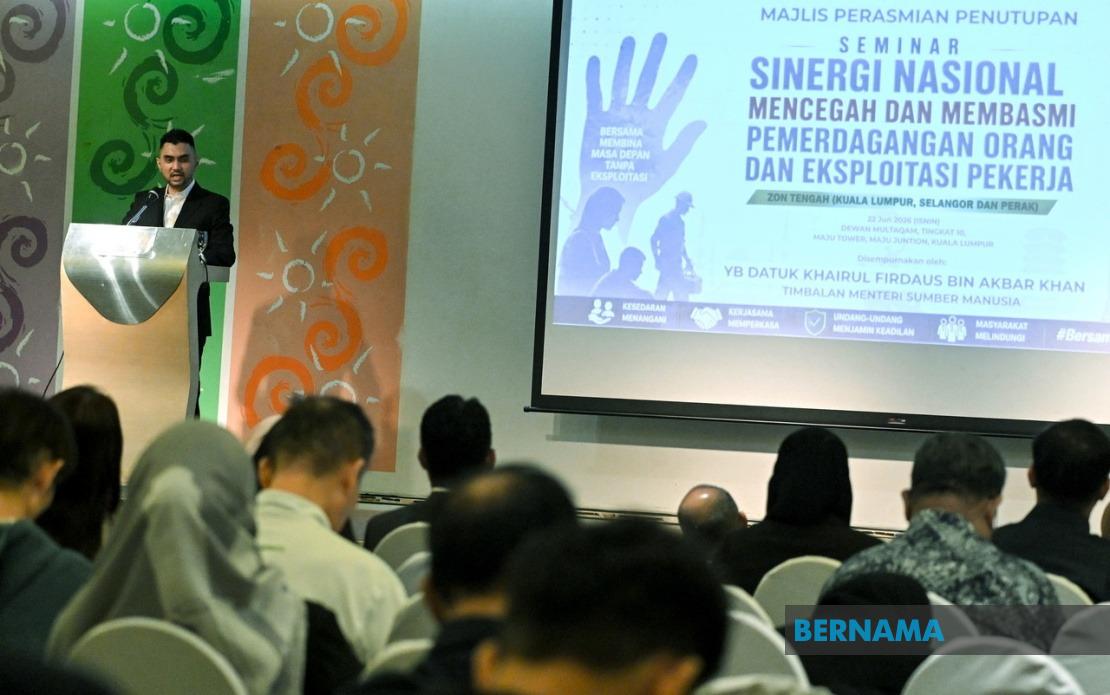
The number of people rescued from human trafficking and labour exploitation in Malaysia has dropped significantly over the past two years, a development that Deputy Human Resources Minister Datuk Khairul Firdaus Akbar Khan attributes to strengthened enforcement and prevention initiatives by federal authorities. Speaking after officiating a national seminar on the issue in Kuala Lumpur, the deputy minister unveiled figures showing a substantial decline in documented rescues from 70 victims in 2023 to just four as of May 2025, with an intermediate tally of 10 in 2024 and 17 in the first four months of 2025.
The Peninsular Malaysia Manpower Department, which compiles these statistics, provided the baseline data that frames this apparent improvement in Malaysia's ongoing battle against forced labour and human trafficking. While the downward trajectory suggests that coordinated government efforts are yielding measurable results, Datuk Khairul Firdaus cautioned that the decline cannot be viewed with unguarded optimism. He emphasised that many victims remain hidden from official detection, either because they fear authorities, lack awareness of assistance pathways, or operate within criminal networks that successfully evade enforcement scrutiny. This observation reflects a reality common across Southeast Asia: official statistics frequently undercount the true prevalence of trafficking, which remains a deeply entrenched challenge in the region's informal economy.
The government's commitment to tackling forced labour aligns with Malaysia's obligations under protocols established by the International Labour Organisation, a framework that obligates member states to pursue systematic prevention and prosecution strategies. This multilateral commitment has translated into concrete enforcement activity across the country. Between January and May 2025 alone, authorities conducted 386 labour-related enforcement operations nationwide, resulting in the opening of 311 investigation papers. These figures demonstrate the considerable administrative and investigative resources mobilised by the government, though questions remain about whether such operations are sufficiently targeted at the most vulnerable worker populations or whether they adequately address the supply chains that facilitate trafficking.
A significant component of Malaysia's anti-trafficking strategy involves public awareness and stakeholder engagement. The National Synergy Seminar on Preventing and Eradicating Human Trafficking and Labour Exploitation represents a deliberate effort to build a coordinated response across government agencies, civil society, and the private sector. The Central Zone seminar, held in Kuala Lumpur, followed earlier iterations in the North Zone at Sungai Petani, Kedah in May and the South Zone at Kluang, Johor in June. Collectively, these three regional seminars attracted nearly 1,000 participants, creating forums where stakeholders could exchange perspectives, share intelligence, and develop collaborative solutions to a problem that cuts across jurisdictional and sectoral boundaries.
The scaling of awareness initiatives across Malaysia's geographical zones reflects recognition that human trafficking manifests differently depending on local economic conditions, migrant worker populations, and enforcement capacity. The peninsula's industrial heartland, agricultural regions, and urban centres each present distinct vulnerabilities. Migrant workers in manufacturing, construction, plantation, and domestic service sectors face elevated risk, a pattern that extends across Southeast Asia. Malaysia's position as both a destination and transit country for trafficked persons adds complexity to enforcement efforts, requiring coordination with neighbouring countries and international partners beyond the ILO framework.
Datuk Khairul Firdaus's measured assessment—expressing qualified satisfaction while urging vigilance—reflects a pragmatic understanding of the limits of official data. Trafficking and labour exploitation operate largely in shadow economies where documentation is minimal and victims face severe constraints in seeking help. Undocumented migrant workers, in particular, may avoid contact with authorities for fear of deportation, creating a significant blind spot in victim identification. This structural gap means that falling rescue numbers could reflect either genuine progress or simply a shift in trafficking methods that evade detection more effectively.
The investigation papers opened during the first five months of 2025 represent the prosecutorial pipeline through which enforcement operations translate into legal consequences for traffickers. However, the ratio of enforcement operations to investigation papers—311 from 386 operations—suggests that many operations may not reach the threshold for formal investigation, either because victims cannot be identified, evidence is insufficient, or the situation does not constitute trafficking under legal definitions. This investigative yield raises questions about whether enforcement strategies are sufficiently precise or whether definitional boundaries exclude forms of labour abuse that fall short of strict trafficking criteria.
For Malaysian businesses and employers, particularly those operating in sectors with high proportions of migrant workers, the government's intensified focus carries both compliance and reputational implications. Supply chain transparency and worker welfare standards have become increasingly scrutinised by international buyers and investors, especially following heightened attention to forced labour risks in Southeast Asian manufacturing and agriculture. Companies that fail to implement adequate labour practices face not only government penalties but also commercial pressure from global brands concerned about reputational exposure.
The broader context for Malaysia's anti-trafficking efforts includes regional disparities in capacity and commitment. Countries throughout Southeast Asia face comparable challenges, yet responses vary considerably in effectiveness and resource allocation. Malaysia's membership in multilateral anti-trafficking frameworks and its status as an upper-middle-income nation provides advantages in investigative resources and international cooperation that smaller or less developed neighbours may lack. This differential capacity shapes the pattern of trafficking flows across the region, potentially pushing vulnerable populations toward jurisdictions with weaker enforcement.
Looking forward, the sustainability of Malaysia's prevention efforts depends on whether awareness campaigns translate into behavioural change among employers, workers, and communities. The near-1,000 participants in the three regional seminars represent a significant reach, but measuring actual impact requires long-term tracking of whether knowledge acquisition leads to improved reporting, better workplace practices, and reduced trafficking incidents. Government officials must also address the underlying economic vulnerabilities that make trafficking profitable—poverty, wage disparities, and limited employment options—which awareness campaigns alone cannot resolve.

