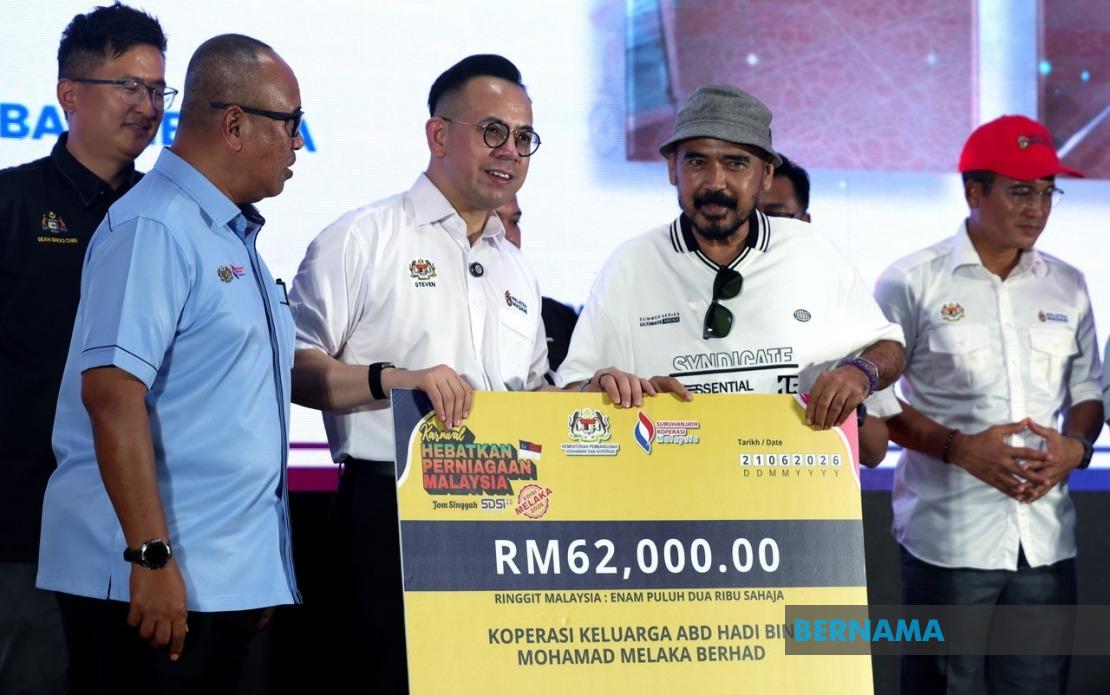
The Empowering Malaysian Businesses Carnival (Karnival Hebatkan Perniagaan Malaysia 2026), or HPM 2026, concluded its three-day run in Melaka this month with exceptional outcomes that underscore the government's commitment to nurturing the entrepreneurial ecosystem. Held from June 19 to 21, the carnival successfully channelled RM8.45 million in combined business matching value and financing opportunities, while drawing an impressive 70,000 visitors and generating direct product sales worth RM532,802.77 for participating entrepreneurs.
The Ministry of Entrepreneur Development and Cooperatives (KUSKOP) orchestrated the event as a cornerstone initiative under the broader Hebatkan Perniagaan Malaysia agenda spearheaded by Minister Steven Sim Chee Keong. The carnival represents a practical embodiment of the government's ABCD framework—Accelerating Productivity, Bureaucracy Reduction, Capital Accessibility and Developing Market Access—which aims to systematically strengthen the foundation of local enterprises at every stage of their development.
The business matching component proved particularly robust. Through 72 structured networking sessions facilitated throughout the carnival, 25 potential entrepreneurs successfully connected with established partners and stakeholders, generating RM6.4 million in matched business opportunities. These sessions functioned as critical connective tissue between aspiring business owners seeking guidance, resources, and partnerships, and experienced operators willing to mentor or collaborate. Such direct interaction often proves invaluable in Malaysia's fragmented SME landscape, where access to the right networks remains a persistent challenge for many grassroots entrepreneurs.
Equally significant was the financing acceleration component. A total of 55 micro, small and medium enterprises participated in dedicated financial interaction sessions, where their expansion plans and capital requirements were evaluated by financial institutions and development agencies. These discussions resulted in RM2.05 million in potential financing commitments, addressing one of the most pressing constraints facing Malaysian MSMEs—reliable access to growth capital at reasonable terms. For enterprises operating in labour-intensive sectors or those requiring inventory and equipment investment, such capital accessibility directly translates into expansion capacity and job creation potential.
The scale of visitor attendance at 70,000 participants over three days reflects strong market demand for such platforms among both established business operators and aspiring entrepreneurs. This footfall demonstrates that Malaysians recognise the value of centralised, curated spaces where multiple services—mentorship, financing, partnerships, market intelligence—converge under one roof. The direct product sales figure of RM532,802.77 also validated the carnival's function as a genuine commercial marketplace, not merely an informational showcase. Participating MSMEs achieved immediate revenue while simultaneously building brand visibility and customer databases.
The Melaka carnival represented the third iteration of the HPM 2026 series, indicating a maturing, periodic approach to regional entrepreneur support. The Ministry has already scheduled the fourth edition for Penang, set to run from July 17 to 19 at the Penang Waterfront Convention Centre (PWCC). By rotating these major events across different states, KUSKOP ensures that Malaysian entrepreneurs in every region benefit from access to similar ecosystems of support, reducing the geographic disadvantage that entrepreneurs outside the Klang Valley traditionally face when seeking capital, partnerships, and expertise.
For Malaysian entrepreneurs, particularly those in underserialised sectors or emerging zones, such carnivalsa represent tangible expressions of government support beyond rhetoric. The RM8.45 million in unlocked value at the Melaka edition—whether through direct partnerships, financing approvals, or sales—translates into real economic stimulus flowing toward enterprises that typically struggle to access mainstream financial and commercial channels. Many Malaysian MSMEs remain invisible to institutional lenders and corporate buyers until they achieve sufficient scale; carnivalsa like HPM 2026 compress the timeline for such visibility and credibility-building.
The emphasis on both productivity acceleration and bureaucracy reduction within the ABCD framework also signals a philosophical shift in how Malaysia approaches SME development. Rather than viewing entrepreneurs primarily as candidates for grant schemes or loan subsidies, the government increasingly positions them as participants in a dynamic, networked economy where peer learning, direct deal-making, and institutional partnerships matter as much as capital provision. This philosophy aligns with contemporary development thinking that sees entrepreneurial ecosystems—networks of mentors, investors, service providers, and fellow founders—as critical infrastructure for durable business growth.
The diversity of participants at the Melaka carnival likely spanned sectors from traditional manufacturing and trade to digital commerce and services. The breadth of business matching value suggests that entrepreneurs across multiple industries found relevant partners, whether suppliers, distributors, technology providers, or co-investors. This sectoral diversity strengthens the argument that Malaysia's entrepreneurship agenda cannot be narrowly targeted but must cast a wide net to capture the full spectrum of economic dynamism beneath the headline statistics.
As the HPM 2026 series progresses toward Penang and presumably other states beyond, the template established in Melaka offers a replicable model for addressing structural constraints in Malaysia's entrepreneurial landscape. The combination of business matchmaking, financing facilitation, and commercial marketplace functions addresses multiple bottlenecks simultaneously. For a regional economy seeking to diversify away from commodity dependence and foster greater domestic entrepreneurship, such coordinated, state-level intervention mechanisms constitute necessary infrastructure. The success metrics from Melaka—RM8.45 million in unlocked value, 70,000 participant engagements, and RM532,802.77 in direct sales—establish a credible baseline against which subsequent regional carnivalsa can be measured and potentially improved, creating accountability and fostering continuous refinement of this emerging policy tool.

