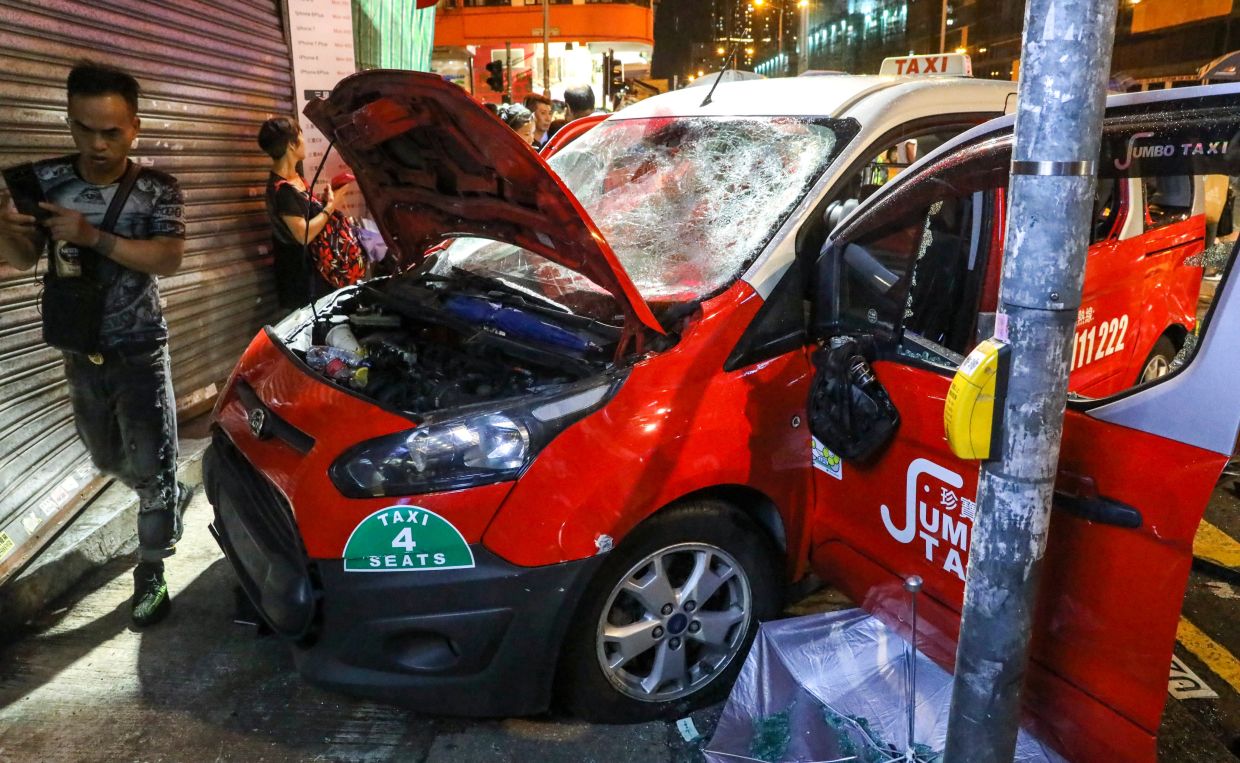
A Hong Kong kindergarten clerk whose life was dramatically altered by a taxi accident during the 2019 protests is pressing her case for HK$8.4 million in compensation from the driver. Park Hoi-lam's legal team presented arguments this week before the court, arguing that taxi driver Henry Cheng Kwok-chuen bears responsibility for mounting a pavement and striking her and another woman along Yen Chow Street in Sham Shui Po on October 6, 2019, during demonstrations that gripped the city that autumn.
The collision occurred at a moment of intense civil unrest, when Hong Kong's streets became flashpoints for conflict between protesters and authorities. On that particular afternoon, Park had been attempting to navigate the disrupted transport network with friends after blocked roads forced them off their bus. With railway services suspended as well, the group decided to walk toward Mong Kok, though Park became separated from her companions as she moved through the crowd. She described the atmosphere as initially calm before chaos erupted near where Cheng's vehicle was positioned.
According to Park's testimony, the taxi struck her at high speed with no warning—no horn sounded, no braking attempted. She recalled turning to flee upon hearing commotion but found herself unable to escape before the vehicle struck her. The impact left her with severe injuries to her lower limbs requiring seven surgical operations over the subsequent three months. When she was finally discharged from hospital in January 2020, she remained dependent on ongoing outpatient therapy.
Three years on, Park's physical condition continues to constrain her daily existence. Chronic knee pain prevents her from standing or walking for extended periods, limiting her capacity to function fully in her current role at a kindergarten near her Tuen Mun residence. Her employer's expectations—lifting objects, comforting distressed children—are activities she can no longer perform without difficulty. Medical specialists have indicated that her injury trajectory may lead toward future knee replacement surgery, while cosmetic procedures to address scarring remain financially out of reach for her.
Plaintiff's counsel Susanna Leong framed the collision itself as compelling evidence of negligence and failure to exercise reasonable care by the driver. She emphasized that the subsequent assault on Cheng by protesters bore no relevance to the mechanics of how and why the collision occurred in the first place. This legal distinction is crucial: Leong sought to separate the circumstances of the accident from the broader context of protest violence, arguing that regardless of what happened to the driver afterward, his actions at the moment of impact demonstrated a failure to protect those on the pavement.
The defence mounted a contrasting narrative, portraying Cheng not as a negligent operator but as another casualty of the day's violence. Legal representatives argued that the driver himself was victimized, sustaining violent attacks from protesters wielding metal rods and hard objects as he performed his ordinary work duties. From this perspective, seeking compensation from "another victim of the violence," as the defence stated, represents a misallocation of responsibility and does not deliver genuine justice. This framing attempts to shift focus away from the moment of collision and toward the broader assault on the driver.
Central to the defence strategy was a counterargument about Park's actual recovery and capacity. Private detective surveillance footage presented to the court showed Park shopping and dining after her work shifts, activities the defence counsel suggested indicated a far more functional life than her testimony implied. However, Park rejected this interpretation, asking whether the ability to engage in routine errands and meals truly constituted living a meaningful existence. Her question encapsulates a fundamental tension in personal injury litigation: whether the resumption of basic activities should be conflated with genuine recovery and restoration of one's former life.
The case unfolds within the complicated legal landscape that emerged from 2019's prolonged unrest. Numerous incidents during those months generated liability questions that courts continue to adjudicate, often facing competing claims about who bears responsibility when violence intersects with ordinary urban life. Some cases have involved protesters seeking damages from police; others have involved businesses suing for property destruction. Park's lawsuit represents a different variant—an ordinary citizen injured during a protest claiming damages from a private individual whose vehicle caused the immediate harm.
Park's own account of that afternoon complicates easy categorization. She was not a protest participant; she was simply attempting to move through the city amid disrupted services. Yet she found herself in a location where tensions ran high, where a taxi driver faced assault, and where a pedestrian was struck. Her legal representatives must convince Justice Simon Leung Chun-man that despite the chaotic environment, the driver's actions at the precise moment of collision constituted negligence—a failure to brake, to signal, to exercise the care a reasonable driver would deploy when navigating a crowded street where pedestrians might be present.
The trial is expected to extend across six days, allowing both sides to fully develop their competing narratives about responsibility, causation, and the proper allocation of liability when protest violence and traffic accidents intersect. The outcome will likely establish precedent for how Hong Kong courts weigh the conduct of individual actors against the broader context of civil unrest. It will also speak to the practical limitations injury victims face when seeking redress in an environment where multiple parties claim victimhood and where the ordinary duties of care become entangled with extraordinary circumstances.
For Park personally, the case represents an attempt to restore some financial stability after her world narrowed considerably following those few seconds on Yen Chow Street. The HK$8.4 million figure reflects calculations about medical costs, lost earning capacity, and pain and suffering across what may be decades of reduced mobility. Yet even if she prevails, no judgment can fully restore the life she was living before the taxi mounted the pavement—the life where she could work without physical limitations, walk without pain, and hold children without constraint. The Hong Kong court's task is determining who should bear the financial burden of that permanent disruption.

