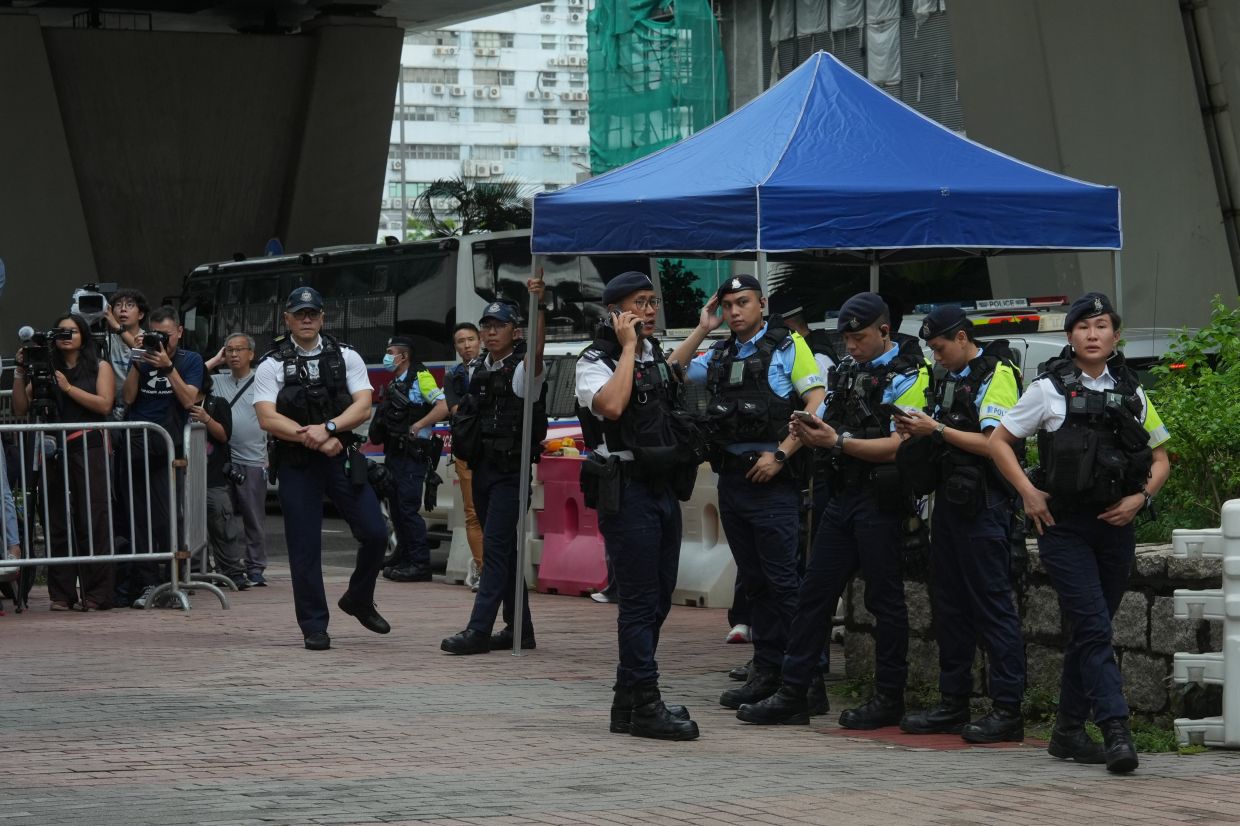
A woman has been arrested in Hong Kong on suspicion of wearing seditious clothing outside West Kowloon Court, marking another instance of authorities moving swiftly against perceived breaches of the national security law. Police detained the individual last week on charges of disorderly conduct in a public space, obstructing officers, and acting with seditious intent, according to a statement issued Monday evening. Officials justified the operation as necessary to maintain public safety and order, though they declined to elaborate on specific details of how the security operation was conducted.
The arrest unfolded in the early morning hours as more than 50 people gathered outside the courthouse awaiting a significant legal judgment. The crowd had assembled before dawn on Friday, with some arriving to witness or cover the verdict against Lee Cheuk‑yan and Chow Hang‑tung, former leaders of the Hong Kong Alliance in Support of Patriotic Democratic Movements of China. According to eyewitness accounts, a plainclothes officer identified a woman whose shirt bore Japanese characters and escorted her into a police vehicle without explanation. Media personnel captured the incident on film, but officers reportedly instructed journalists to vacate the area as the detainee was removed.
The timing of the arrest—occurring mere hours before the court's landmark decision—underscores the intensifying enforcement environment surrounding political expression in the territory. The two former activists and their now-disbanded alliance faced accusations of inciting subversion under Hong Kong's national security law, specifically for their calls to end "one-party dictatorship" in mainland China. This terminology, which formed the core of their alleged transgression, reflects how authorities interpret even declarative statements about political systems as potential violations of security legislation.
The subsequent verdict delivered by three High Court judges reinforced the expansive scope of subversion charges under the security regime. In a comprehensive 216-page ruling, the bench determined that any attempt to overthrow or undermine the Communist Party of China's leadership constitutes subversion. More significantly, judges held that Hong Kong's constitutional framework does not accommodate Western-style democratic governance, establishing a legal precedent that constrains the boundaries of acceptable political discourse. This interpretation suggests that advocating for democratic reforms or questioning single-party rule can legally qualify as seditious activity.
Lee Cheuk‑yan, a former legislator, and Chow Hang‑tung, a practising barrister, have remained in custody for approximately five years throughout legal proceedings. A third defendant, Albert Ho Chun‑yan, who served as vice‑chairman of the alliance, has been detained for over four years. Ho entered a guilty plea in January and now awaits sentencing, having effectively accepted the prosecution's characterization of his activities as unlawful. The extended detention periods raise concerns about due process timelines and the conditions under which political defendants are held pending trial and conviction.
The Hong Kong Alliance had organized the annual Tiananmen Square vigil, a commemoration marking the 1989 crackdown on pro-democracy protests in Beijing. This annual gathering represented one of the most visible displays of political dissent in Hong Kong and served as a symbolic connection between the territory's civil society and broader democratic movements across the region. The alliance's disbandment and the criminal convictions of its leadership effectively eliminate an institutional framework through which such commemoration could occur, signifying a fundamental shift in Hong Kong's political landscape.
For Malaysian observers, the case illustrates how national security legislation, once enacted, can expand significantly beyond its stated scope to encompass clothing, symbols, and speech that authorities deem problematic. The arrest on the basis of a T-shirt's printed characters demonstrates how subjective interpretation of sedition laws can create an environment where citizens must carefully monitor their public presentation. This pattern of enforcement raises questions about whether similar provisions in Malaysia's own security and sedition frameworks might experience comparable expansion.
The conviction's legal reasoning—particularly the assertion that democratic governance is incompatible with Hong Kong's constitutional order—establishes a precedent with regional implications. If accepted as legitimate jurisprudence, such reasoning could influence interpretations of governance and political rights across jurisdictions with comparable legal frameworks. For Southeast Asian nations navigating questions of security legislation and democratic expression, the Hong Kong precedent suggests how courts can be instrumental in narrowing the space for political dissent.
The incident also reflects the operational tactics deployed to enforce these expanded interpretations of sedition law. The plainclothes identification and detention of an individual based on clothing, combined with media restrictions on reporting the incident, demonstrates how security operations function at the intersection of law enforcement and information control. Such practices have become normalized within Hong Kong's security apparatus, suggesting a systematic approach to managing public gatherings and political expression.
The broader context reveals a deliberate sequencing of state actions: the arrest immediately preceded the verdict, ensuring that news coverage would encompass both developments and reinforce narratives about threats to social order. This strategic timing, whether intentional or coincidental, amplifies the chilling effect on public participation in political activities. Prospective participants in future gatherings now possess concrete evidence that mere attendance or controversial clothing choices carry detention risks.
As Southeast Asian democracies and semi-democracies grapple with balancing security concerns against civil liberties, the Hong Kong experience offers cautionary lessons about the trajectory of national security legislation. What begins as provisions targeting defined security threats can gradually encompass broader categories of political expression. The arrest of a woman for her T-shirt, occurring in parallel with convictions for political speech, demonstrates how security frameworks can transform entire societies' relationship with public dissent.

