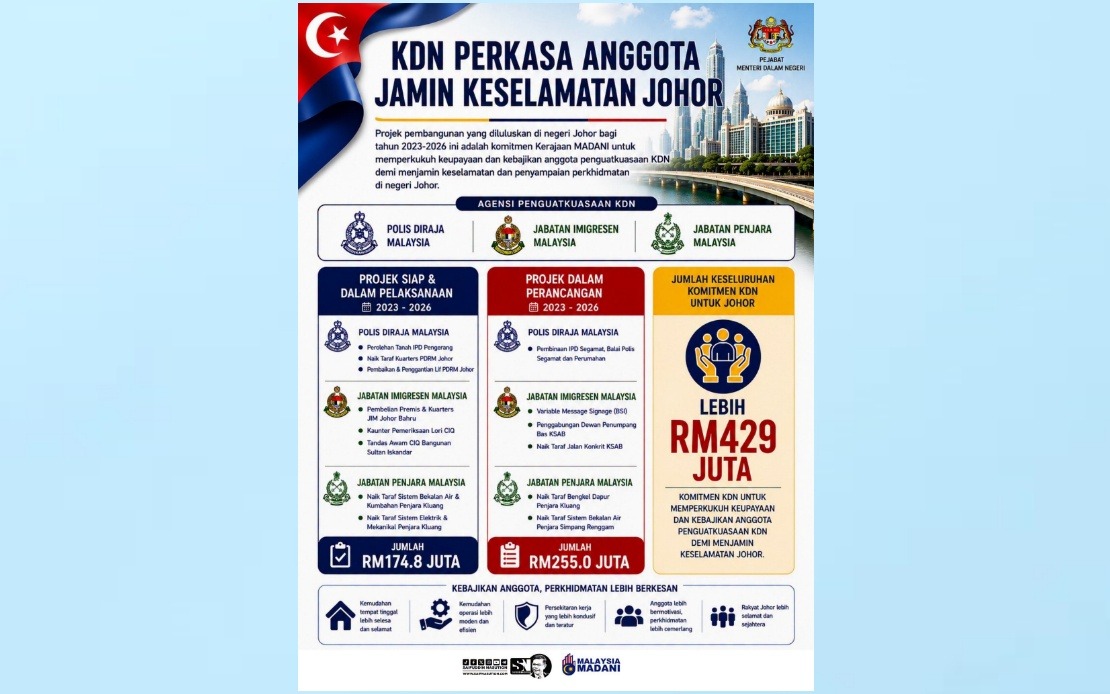
The Home Ministry has committed more than RM429 million in funding since 2023 to address the infrastructure and welfare needs of enforcement agencies operating across Johor, signalling a sustained effort to modernise the state's security apparatus. The investment programme encompasses three principal agencies—the Royal Malaysia Police, Malaysian Immigration Department, and Malaysian Prisons Department—and demonstrates a comprehensive approach to strengthening law enforcement capacity in a state that remains strategically important to national security and economic stability.
Home Minister Datuk Seri Saifuddin Nasution Ismail framed the funding initiative as more than a routine budgetary exercise, emphasising that personnel welfare investments carry direct implications for operational performance and public safety outcomes. By improving working conditions, residential facilities, and operational infrastructure, the ministry argues that enforcement officers become better positioned to discharge their duties with greater efficiency and effectiveness. This rationale reflects a growing recognition within Malaysian government circles that workforce investment yields measurable returns in service delivery quality and crime prevention.
The allocation divides into two distinct phases: RM174.8 million has already been committed to projects either completed or actively underway, while RM255 million remains allocated to initiatives still in planning stages. This bifurcation allows the ministry to balance immediate operational improvements with longer-term strategic development. Among projects currently under implementation are land acquisition for the Pengerang District Police Headquarters, procurement of office premises and residential quarters for the Johor Bahru Immigration Department, and facility upgrades at Kluang Prison. These investments address immediate infrastructure deficiencies that have likely constrained agency effectiveness in recent years.
The pipeline of future projects reveals ambitions for more substantial infrastructure transformation across Johor's enforcement landscape. Construction of the Segamat District Police Headquarters—designed to integrate both a police station and residential quarters—represents a significant undertaking that will enhance police presence in the district. Similarly, consolidation of the bus passenger terminal at the Sultan Abu Bakar Complex signals integration with broader transportation infrastructure, while planned upgrades to kitchen and water supply systems at prisons reflect attention to basic operational standards. These projects suggest a methodical approach to addressing identified gaps rather than ad hoc responses to immediate crises.
For Malaysian readers, particularly those in Johor, the investment programme carries tangible implications for both service delivery and community safety. Enhanced police headquarters facilities typically correlate with improved response times and investigative capacity, directly affecting crime prevention and public confidence in law enforcement. Immigration facilities upgrades address operational bottlenecks at border crossings and visa processing centres, with potential benefits for business communities and travellers. Prison infrastructure improvements contribute to institutional stability and officer safety, reducing incidents that occasionally generate negative headlines and public concern.
Saifuddin Nasution positioned the initiative within the broader context of the MADANI Government's development philosophy, asserting that each state receives support proportional to its development priorities and population welfare requirements. This framing attempts to address historical perceptions of unequal resource distribution between states, a persistent source of political tension in Malaysia's federal system. By highlighting increased allocations to Johor specifically, the ministry implicitly acknowledges competing demands from other states and seeks to demonstrate equitable governance approaches.
The reference to Prime Minister Datuk Seri Anwar Ibrahim's recent parliamentary clarification provides concrete metrics for assessing the government's commitment to Johor's development. The stated increase from RM10.2 billion to RM14.6 billion in development and management allocations represents approximately a 43 percent rise, suggesting significant reallocation of federal resources toward the state. For context, such expansions typically occur following political realignments or recognition of infrastructure deficiencies. Johor's strategic location as Malaysia's gateway to Singapore and its role in regional supply chains likely influenced the prioritisation.
The enforcement agencies receiving allocations—police, immigration, and prisons—form the backbone of Malaysia's internal security infrastructure. The police force operates across public safety, crime investigation, and counter-terrorism functions; immigration handles border security and population control; prisons manage convicted offenders and contribute to rehabilitation objectives. Strengthening these agencies in Johor, a state with significant population density and economic activity, addresses vulnerabilities that could have national security implications. Enhanced capacity translates to improved detection and prevention of transnational crime, human trafficking, and security threats.
Southeast Asian readers should note that Malaysia's investment in domestic enforcement capacity reflects regional security challenges, including transnational organised crime, migrant smuggling, and increasingly sophisticated cyber-enabled criminal activities. Johor's proximity to Singapore and its role as a regional logistics hub make it particularly vulnerable to these threats. The ministry's willingness to commit substantial resources indicates recognition that maintaining competitive enforcement capabilities requires sustained investment, not merely reactive spending in response to specific incidents.
The welfare emphasis in the allocation programme deserves analytical attention, as it suggests institutional learning within Malaysian security agencies. Historically, Malaysian enforcement personnel have worked under challenging conditions with ageing facilities and limited amenities, contributing to attrition and morale issues documented in various oversight reports. By prioritising both operational infrastructure and personnel welfare, the ministry acknowledges that institutional effectiveness depends on workforce stability and job satisfaction. This approach aligns with international best practices in law enforcement and corrections management.
However, the success of this investment programme ultimately depends on implementation efficiency and sustained political commitment beyond the current electoral cycle. Malaysian readers familiar with infrastructure projects recognise that budget allocation, while necessary, does not guarantee timely completion or optimal utilisation. Transparent progress reporting and accountability mechanisms will prove essential to ensuring that allocated funds translate into tangible improvements in agency capability and personnel conditions. Public oversight through parliamentary questions and independent audits could enhance confidence in programme execution.
Looking forward, the RM429 million commitment in Johor may serve as a template for similar investments in other states, particularly those facing comparable infrastructure challenges or strategic significance. The programme's focus on integrated agency development—addressing police, immigration, and corrections simultaneously—demonstrates a systems-thinking approach that recognises security challenges require coordinated responses. Success in Johor could justify similar comprehensive investments elsewhere, gradually modernising Malaysia's broader enforcement infrastructure across the federation.

