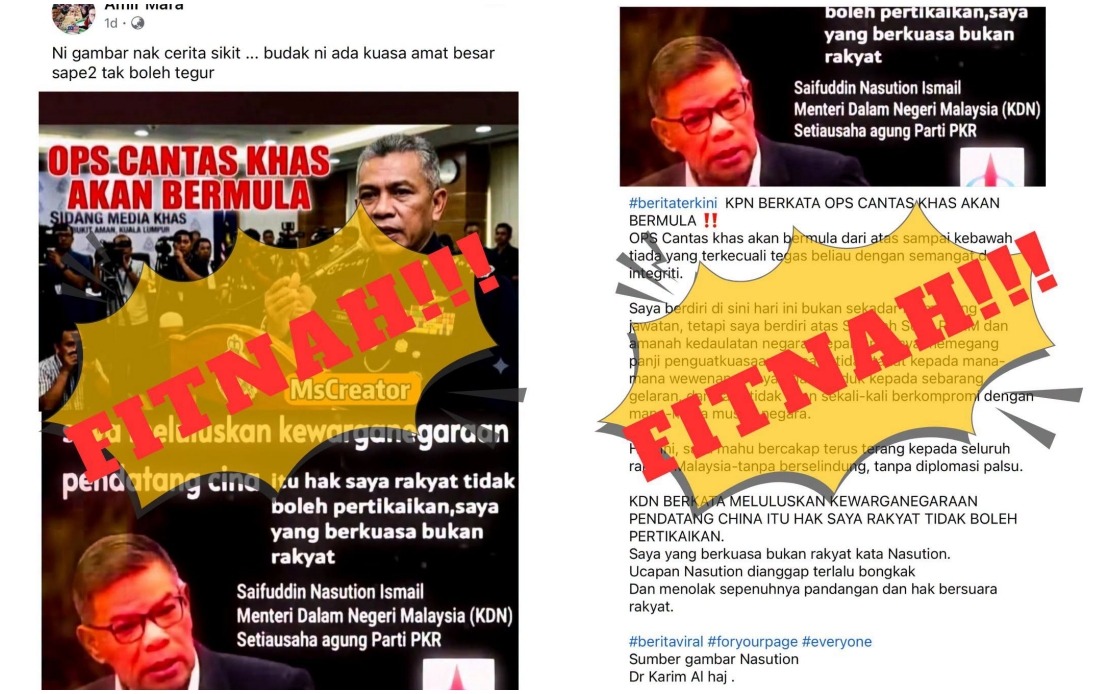
Home Minister Datuk Seri Saifuddin Nasution Ismail has roundly rejected persistent claims that the Ministry of Home Affairs (KDN) conducted mass citizenship grants to foreign nationals, including allegations that 1.2 million Chinese nationals remain in Malaysia through such irregular means. Speaking through his official social media channels, Saifuddin stressed that he has publicly addressed these allegations multiple times, each occasion supported by official documentation and verifiable data, yet sections of the public continue to resurrect recycled videos, posters and narratives that have already been comprehensively debunked.
The minister's latest statement represents a continued effort to counter what he characterises as a deliberate misinformation strategy. Saifuddin emphasised that despite his repeated clarifications backed by factual evidence and government records, certain parties persist in circulating the same discredited claims across digital platforms. This pattern of recirculation, he suggested, points to a coordinated attempt to sustain false narratives rather than genuine public inquiry or debate.
The implications of such misinformation extend far beyond simple factual correction. Saifuddin highlighted that the dissemination of unsubstantiated claims about citizenship fraud not only damages the credibility of individuals and government institutions but more critically, erodes public trust in the machinery of state. When citizens lose confidence in official institutions—particularly those responsible for national security and immigration matters—the consequences ripple across the entire fabric of governance and social cohesion.
The minister warned explicitly that these narratives carry particular danger in Malaysia's multicultural context. Claims of mass naturalisation, especially when ethnically coded, risk stoking communal tensions and deepening inter-racial animosity at a time when social stability depends on measured, fact-based discourse. Saifuddin linked the circulation of these false claims to deliberate efforts to manufacture division and undermine public order, framing such activities as potential threats to national security.
Among Malaysian readers accustomed to polarised discussions around citizenship and immigration, this issue resonates with deep historical concerns. Malaysia's demographic composition and citizenship policies have long been sensitive topics, reflecting constitutional arrangements dating back to independence. Saifuddin's intervention attempts to reestablish factual grounding in what has evidently become an emotionally charged conversation dominated by unverified social media claims.
The minister's call for media literacy and responsible information consumption targets a wider challenge facing Southeast Asian democracies. False claims about citizenship, nationality and immigration spread rapidly on social platforms, particularly when they align with existing anxieties about demographic change and national identity. Malaysia, as a nation where such sensitivities carry constitutional weight and historical significance, faces particular vulnerability to weaponised misinformation in this domain.
Saifuddin's exhortation to citizens to verify claims with official sources before sharing represents a practical appeal to responsible digital citizenship. He explicitly urged social media users to exercise care in evaluating information credibility and cautioned against allowing unsubstantiated narratives to displace factual evidence. The minister's formulation—"Facts are facts, and data is data"—underscores the minister's apparent frustration with the persistence of claims despite official contradiction and factual rebuttal.
The government's position reflects broader institutional concerns about the weaponisation of social media in contemporary politics. When false claims circulate repeatedly despite official denial, they create a challenging environment for governance. Each recirculation requires renewed institutional response, consuming resources and potentially amplifying the original misinformation through increased visibility. This dynamic appears to have motivated Saifuddin's explicit calls for the public to cease spreading such claims and for citizens to resist exploitation of sensitive issues for political positioning or social media engagement.
For Malaysian observers, this statement underscores ongoing tensions between institutional authority and digital democracy. The government possesses documentary evidence and administrative records to substantiate its position, yet these materials prove insufficient to dislodge narratives that have achieved currency in certain online spaces. The gap between official truth claims and social media narratives reflects broader challenges facing governments across Southeast Asia in maintaining informational authority and public confidence.
Saifuddin's emphasis on the deliberate recycling of corrected materials suggests a strategic communication problem rather than mere misunderstanding. If false claims continue circulating despite repeated correction, the issue becomes one of persuasion and narrative control rather than simple fact provision. This reflects the evolving nature of political communication in Malaysia, where social media enables rapid circulation of claims that official statements struggle to contain or conclusively refute.
The minister's positioning also carries implicit criticism of political actors or groups who might benefit from perpetuating such narratives. While Saifuddin avoided direct partisan accusation, his reference to exploitation of sensitive issues for political purposes and social media attention points toward motivated behaviour rather than organic public misunderstanding. This framing invites readers to consider whether such claims serve any legitimate democratic function or whether they function primarily to stoke division and attract online engagement.
Moving forward, Saifuddin's intervention suggests the government will continue insisting on official documentation and data-driven discussion of citizenship matters. For Malaysian citizens navigating an information landscape crowded with competing claims, the minister's appeal to verify sources and exercise critical judgment offers practical guidance. However, the persistence of such claims despite multiple official denials indicates that information correction alone may prove insufficient to resolve what has become a politically and socially charged issue requiring broader institutional and societal responses.

