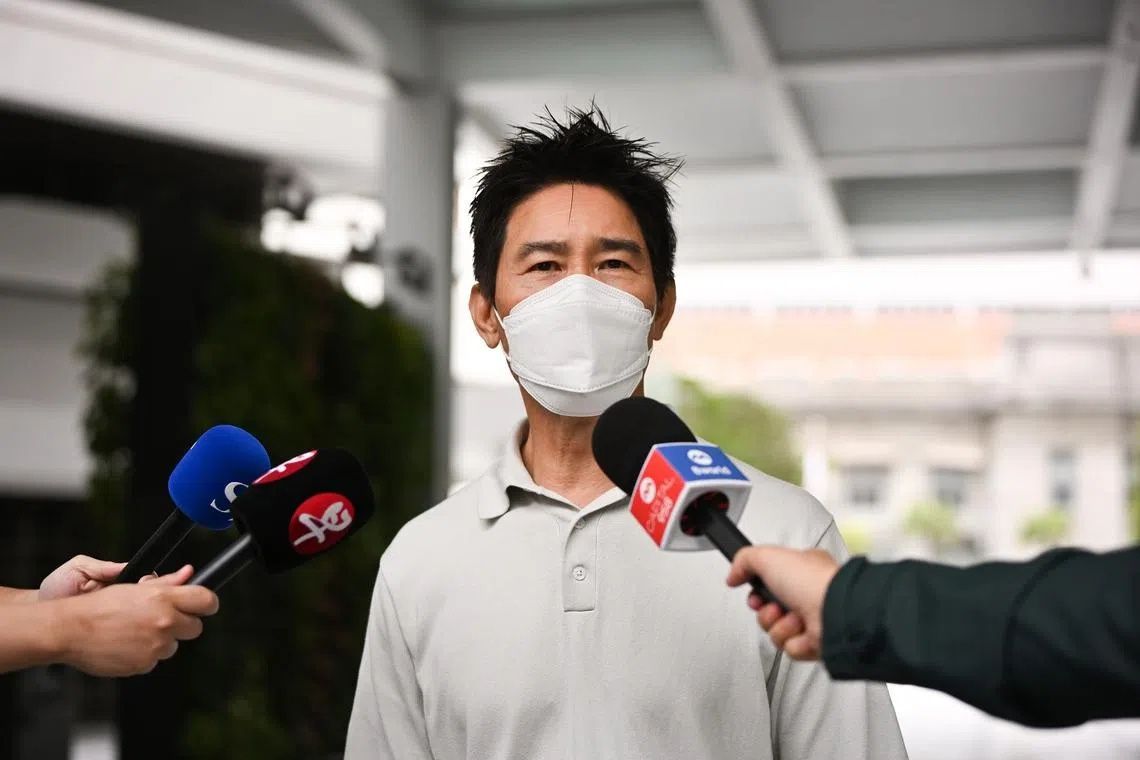
The High Court in Singapore has substantially reduced the custodial sentence imposed on former actor Edmund Chen, cutting his five-day jail term to a single day in connection with a traffic accident. Justice Hri Kumar Nair delivered the decision on Monday, July 20, finding that the original penalty handed down by the district court was manifestly excessive, though he acknowledged that the lower court was not entirely wrong to impose a custodial sentence. Chen, whose legal name is Tan Kai Yuan, pleaded guilty to causing grievous hurt to a 21-year-old motorcyclist while operating a motor vehicle without appropriate care for other road users.
The incident occurred on March 4, 2025, around midday on the Ayer Rajah Expressway heading towards the Central Expressway. Chen had been driving on the fourth lane when he decelerated dramatically, nearly bringing his vehicle to a standstill, before attempting to filter across to the third lane. His intention was to transition onto the CTE/SLE junction, but he had failed to position himself in the correct lane upstream of the road split. The motorcyclist travelling behind could not avoid the collision despite attempting to swerve, and the impact resulted in multiple fractures to both wrists requiring surgical intervention at Singapore General Hospital.
Chambering the decision to appeal the sentence, Chen engaged Senior Counsel Abraham Vergis of Providence Law Asia, who mounted a forceful argument that the financial penalty should have been the primary recourse. Vergis contended that the threshold for imposing imprisonment had not been satisfied in this particular matter and advocated for the maximum allowable fine of S$5,000 instead. The original district judge had imposed the five-day term on January 29 despite the prosecution itself requesting only a monetary penalty ranging between S$3,000 and S$5,000, a significant factual backdrop that influenced the appellate review.
Evidence presented in court included dashcam footage from Chen's own vehicle, which formed a critical component of the judicial examination. Vergis drew the court's attention to several mitigating factors evident in the recording: Chen had activated his vehicle's indicator lights before the manoeuvre, and the motorcyclist's view had been obscured by another passing vehicle due to the road's curvature. The defence counsel highlighted that the footage actually demonstrated Chen had crossed the white chevron road markings only after the collision had already occurred, suggesting the traffic violation occurred as a consequence rather than a cause of the accident. The original district judge had weighted the deliberate crossing of chevron markings as a significant aggravating factor in determining sentence.
Regarding the injuries inflicted, Vergis characterised them as falling toward the lesser end of the grievous hurt spectrum. The fractures were localised to the wrists and extremities rather than affecting vital areas, and the surgeon had opted for local anaesthesia during the procedure, implying the medical assessment did not classify them as severe. The victim spent two days in hospital and received 99 days of medical leave, but suffered no lasting disability or permanent impairment. These particulars formed the crux of the mitigation argument—that the harm, while real, did not necessitate incarceration for the person responsible.
Chén's legal team emphasised the profound psychological toll the prosecution had already exerted on their client. The former television personality had carried five days' worth of medication to the courthouse and reported that he and his family had been unable to sleep the night before his appeal hearing. Vergis submitted to the court that this was precisely the kind of case where a substantial financial penalty combined with an extended driving prohibition would serve justice adequately, and that custodial remand was unnecessary and counterproductive. The defence advanced that Chen was not the type of offender the criminal justice system needed to incarcerate, and that the threatened loss of driving privileges for five years would serve as a potent deterrent against future reckless behaviour.
Deputy Public Prosecutor Ben Tan, however, maintained that the stringency of the original sentence remained justified. The prosecutor noted that while the district judge had adopted the upper reaches of the sentencing range, no reviewable error had been committed that warranted appellate interference. He directed the court's attention to a particularly aggravating circumstance: drivers of two separate vehicles had sounded their horns to warn Chen of the danger posed by his manoeuvre, yet he had persisted regardless. This suggested a degree of inattention or recklessness beyond mere momentary lapse in concentration.
The appellate court's judgment, however, sided with the defence. Justice Hri Kumar Nair determined that whilst he could not fault the district judge's conclusion that some custodial element was warranted, the quantum of five days crossed the threshold of proportionality. The reduction to a single day represents a 80 per cent reduction in the jail component, though the five-year driving disqualification remained in place—a substantial penalty in its own right for any motorist. This sentencing adjustment reflects ongoing judicial debate within Singapore's courts regarding the appropriate balance between deterrence and proportionality in traffic accident cases involving injury.
Edmund Chen occupies a unique position in Singapore's entertainment landscape. The 64-year-old was formerly a recognisable television personality, having appeared in multiple acclaimed drama series including Star Maiden and Patrol during the height of his acting career. He stepped away from the entertainment industry around 2000 when his daughter was born, prioritising family commitments over professional opportunities, though he maintained selective involvement in television productions, notably appearing in Life Less Ordinary in 2017. Chen is married to veteran actress Xiang Yun, whose career encompassed roles in celebrated local dramas such as The Awakening, Double Happiness and The Little Nyonya, placing them among Singapore's recognised entertainment figures.
The case has attracted attention not merely for its legal dimensions but also because it involves a public personality navigating Singapore's strict traffic law framework. The jurisdiction has long maintained rigorous standards for road safety, with courts treating traffic offences involving injury with considerable gravity. The reduction from five days to one day imprisonment signals that appellate courts will critically examine custodial sentences even when the circumstances support some incarceration, provided that alternative penalties can adequately address sentencing principles. For Malaysian readers observing Singapore's legal approach, the case illustrates how neighbouring jurisdictions calibrate traffic penalties and the role of appellate review in moderating initial judicial assessments.

