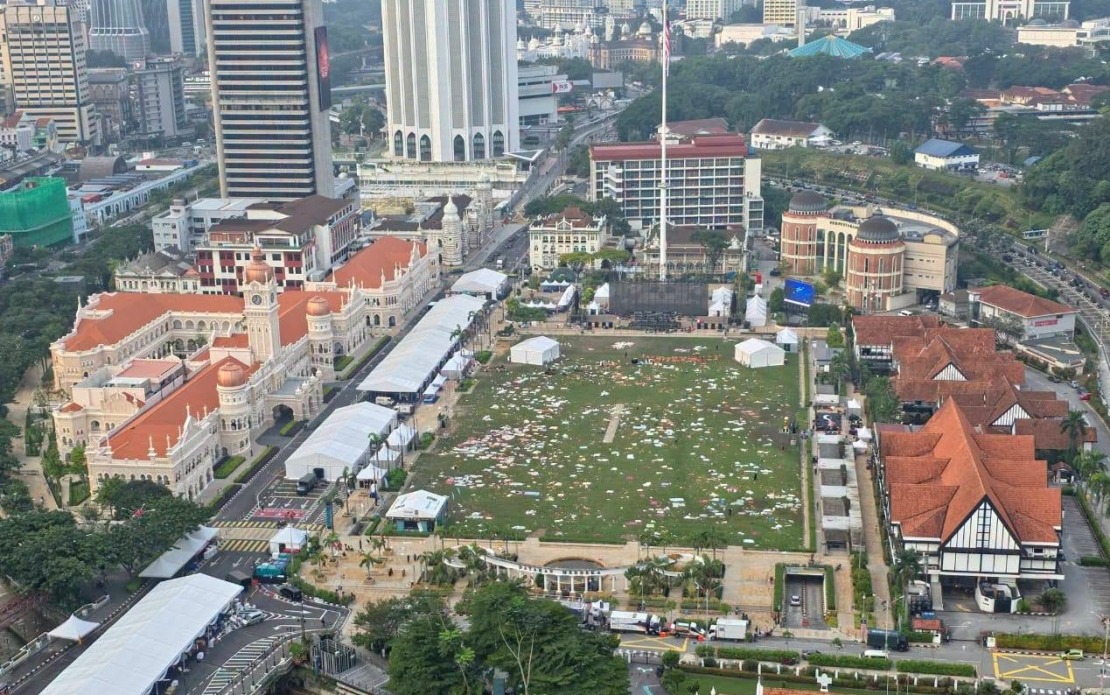
Following the public screening of the 2026 FIFA World Cup final at Dataran Merdeka, the historic venue was left scattered with discarded rubbish—prompting Federal Territories Minister Hannah Yeoh to express her gratitude to Kuala Lumpur City Hall workers who undertook the demanding task of restoring the landmark to its proper condition. However, rather than allowing the moment to pass without comment, Yeoh seized the opportunity to deliver a broader message about collective responsibility and the civic duties that extend beyond the machinery of government.
In a Facebook statement released on July 20, Yeoh acknowledged that while DBKL has fulfilled its obligation to maintain the city's public spaces, the root cause of such cleanliness challenges lies not with municipal workers but with public behaviour. She articulated a position that has become increasingly central to Malaysia's governance philosophy: that citizens cannot simply delegate all responsibilities to state institutions and expect satisfactory outcomes. The minister's intervention reflects a growing recognition among policymakers that infrastructure and services alone cannot sustain urban environments without corresponding changes in public conduct.
Yeoh's remarks touched upon a tension that urban administrators across Southeast Asia grapple with constantly. While Kuala Lumpur residents rightfully expect efficient municipal services in exchange for their taxes, the minister argued that this expectation should not extend to absolving individuals of basic cleanliness practices. The distinction she drew—between the government's duty to provide services and citizens' duty to use public spaces responsibly—represents an attempt to reframe the social contract in terms of mutual obligation rather than one-directional service delivery.
The incident at Dataran Merdeka serves as a microcosm of broader urban management challenges facing Malaysian cities. Major public events frequently result in significant littering, straining resources and diverting municipal attention from routine maintenance. When thousands gather in public spaces, the concentration of waste can overwhelm even well-resourced city councils. Yeoh's intervention suggests an attempt to address this structural problem not through punitive measures but through appeals to shared national pride and civic consciousness.
The minister characterised Dataran Merdeka as more than merely a venue for entertainment or sporting events. Describing it as a historical landmark and symbol of the capital's dignity, Yeoh elevated the conversation beyond mere cleanliness concerns. The space holds profound significance in Malaysian national consciousness as the location of independence declarations and major commemorative events. Framing its upkeep as a matter of national pride rather than municipal obligation potentially carries greater emotional resonance for citizens and may prove more effective in influencing behaviour than administrative enforcement alone.
Yeoh's positioning aligns her message with the broader Malaysia MADANI vision articulated by Prime Minister Datuk Seri Anwar Ibrahim. This governance framework emphasises that national progress encompasses not only physical infrastructure and economic development but also the character and values embodied in how citizens interact with their shared environment. Malaysia MADANI represents an attempt to move beyond purely materialist measures of development towards holistic assessments of societal wellbeing and cultural standards. In this context, littering becomes more than an aesthetic or hygiene matter—it reflects the moral fabric of the nation.
The minister directly invoked Prime Minister Anwar Ibrahim's perspective that a nation's advancement cannot be measured solely through construction and economic indicators. This reference positions individual cleanliness behaviour as integral to Malaysia's development trajectory. By elevating personal discipline to a development metric, Yeoh and the broader government leadership signal that achieving Malaysia MADANI requires shifts in collective consciousness and individual practice, not merely policy changes or infrastructure investment.
Yeoh's appeal to Malaysians to refrain from littering public spaces and to dispose of waste responsibly might appear self-evident, yet her emphasis suggests that deliberate non-compliance rather than accidental oversight characterises much of the littering problem. She specifically referenced "rubbish that we deliberately leave behind," implying a conscious choice by some members of the public to disregard both municipal services and shared civic spaces. This acknowledgment that the problem stems partly from intentional behaviour suggests that education and moral persuasion may be necessary complements to enforcement mechanisms.
For Malaysian readers and regional observers, Yeoh's remarks carry particular relevance given Southeast Asia's broader struggle with urban waste management and public space maintenance. Cities across the region face similar challenges, with rapid urbanisation often outpacing institutional capacity to manage waste and maintain cleanliness. Singapore's success in maintaining pristine public spaces has long rested on combining efficient municipal services with strict enforcement and strong social norms against littering. Yeoh's emphasis on shared responsibility suggests Malaysia may be attempting to cultivate comparable social standards, though perhaps through persuasion rather than punishment.
The framing of civic responsibility as inseparable from national identity and progress offers a distinctive approach to urban governance challenges. Rather than viewing the DBKL cleanup as simply a service delivery success story, Yeoh has recontextualised it as an opportunity to reinforce values of collective stewardship and mutual obligation. This rhetorical strategy acknowledges that municipal authorities cannot single-handedly resolve cleanliness challenges without corresponding shifts in public behaviour and attitudes toward shared spaces.
Moving forward, Yeoh's intervention may prompt broader reflection within Malaysian society about the relationship between rights and responsibilities in urban settings. The minister's fundamental assertion—that public services represent a right but public cleanliness represents a shared responsibility—establishes a philosophical foundation for addressing not only littering but numerous other challenges affecting urban environments. Whether such appeals prove sufficient to transform behaviour absent enforcement mechanisms or incentive structures remains an open question, but they signal an important recognition that sustainable urbanism requires engagement with the values and practices of citizens themselves.

