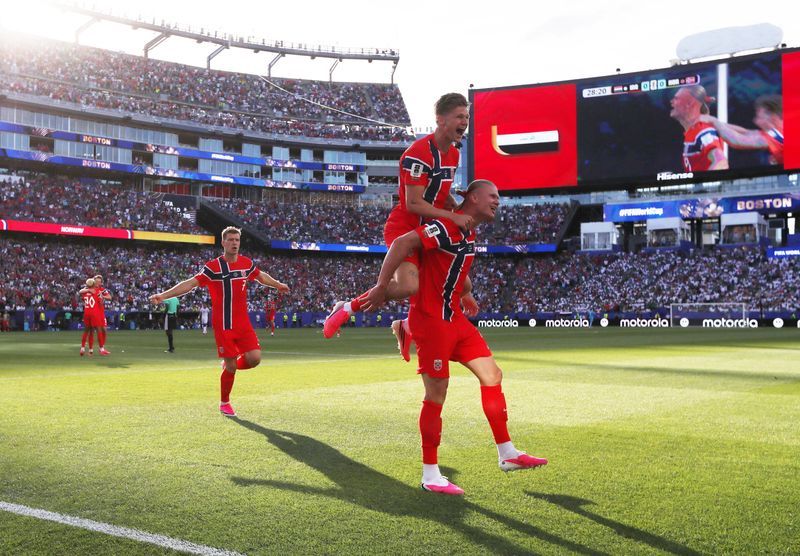
Norway's long-awaited return to the World Cup stage has been lit by the finishing brilliance of Erling Haaland, whose two-goal salvo guided the Scandinavian nation to a resounding 4-1 triumph over Iraq on Tuesday. The 23-year-old striker seized the occasion with characteristic efficiency, announcing himself on football's grandest platform with a first-half performance that exemplified his predatory instincts and justified the considerable expectations trailing him into the tournament. For a nation absent from the men's World Cup since 1998, the prospect of Haaland carrying the attack represented perhaps the most tantalising ingredient in any renewal of their international ambitions.
Haald's journey across European football's elite competitions has been marked by an uncanny ability to find the net when the stakes feel highest. His debut goals across the German Bundesliga, English Premier League, Champions League and now the World Cup finals form a distinctive pattern—one that suggests the young striker thrives when the spotlight burns brightest. Against Iraq, he wasted no time establishing that reputation at international level, claiming his opening goal through a poacher's instinct exemplified by his conversion of David Moller Wolfe's delivery into the penalty area. The simplicity of his finishing belied the positioning intelligence required to arrive in the correct space at the precise moment.
Haaland's second contribution emerged from aggressive play rather than passive waiting. Recognizing a moment of Iraqi weakness in possession, the striker pressed the defence with sufficient conviction to force a hurried back-pass. His presence of mind to block the goalkeeper's attempted clearance and deflect the ball into the net demonstrated the multifaceted nature of his threat. Such industry, combined with his aerial presence and physical dominance, creates complications that few opposing defences can adequately solve across ninety minutes. For Iraq's backline, the evening became a masterclass in defensive frustration.
Despite the comprehensive final scoreline, Norway's overall performance revealed layers of inconsistency that manager Stale Solbakken will certainly address in preparation for subsequent group assignments. The Norwegians generated multiple passages of loose play and misdirected passes that suggested a team still acclimatizing to the World Cup environment. Their midfield architects, most notably captain Martin Odegaard, operated below the creative standards one might expect from the squad's primary playmaker. Such lapses ordinarily carry consequences at tournament level, though Haaland's clinical execution temporarily masked structural vulnerabilities in the Norwegian approach.
The defensive frailties became apparent when Iraq seized upon Norwegian inattention to equalize through Aymen Hussein, a goal that underscored how single moments of lost concentration can puncture even dominant performances. The Norwegian backline's ball-watching at that juncture provided genuine warning signs concerning their vulnerability to more technically sophisticated opponents than Iraq. France's earlier 3-1 victory against Senegal had already signaled the calibre of opposition within the group, making such defensive lapses concerning for aspiring qualification strategists among the coaching staff.
Nonetheless, the mathematics of the group stage momentarily favored Norway following their victory. The three points positioned them atop their section on goal difference ahead of France, whose Senegal encounter had concluded earlier. Yet as Haaland himself acknowledged in the aftermath, such early advantages carry minimal predictive value in tournament football. The striker's cautious confidence reflected the awareness that two successive matches remain before knockout qualification becomes mathematically assured. Norway must navigate the minefield of sustained consistency to translate this opening flourish into genuine advancement.
The geopolitical and cultural weight carried into this match cannot be understated for Norwegian football followers. Twenty-eight years without World Cup participation represents a generation of supporters who have never witnessed their national team compete at the tournament level. For those who recall the 1998 campaign, this represents an opportunity for redemption and renewed engagement with their international side. The emotional investment surrounding this group transcends ordinary sporting concern, particularly given Norway's modest population and the outsized prominence of football within national consciousness.
Prime Minister Jonas Gahr Stoere's pre-match remarks framed the philosophical challenge confronting the Norwegian effort. His observation that individual brilliance creates goals whilst collective effort produces victories captured the fundamental tension within tournament football. Solbakken's tactical approach effectively weaponizes Haaland's exceptional abilities through a system specifically designed to position the striker for maximum effectiveness. Yet this dependence also invites risk—should opposing defences successfully neutralize Haaland through intensity or tactical innovation, the entire Norwegian offensive structure potentially crumbles.
Haaland's modest demeanor in victory provided refreshing contrast to the occasionally grandiose pronouncements that accompany World Cup debuts. His grin when discussing Norwegian celebrations back home suggested genuine pleasure in the collective achievement rather than personal aggrandizement. The striker's customary reticence toward media engagement means his communication remains primarily through goal contributions rather than verbal exposition. Such restraint potentially benefits the squad's focus, preventing the distraction that excessive external commentary occasionally generates.
Looking forward, Norway faces the considerably more demanding prospect of competition against technically superior opponents. The group structure suggests that France, despite their opening victory against Senegal, represent the likely qualifying favorites. Norway's pathway to advancement therefore likely requires maximum points against weaker opposition whilst securing enough from contests against France to escape as second-placed finishers. Haaland's performance against Iraq provides the foundation upon which such aspirations might realistically build, though the striker will require substantially greater defensive scaffolding against more sophisticated attacking sides.
The broader regional perspective sees Norway's World Cup participation enriching the tournament narrative beyond the European contingent's traditional dominance. Though Scandinavian football has achieved occasional success through strategic organization and technical competence, sustained tournament impact remains elusive. Haaland represents the exceptional talent required to elevate Norway's ambitions beyond group-stage survival. Subsequent matches will determine whether his striking brilliance can compensate for the inconsistencies evident even in victory, or whether greater collective improvement becomes necessary for the Norwegian challenge to gain genuine traction within the tournament structure.

%22%2F%3E%3C%2Fpattern%3E%3C%2Fdefs%3E%3Crect%20width%3D%22100%25%22%20height%3D%22100%25%22%20fill%3D%22url(%23ph1354vg)%22%2F%3E%3Crect%20width%3D%22100%25%22%20height%3D%22100%25%22%20fill%3D%22url(%23ph1354vp)%22%2F%3E%3Ctext%20x%3D%2250%25%22%20y%3D%2250%25%22%20text-anchor%3D%22middle%22%20dominant-baseline%3D%22central%22%20fill%3D%22rgba(255%2C255%2C255%2C0.95)%22%20font-family%3D%22Georgia%2C%20'Times%20New%20Roman'%2C%20serif%22%20font-weight%3D%22700%22%20font-size%3D%22320%22%20letter-spacing%3D%22-0.02em%22%3EGRS%3C%2Ftext%3E%3C%2Fsvg%3E)