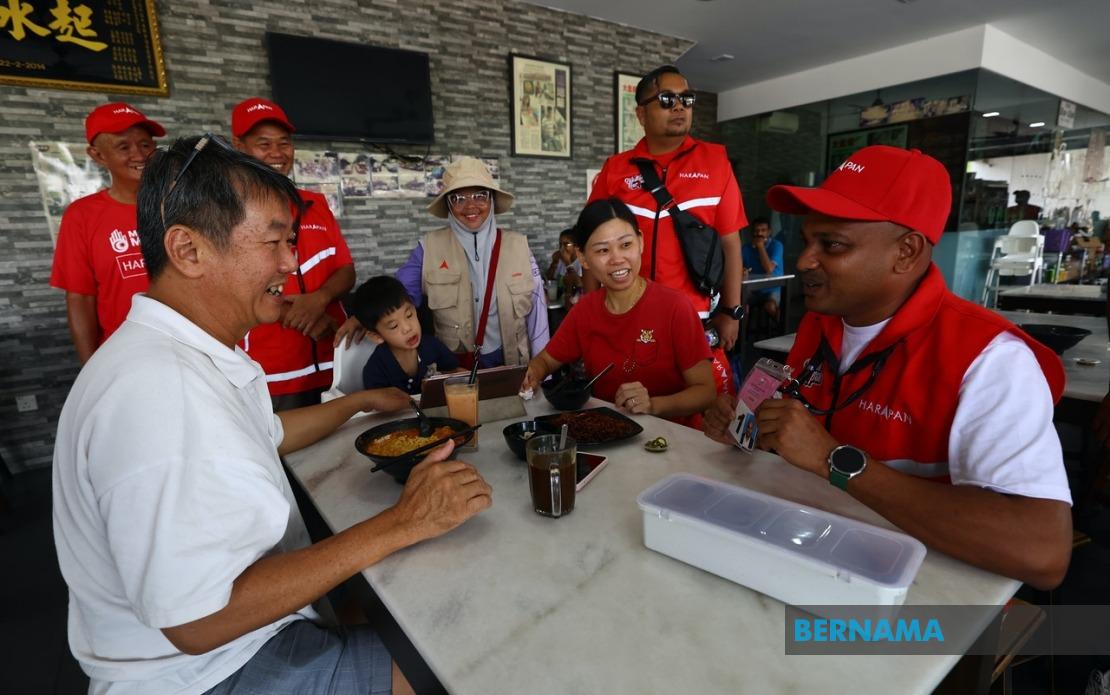
With only five days remaining until voters head to the polls, Pakatan Harapan candidate Guna Balakrishnan is mounting an aggressive final push in the Layang-Layang state seat contest, acknowledging that nearly one-fifth of the constituency's voters remain to be persuaded. Speaking from the PH campaign headquarters in Kluang, Guna indicated that his team has already canvassed approximately 80 per cent of the 25,181 registered voters in the division, but recognises that the closing phase of the campaign demands heightened intensity to ensure no potential supporter is overlooked.
The candidate's comments underscore the competitive three-way battle taking shape in Layang-Layang, where Guna faces off against Barisan Nasional's Chua Jian Boon and Perikatan Nasional's Abd Mutalip Abd Rahim, the incumbent. The tight timeline—with early voting scheduled for July 7 and polling day set for July 11—has forced all contenders to maximise their ground presence and messaging. For PH, which is seeking to consolidate gains in Johor after the 2023 general election, the Layang-Layang seat represents one of several marginal contests where superior organisation and voter contact could prove decisive.
Guna's manifesto reflects a deliberately broad-based development agenda designed to resonate across different demographic segments of the constituency. Infrastructure improvements feature prominently, with commitments to tackle chronic flooding issues that have plagued certain areas, upgrade road networks, and enhance street lighting infrastructure. These tangible, local-level interventions address concerns that residents encounter daily and represent the kind of granular governance promises that often determine electoral outcomes in state-level contests. The candidate has clearly conducted sufficient ground engagement to identify these as genuine community priorities rather than generic campaign rhetoric.
Beyond infrastructure, Guna's platform emphasises connectivity as a development lever—a recognition that rural and semi-urban constituencies in Johor continue to grapple with inadequate digital access and unstable internet coverage. This focus carries particular relevance for younger voters pursuing education or business opportunities, as well as for workers in agricultural or small-trade sectors dependent on online platforms. By positioning digital infrastructure as integral to economic opportunity, the PH candidate is framing the election not merely as a choice between political parties but as a referendum on whether the constituency will gain better access to tools necessary for prosperity.
The manifesto's human capital dimension demonstrates strategic thinking about Layang-Layang's demographic composition and economic future. The commitment to expand Technical and Vocational Education and Training opportunities addresses a persistent gap in Malaysia's education ecosystem, where TVET pathways remain underutilised despite strong labour market demand for skilled trades. Similarly, targeted support for women's entrepreneurship programmes recognises that economic inclusion requires removing barriers women face in accessing capital, networks, and business support services. These initiatives signal an understanding that sustainable development depends not merely on infrastructure spending but on equipping residents with skills and economic agency.
The proposed establishment of a senior citizen activity centre—termed PAWE in local shorthand—reflects demographic realities that confront constituencies across Malaysia as the population ages. Rather than treating elderly citizens as passive welfare recipients, Guna's proposal frames them as participants in community life deserving spaces for social engagement and activity. This approach carries genuine appeal among voters with ageing parents or grandparents, as it speaks to dignity and active ageing rather than mere subsistence support. The inclusivity messaging embedded in this commitment may resonate particularly strongly with middle-aged voters evaluating candidates' capacity for empathetic governance.
Local validation of Guna's platform came from trader Tan Ah Kiat, 55, who endorsed the candidate's understanding of community needs, specifically citing the focus on flood mitigation in vulnerable areas and infrastructure improvements to drainage and street lighting. Tan's testimony carries weight precisely because it emanates from a business operator with direct exposure to how poor infrastructure affects commercial activity and daily operations. When traders and self-employed individuals publicly support a candidate on grounds of practical service delivery, they lend credibility that transcends partisan messaging, as their livelihoods depend on whether promises translate into reality.
R. Kalaiselvan, 48, articulated enthusiasm for Guna's human development focus, particularly the TVET expansion and women's entrepreneurship initiatives alongside the senior citizen welfare commitment. Kalaiselvan's endorsement highlights how Guna has crafted a manifesto with genuine cross-generational appeal—addressing concerns of working-age parents seeking educational pathways for children, women seeking economic opportunity, and older citizens seeking active engagement. This breadth of appeal may prove crucial in a marginal seat where mobilising diverse voter segments can determine the margin of victory.
The campaign context in Layang-Layang reflects broader dynamics in Malaysia's 16th Johor state election, where the competition between PH, BN, and PN intensifies competition for seats that neither coalition can claim as secure. Johor's significance as a major economic contributor to Malaysia, combined with its electoral volatility in recent years, means that outcomes here influence perceptions about coalition strength heading into future national contests. For PH, strong performances in seats like Layang-Layang would reinforce the narrative of broad appeal and governance-focused messaging; conversely, losses would feed narratives about limited progress or voter dissatisfaction.
Guna's stated determination to elevate campaign effort from 100 to 200 per cent in the final week reflects the intensity of competition and the awareness that marginal contests are frequently decided by differential voter turnout and persuasion in the campaign's closing phase. The concentration on reaching the remaining 20 per cent of voters—rather than repeatedly visiting areas already canvassed—demonstrates tactical sophistication about where campaign resources can yield greatest marginal return. In a three-cornered contest where victory margins may prove thin, such strategic deployment of effort can matter considerably.
The July 11 polling date marks a significant checkpoint in Malaysia's broader political trajectory, as Johor's results will offer early signals about voter sentiment toward the incumbent federal government and the relative strength of competing political coalitions. For residents of Layang-Layang, the contest represents an opportunity to choose a representative equipped to address local development priorities and responsive to community needs. Guna's manifesto-driven campaign, grounded in specific commitments rather than abstract rhetoric, positions him as a candidate cognisant of what effective representation at state level demands—concrete delivery on infrastructure, economic opportunity, and inclusive welfare.

