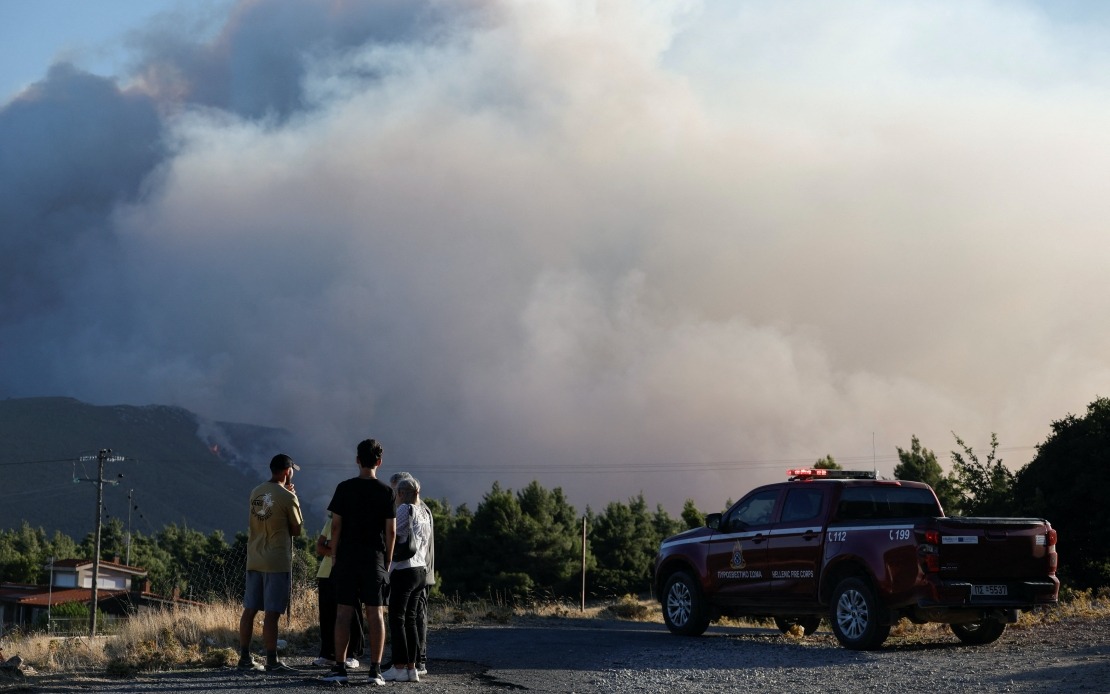
A sprawling wildfire continues to rage west of Athens as Greek emergency services intensify containment efforts across the Kithairon Mountains region. The conflagration has mobilised hundreds of personnel throughout the night, with military support, volunteer contingents, and substantial firefighting equipment positioned along the advancing fire lines. As Sunday morning broke, state authorities deployed firefighting aircraft and helicopter squadrons to resume aerial operations, signalling the scale of the crisis unfolding in one of Europe's most fire-prone summers.
The fire's trajectory eastward poses an immediate threat to the city of Megara, situated roughly 50 kilometres west of the Greek capital. Wind conditions have repeatedly accelerated flame spread across the rugged terrain, with the communities of Veniza and Psatha experiencing particularly severe devastation. Meteorological forecasters have flagged the unpredictable nature of winds in mountainous terrain as a complicating factor for ground crews attempting to establish defensive perimeters. The proximity of the fire to an urban centre of Megara's significance marks a critical juncture in the emergency response, forcing authorities to prepare evacuation protocols for surrounding neighbourhoods whilst simultaneously marshalling resources to prevent further eastward advancement.
The scale of international cooperation underscores the severity of the situation. At minimum, 500 firefighters have been positioned across active zones, with crews dispatched from Romania and France joining Greek personnel in coordinated suppression efforts. This multinational deployment reflects the broader Mediterranean crisis as southern European nations increasingly share resources during peak wildfire seasons. For Southeast Asian observers, the reliance on international mutual aid during natural disasters parallels regional cooperation mechanisms like ASEAN's disaster management protocols, highlighting how environmental emergencies transcend national boundaries and necessitate collaborative frameworks.
Authorities have already identified criminal negligence as a contributing factor, with 13 arrests made nationwide on charges of negligent arson. The arrest figures suggest that human carelessness, rather than purely climatic factors, bears responsibility for igniting at least some of the region's blazes. This pattern mirrors global wildfire trends where prevention education and enforcement of safety protocols can significantly reduce fire incidence, particularly during high-risk periods characterised by elevated temperatures and low moisture levels.
The crisis extends beyond the immediate Athens vicinity. A substantial fire continues consuming vegetation on the island of Cephalonia in the Ionian Sea, though state broadcaster ERT indicated that populated settlements have not yet faced direct threats. More encouragingly, wildfires ravaging the island of Crete appear to have moved into containment phases, with most flames extinguished following significant evacuations. Nevertheless, preliminary media reports indicate that as many as 200 residential structures on Crete were destroyed, though official confirmation of this casualty figure remains pending as authorities complete damage assessments.
The cumulative environmental toll remains staggering. Meteorological estimates suggest that approximately 10,000 hectares of land across the northwestern and western Athens region have been consumed by the current fire sequence. To contextualise this destruction, such acreage represents a substantial proportion of the agricultural and forested lands surrounding Greece's metropolitan heart. The loss of vegetation has cascading implications for local ecosystems, regional air quality, and long-term land recovery, particularly given climate change projections indicating intensified fire seasons across the Mediterranean basin.
For Malaysian and Southeast Asian policymakers, the Greek scenario presents instructive lessons regarding preparedness infrastructure and resource allocation during environmental crises. Greece's deployment of pre-positioned military assets, coordination mechanisms with neighbouring nations, and rapid aerial response capabilities demonstrate institutional responses to wildfire emergencies. The region's experience contrasts with variations in Southeast Asian wildfire management capacity, where transboundary haze from Indonesian peatland fires has historically challenged coordinated regional responses and exposed gaps in mutual aid frameworks.
Climate scientists have consistently warned that Mediterranean Europe faces accelerating fire seasons extending well into autumn months, driven by atmospheric warming and altered precipitation patterns. Greece's current emergency represents the visible manifestation of these trends, with summer conditions creating fuel loads and ignition probabilities unprecedented in historical records. The advancing flames near Megara exemplify the vulnerability of urban peripheries caught between expanding settlement patterns and increasingly volatile fire regimes.
Greek authorities face mounting pressure to prevent the fire's further eastward progression toward densely populated areas surrounding Athens. The combination of terrain challenges, wind unpredictability, and resource constraints typical of large-scale wildfire response creates an inherently uncertain operational environment. As evening approaches, weather pattern monitoring becomes critical to predicting whether conditions will favour firefighting operations or permit continued flame advancement. The outcome will likely determine whether additional evacuation orders become necessary and whether international assistance requirements increase beyond current deployments.

