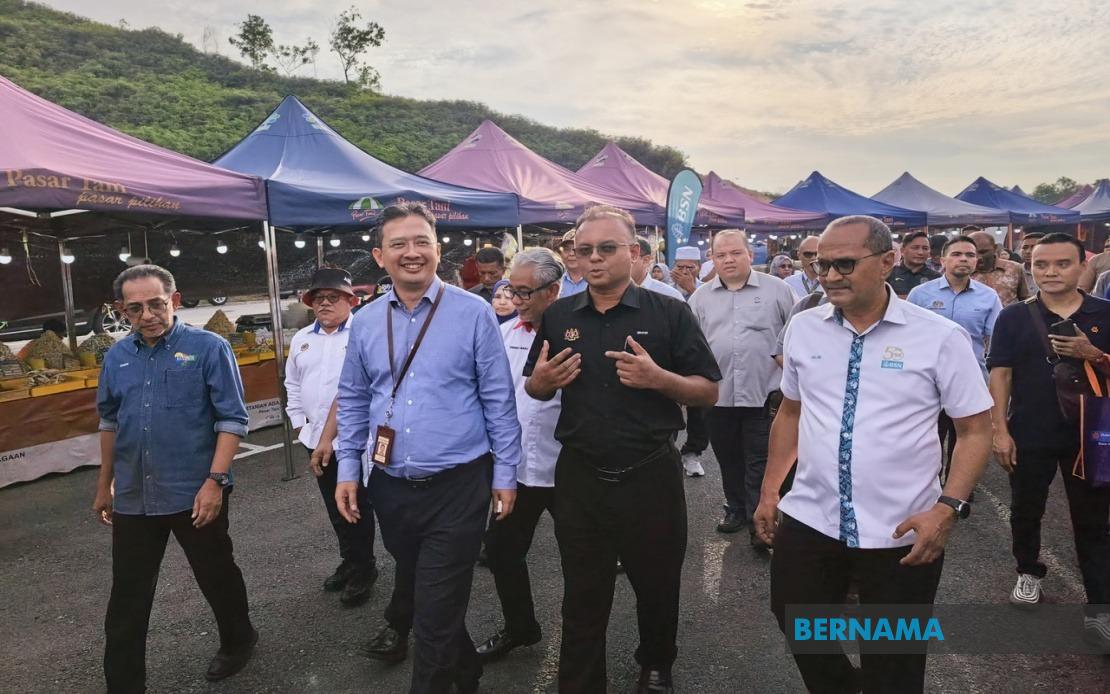
The Malaysian government is stepping up a coordinated campaign to ensure small entrepreneurs and traders across the country understand and access the full scope of micro-financing assistance on offer. Treasury Secretary-General Tan Sri Johan Mahmood Merican revealed that despite the availability of more than RM5 billion in micro-credit through various government-linked agencies, awareness gaps persist among eligible applicants. To address this shortfall, all participating agencies are now implementing ground-level engagement programmes designed to reach traders directly in their communities, rather than waiting for applicants to navigate bureaucratic channels.
The initiative encompasses several key financial institutions that collectively administer the micro-credit scheme. Agrobank, Bank Simpanan Nasional, Bank Rakyat, TEKUN Nasional, Amanah Ikhtiar Malaysia, and Majlis Amanah Rakyat together form the backbone of this financing ecosystem. The Prime Minister Datuk Seri Anwar Ibrahim had previously announced the availability of these funds as part of the government's commitment to supporting entrepreneurship and small business development at the grassroots level. However, the actual flow of capital to intended beneficiaries had not reached optimal levels, prompting the shift toward a more proactive community engagement strategy.
During a visit to Putrajaya Pasar Tani, Johan noted that direct engagement with traders revealed encouraging patterns. The vast majority of market operators whom officials met had already accessed government financing at some point, with several having benefited from multiple rounds of assistance. This feedback suggests that the government's financing infrastructure, once accessed, delivers meaningful impact on business operations and sustainability. The challenge, therefore, centres not on the quality or utility of the financial products themselves, but rather on the visibility and accessibility of information reaching potential borrowers in the first instance.
Agrobank's participation in the farmers' market engagement series has yielded measurable results that demonstrate demand for simplified, accessible financing. The bank has processed more than 160 applications since launching its market-level outreach, representing approximately RM6.4 million in micro-financing commitments. This figure is particularly significant because it emerged from a single series of ground-level visits, suggesting that widespread awareness campaigns could unlock substantially greater capital deployment across the broader small business sector. The response rates indicate that traders are highly receptive to financing opportunities when presented in accessible, non-intimidating settings that align with their regular activities and schedules.
Agrobank President and Chief Executive Officer Datuk Tengku Ahmad Badli Shah Raja Hussin emphasised that the bank's shift toward on-site engagement at farmers' markets serves a strategic purpose beyond simple application processing. By stationing staff directly within market environments, the institution can offer real-time consultation that addresses traders' specific circumstances and constraints. This proximity enables clearer explanations of eligibility criteria, repayment terms, and the range of complementary services available alongside basic financing. The direct feedback mechanism also allows Agrobank to refine its product offerings based on demonstrated needs rather than operating from assumptions about what small traders require.
Beyond pure credit provision, the government's micro-financing approach increasingly incorporates broader business support services that enhance long-term sustainability. Traders accessing government micro-credit now gain access to financial advisory services, takaful protection schemes, business digitalisation support, and financial literacy programmes. These supplementary offerings address a fundamental challenge in micro-enterprise development: many small operators lack formal business training and risk management practices that enhance survival rates and profitability. By bundling comprehensive support with financing, the government attempts to move beyond simple capital provision toward integrated enterprise strengthening.
The farmers' market initiative also reflects broader concerns about cost-of-living pressures affecting Malaysian consumers. The Ministry of Agriculture and Food Security has reinforced its monitoring capacity through the SISDA portal operated by the Federal Agricultural Marketing Authority, which provides real-time tracking of food and agricultural product price movements. This system functions as an early warning mechanism enabling authorities to identify emerging price anomalies and intervene through supply management before sharp spikes reach consumers. The public can themselves access this portal to monitor price trends and understand market dynamics, creating transparency that counterbalances information asymmetries between wholesalers and retailers.
For Malaysian traders and small entrepreneurs, these coordinated initiatives address multiple economic pressures simultaneously. Access to simplified micro-credit reduces reliance on predatory informal lending channels that impose exploitative interest rates. Enhanced business support services increase operational efficiency and competitiveness. Real-time market price monitoring helps traders understand supply conditions and make informed purchasing decisions. When viewed together, these programmes represent an attempt to strengthen the entire ecosystem supporting grassroots economic activity, rather than addressing financing gaps in isolation.
The ground-level engagement strategy also carries implications for Southeast Asia's broader financial inclusion agenda. Malaysia's approach demonstrates that awareness and accessibility barriers often pose greater obstacles to development finance utilisation than the absolute availability of capital. By replicating the farmers' market model across diverse trader communities, the government can systematically identify and address specific barriers facing different business segments. The model's emphasis on direct engagement, bundled support services, and responsive feedback mechanisms offers a template that other regional economies might adapt to their own contexts and institutional frameworks.

