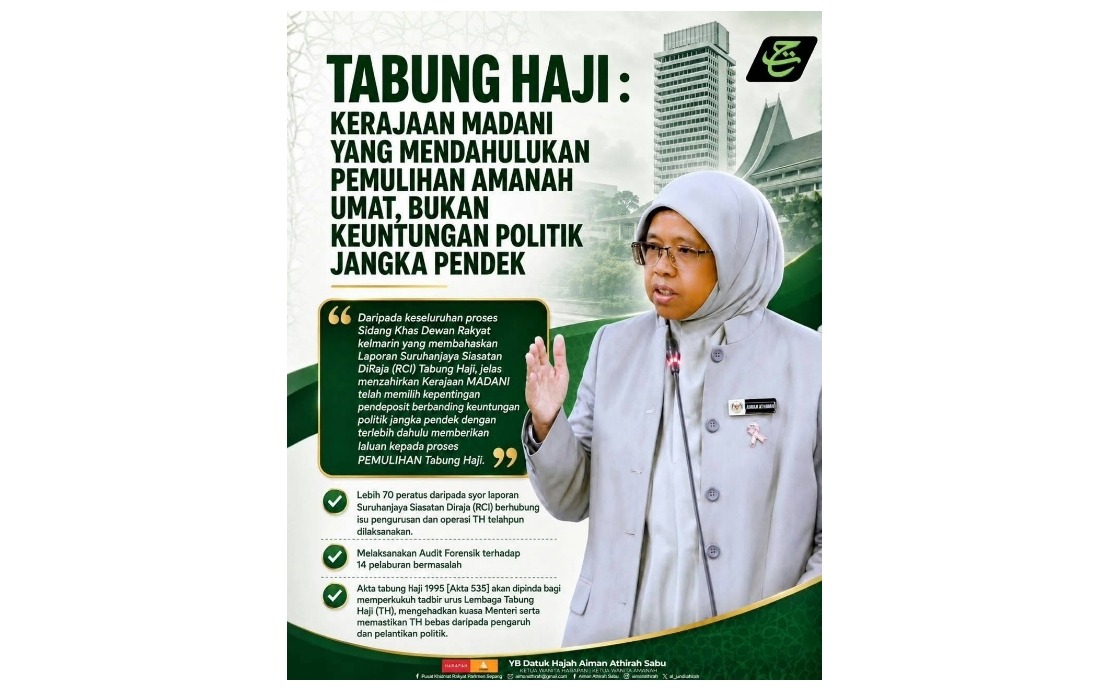
The Malaysian government is prioritising the financial security of Tabung Haji's depositors over short-term political advantage by adopting a cautious strategy towards the release of the Lembaga Tabung Haji (TH) Royal Commission of Inquiry findings, according to Datuk Aiman Athirah Sabu, Deputy Minister of Housing and Local Government. Her remarks come amid mounting pressure from some opposition quarters, including PAS and Parti Wawasan Negara, to disclose the RCI report more rapidly, with critics questioning the government's timing and motives in handling this sensitive matter.
Aiman Athirah's statement underscores a fundamental tension in Malaysian governance: the need to address institutional failures while maintaining public confidence in critical financial systems. Tabung Haji, which serves as the primary savings vehicle for millions of Muslim Malaysians accumulating funds for the hajj pilgrimage, operates at the intersection of religious duty and financial stability. With over 10 million depositors relying on the institution, any precipitous action could trigger the kind of mass withdrawal crisis the country experienced in 2018, when more than RM6 billion was withdrawn following revelations of governance deficiencies. This historical precedent shapes the government's current approach and reflects hard lessons about institutional vulnerability.
The deputy minister argued that hasty disclosure of the RCI findings without proper mitigation measures could undermine confidence in an institution that represents both accumulated savings and spiritual aspiration for millions of Muslims seeking to fulfil the fifth pillar of Islam. She characterised the government's strategy not as political manoeuvring but as prudent stewardship of a systemically important financial institution. This framing challenges the narrative pushed by certain political actors who suggest the government is hiding unfavourable findings or playing politics with the timeline. Instead, Aiman Athirah positioned the measured disclosure as evidence of responsible governance that places institutional stability above partisan advantage.
The controversy centres on the scale of Tabung Haji's historical investment failures, which were partially revealed during a special Dewan Rakyat sitting. Second Finance Minister Datuk Seri Amir Hamzah Azizan disclosed that fourteen troubled investments resulted in nearly RM13 billion in cumulative losses, with seven investments suffering complete loss of capital. The government bore RM10.2 billion of this burden through a rescue mechanism involving Urusharta Jamaah Sdn Bhd in 2018, while Tabung Haji itself recorded RM2.6 billion in impairment losses between 2018 and 2025 on remaining investments. These figures demonstrate the magnitude of institutional distress that demanded government intervention and explain the complexity of managing public disclosure without triggering renewed panic.
Aiman Athirah welcomed the intervention of His Majesty Sultan Ibrahim, King of Malaysia, whose statement characterised the governance shortcomings as serious rather than routine management lapses. Royal endorsement for thorough investigation provided political cover for the government's cautious approach while signalling that the matter warranted comprehensive remedial action rather than superficial gestures. She also highlighted remarks by Minister in the Prime Minister's Department (Religious Affairs) Dr Zulkifli Hasan during the parliamentary sitting, noting that more than 70 per cent of RCI recommendations had already been implemented, suggesting the government was not merely procrastinating but actively executing reform measures.
The government has demonstrated tangible recovery indicators that Aiman Athirah presented as evidence of stabilisation. Tabung Haji's investment income reached RM4.64 billion in 2025, representing record performance, while the profit distribution rate expanded from 1.25 per cent in 2018 to 3.5 per cent in 2025. Simultaneously, the haj pilgrimage cost has been maintained at RM33,000 across three consecutive seasons despite inflationary pressures on operational expenses, suggesting management has achieved efficiency gains. These metrics indicate that the institution is moving beyond crisis mode towards sustainable recovery, potentially creating a more stable foundation for fuller disclosure of the RCI findings.
Critical to the government's rehabilitation strategy is planned legislative reform of the Tabung Haji Act 1995. Proposed amendments aim to strengthen governance frameworks, curtail ministerial discretionary power over institutional decisions, and insulate Tabung Haji from political appointments and influence. This structural reform addresses root causes of the institutional failures rather than merely treating symptoms, suggesting the government recognises that governance weaknesses enabled the investment debacles. By coupling disclosure strategy with substantive legislative and operational reforms, the administration attempts to demonstrate that accountability and remedy accompany transparency.
Aiman Athirah directly confronted political opponents, characterising their criticism as rhetorical rather than substantive and their parliamentary walkout during the special sitting as irresponsible. Her rebuke reflects frustration with what the government views as opportunistic politicisation of a complex institutional matter. The opposition's demand for immediate, unfiltered disclosure may resonate with depositors anxious about their savings, but the government argues that such pressure disregards the practical consequences of destabilising a foundational financial institution. This clash reveals divergent philosophies about transparency and governance: one prioritising rapid disclosure as a democratic principle, the other emphasising institutional stability as a precondition for meaningful public confidence.
For Malaysian depositors and the broader Muslim community, the government's position presents a delicate balance between acknowledging institutional failures and maintaining confidence that Tabung Haji remains a secure repository for savings dedicated to religious observance. The scale of past losses—nearly RM13 billion across fourteen investments—necessitates demonstrating that governance safeguards have genuinely been strengthened rather than merely adjusted. The government's strategy effectively converts the disclosure question from a political event into a process: reforms precede revelations, creating conditions where the institution can absorb public disclosure without experiencing renewed instability.
The approach also carries implications for broader public sector governance in Malaysia, where numerous state-linked enterprises have faced scrutiny over investment decisions and governance quality. By managing Tabung Haji's disclosure carefully rather than releasing findings catastrophically, the government establishes a precedent that transparency can be balanced with systemic stability considerations. However, this precedent risks legitimising indefinite delays if depositors perceive that disclosed information remains incomplete or that the government continues withholding findings that would justify more urgent institutional interventions. The government's credibility depends on demonstrating that deliberation reflects genuine reform progress rather than political calculation.
Looking ahead, the full release of the RCI report will inevitably expose details of past decision-making failures, potentially implicating former officials and government figures. Aiman Athirah's framing suggests the government expects critical findings but has constructed conditions—through reforms, financial recovery indicators, and governance changes—where such revelations can be absorbed without institutional collapse. Whether depositors and political critics accept this rationale likely depends on whether subsequent data and regulatory changes substantiate claims of genuine institutional rehabilitation. The government's position essentially argues that accountability and transparency serve different purposes; immediate disclosure without remediation would satisfy one while undermining the other.

