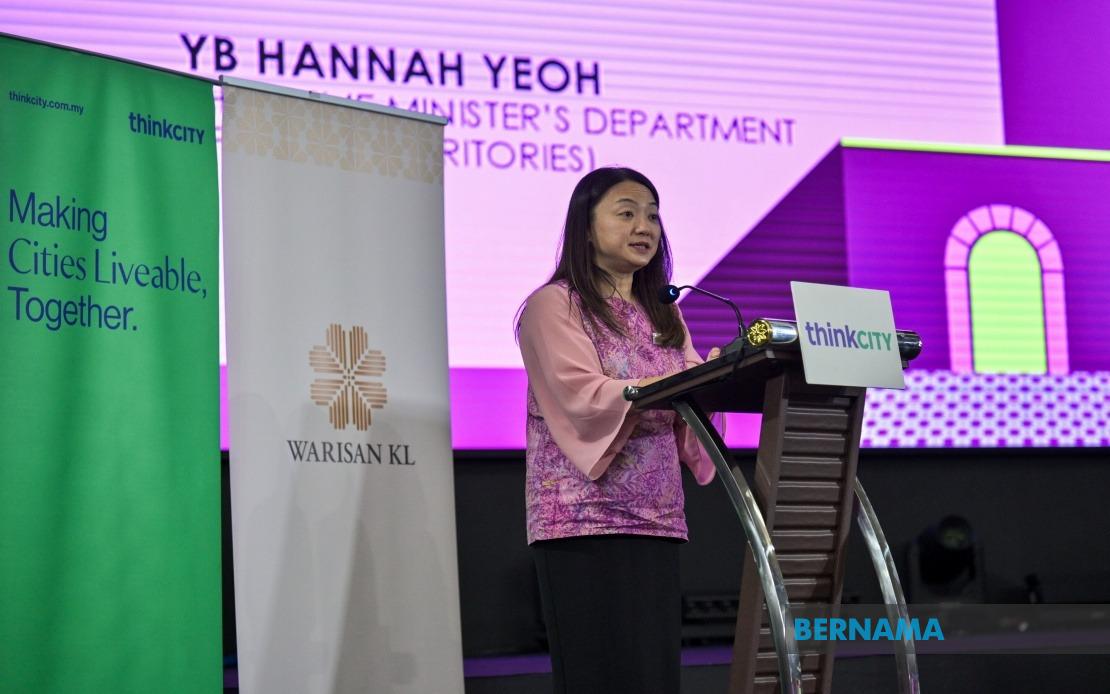
The federal government has committed RM1 million towards preserving Kuala Lumpur's heritage and revitalising its city centre through the Downtown Kuala Lumpur Grants Programme 2026, marking a strategic push to position culture and arts as economic drivers in the nation's capital. Minister in the Prime Minister's Department (Federal Territories) Hannah Yeoh announced the initiative, emphasising that the fund represents a deliberate investment in transforming downtown KL into a thriving cultural and economic hub that retains and attracts residents, investors and visitors alike.
The grants scheme operates on a tiered structure, distributing funds between RM30,000 and RM100,000 per approved project to eligible applicants including community organisations, local entrepreneurs and creative practitioners. This financial framework suggests the government intends to support ventures ranging from modest grassroots initiatives to more substantial heritage restoration efforts, creating diverse pathways for stakeholders to participate in the rejuvenation agenda. The relatively accessible entry point of RM30,000 could enable smaller creative enterprises and non-profits to access capital that might otherwise be unavailable through conventional lending channels.
Yeoh's framing of Kuala Lumpur's identity as simultaneously honouring its past whilst writing its future reflects a contemporary approach to urban governance that resists the false choice between heritage conservation and modernisation. She articulated this vision by noting that the city's success should be gauged not merely by construction activity or skyline additions, but by whether Kuala Lumpur remains an attractive destination for living, working and investing. This philosophy addresses a long-standing tension in Southeast Asian urban development, where rapid modernisation has occasionally come at the cost of cultural erosion and historical authenticity.
The programme derives funding from the Ministry of Finance and positions culture, arts and heritage as fundamental components of Malaysia's domestic economic strategy rather than peripheral amenities. This reframing gains particular significance given Kuala Lumpur's recent designation as a UNESCO Creative City, a credential that carries both symbolic weight and practical implications for tourism positioning and international cultural exchange. The minister stressed that this recognition transcends mere preservation nostalgia, instead anchoring cultural investment to tangible economic outcomes including employment creation, visitor attraction and economic resilience.
Hannah Yeoh's emphasis on transforming Kuala Lumpur City Hall (DBKL) into a facilitator rather than an obstruction represents an implicit acknowledgment of bureaucratic friction that stakeholders have historically encountered. Her determination to reshape DBKL's institutional image suggests awareness that grants programmes succeed only when implementation mechanisms are streamlined and user-friendly. This operational transformation may prove as important as the financial allocation itself, as complex application processes and lengthy approval timelines often deter otherwise qualified applicants from pursuing available funding.
Think City, the strategic implementation partner, will manage programme coordination and shortly announce detailed eligibility criteria. This delegation to a specialised partner organisation signals a professionalised approach to fund administration and suggests the government anticipates substantial application volumes. Think City's involvement also implies integration with existing urban revitalisation networks and existing ecosystem of heritage practitioners and development specialists operating in Malaysia's capital.
The timing of this initiative reflects broader Southeast Asian patterns of urban renewal, where second and third-tier cities alongside regional capitals are increasingly weaponising cultural identity and creative industries to compete economically. Kuala Lumpur's case is particularly instructive because it operates within a mature metropolitan economy where heritage preservation competes with competing land uses and development pressures. The RM1 million allocation, whilst meaningful, must be contextualised against Kuala Lumpur's total municipal budget and real estate values, suggesting the programme functions more as a catalyst and signal of government priority than a comprehensive solution to downtown revitalisation challenges.
For Malaysian entrepreneurs and creative practitioners, particularly those operating in heritage restoration, cultural programming, and community-based initiatives, the grants opportunity addresses genuine funding gaps. Creative industries in Malaysia have historically relied on personal financing or corporate sponsorship, making government-backed grants programmes relatively novel. This initiative could stimulate innovation in how cultural assets are monetised and could develop sustainable business models for heritage-based enterprises.
The programme's success will depend substantially on implementation quality and the breadth of eligible project categories. Narrowly defined criteria might exclude innovative approaches to heritage activation, whilst excessively loose standards could result in funds dispersing without generating measurable urban revitalisation outcomes. The government's decision to welcome applications broadly whilst pledging to announce criteria through Think City suggests confidence that well-designed selection mechanisms can balance accessibility with quality assurance.
For regional observers, Malaysia's approach demonstrates how federal systems can coordinate heritage preservation with economic development objectives. The programme integrates federal finance, municipal governance and specialist implementation partners into a coherent institutional structure, potentially offering a replicable model for other Southeast Asian cities navigating similar tensions between growth and conservation.
The initiative also addresses demographic concerns specific to Malaysian urban development, where downtown areas occasionally experience population decline as residents migrate to peripheral developments. By investing in heritage and cultural vitality, the government signals that central locations retain strategic value and that revitalisation can occur through cultural and community-centred rather than purely physical development paradigms.
Looking forward, this programme's impact will extend beyond immediate grant recipients to shape how Kuala Lumpur positions itself within regional urban hierarchies and how Malaysian policymakers conceptualise the relationship between heritage, culture and economic growth. If successfully implemented, it may prompt similar initiatives in other Malaysian cities and influence how Southeast Asian governments approach downtown revitalisation in an increasingly competitive regional environment.

