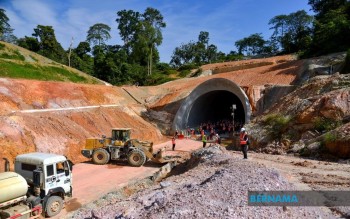
The Malaysian government has committed RM207.2 million towards transforming the Pasir Puteh parliamentary constituency in Kelantan through an ambitious slate of 46 approved projects slated for 2026. This substantial investment reflects a deliberate strategy to harness the region's strategic positioning along the East Coast Rail Link, positioning the area as a competitive logistics and industrial hub for the northern East Coast. Deputy Economy Minister Datuk Mohd Shahar Abdullah disclosed the allocation during parliamentary proceedings, emphasising that the initiative extends beyond conventional infrastructure spending to encompass integrated economic development anchored on regional comparative advantages.
The portfolio of projects centres on land preparation and foundational infrastructure development within the Pasir Puteh downstream industrial zone, designed to complement operational capacity at the nearby ECRL cargo station. Rather than pursuing generic development, planners have adopted a comprehensive blueprint through the ECRL Integrated Land Use Master Plan, which designates the Pasir Puteh station as a dual-function facility serving both passenger and freight logistics operations. This integrated planning methodology reflects lessons drawn from successful port-rail synergies elsewhere in Southeast Asia, where coordinated land-use strategies have catalysed sustained regional growth and attracted multinational supply chain operations.
The geographical advantages underpinning this development strategy are significant. Pasir Puteh's proximity to the Tok Bali Supply Base creates a compelling value proposition for logistics operators seeking to consolidate operations across maritime and rail networks. Deputy Minister Mohd Shahar articulated this explicitly, noting that the convergence of rail infrastructure and port facilities positions the constituency to function as a distribution nexus capable of attracting manufacturing and warehousing investment. For Malaysian policymakers, this represents a critical opportunity to redirect economic activity towards Kelantan, historically among Malaysia's lower-income states, by leveraging hard infrastructure investments that have already been committed through the ECRL project.
The employment generation potential attached to these projects carries particular significance for Kelantan's labour market. The Deputy Minister emphasised that downstream industrial clusters typically generate substantial direct and indirect employment across warehousing, logistics coordination, light manufacturing, and specialist services sectors. Beyond headline job creation figures, such hubs typically command higher wages than agriculture or traditional sectors, potentially improving household incomes across the Pasir Puteh constituency. For stakeholders in the region, this represents a concrete pathway towards economic diversification away from dependence on commodity agriculture and seasonal tourism activity.
The policy framework underpinning these investments emerges from Malaysia's 13th Malaysia Plan, spanning 2026 to 2030, which explicitly prioritises place-based development tailored to each locality's inherent economic strengths. Deputy Minister Mohd Shahar articulated this philosophy during parliamentary questioning, explaining that the government's approach diverges from one-size-fits-all infrastructure deployment. Instead, authorities assess regional comparative advantages—whether logistics, tourism, manufacturing, or agriculture—and channel development resources accordingly. This targeted methodology should theoretically improve return on public investment by concentrating spending where market fundamentals already favour economic activity.
The Pasir Puteh initiative also illustrates how the government intends to leverage the ECRL, a major infrastructure investment that has faced scrutiny regarding its profitability and regional impact distribution. By deliberately cultivating industrial clusters around ECRL stations, policymakers seek to justify the railway's existence through demonstrable employment creation and private sector investment attraction. For other constituencies and states reviewing ECRL-adjacent opportunities, the Pasir Puteh model provides a template for state-level stakeholders negotiating with federal authorities regarding complementary development funding. Kelantan's government has evidently secured substantive support for downstream activities, suggesting that proactive engagement with federal planning machinery can yield tangible resource commitments.
Implementation governance will proceed through the MyRMK system, an integrated monitoring platform that tracks project progress and facilitates parliamentary oversight. Deputy Minister Mohd Shahar confirmed that spending will commence during the current fiscal year and extend through 2030, aligning implementation timelines with the 13th Malaysia Plan's duration. This phased rollout allows for iterative adjustment based on early-stage outcomes, though it also introduces execution risk should project delays occur. For Malaysian observers accustomed to infrastructure project slippages, the emphasis on systematic monitoring represents a welcome safeguard, though parliamentary reporting mechanisms will ultimately determine whether progress meets official timelines.
The regional implications extend beyond Pasir Puteh itself. Kelantan's development has long presented challenges for federal policymakers, encompassing political complexities alongside genuine economic constraints. This RM207.2 million commitment signals renewed federal engagement with Kelantan's development trajectory, potentially setting precedent for similar investments in other constituencies where ECRL infrastructure intersects with underdeveloped hinterlands. For states along the ECRL corridor—spanning Selangor, Pahang, Terengganu, and Kelantan—the Pasir Puteh precedent suggests that constituencies able to articulate coherent development strategies aligned with rail infrastructure capacity may access enhanced federal funding.
The emphasis on logistics and supply chain infrastructure also reflects broader Malaysian economic positioning within global trading networks. Southeast Asian e-commerce and manufacturing sectors increasingly require distributed logistics networks capable of handling both maritime and rail freight. By developing Pasir Puteh as a multimodal hub, Malaysia enhances its competitive standing relative to Thailand and Vietnam in attracting regional distribution operations. For multinational enterprises evaluating East Coast locations, Pasir Puteh's emerging infrastructure portfolio strengthens Malaysia's value proposition, particularly for companies servicing Southeast Asian markets through integrated logistics strategies.
Private sector participation will ultimately determine whether these public investments catalyse sustained economic growth. The government's role extends to infrastructure provision and regulatory facilitation, yet industrial cluster development fundamentally depends on private enterprises identifying genuine business opportunities. Deputy Minister Mohd Shahar referenced the potential to attract investment, implicitly acknowledging that infrastructure alone proves insufficient without corresponding private sector confidence. For businesses considering operations in Pasir Puteh, the government commitment signals long-term policy stability and infrastructure development, reducing investment uncertainty that might otherwise deter operations in historically peripheral constituencies.
Looking forward, the Pasir Puteh initiative exemplifies how major infrastructure projects like the ECRL can be operationalised through integrated land-use planning and complementary industrial development. The 46-project portfolio spanning RM207.2 million represents genuine commitment, though success ultimately hinges on implementation quality and private sector responsiveness. For Malaysian constituencies beyond Pasir Puteh, the model offers lessons regarding how federal resources might be mobilised around existing infrastructure assets, potentially accelerating regional development while improving returns on major capital investments. The coming five years will clarify whether Pasir Puteh emerges as a functional logistics hub or whether implementation challenges constrain realisation of these ambitious development objectives.

