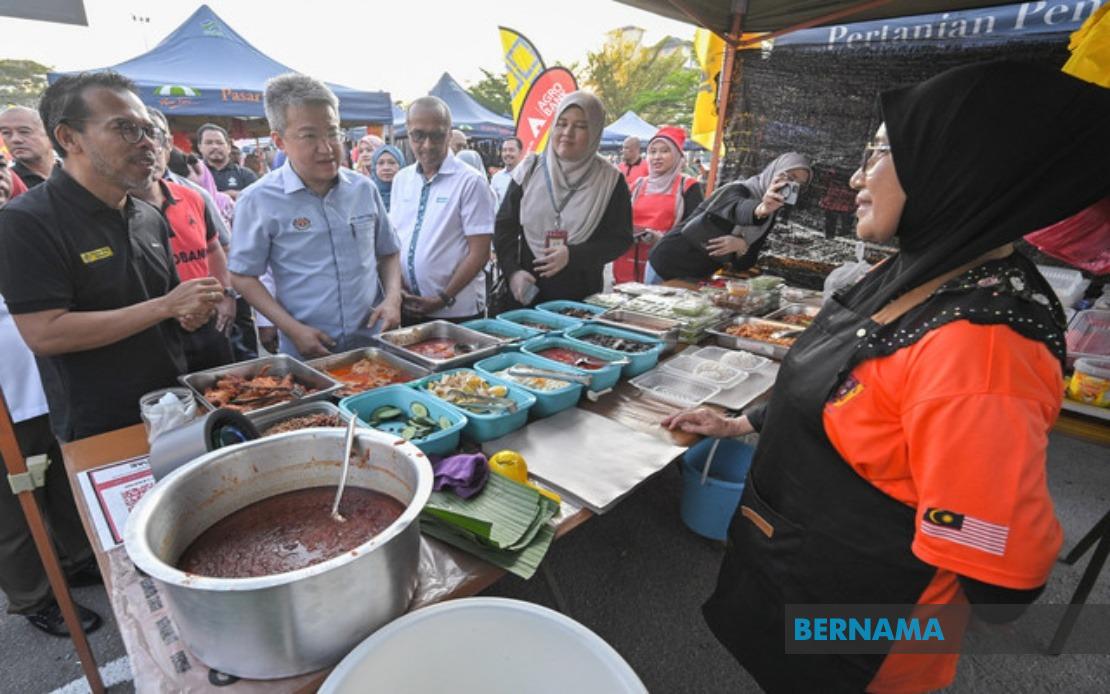
The Malaysian government is mobilising RM9.8 billion in microfinancing capacity through six major financial and government institutions to ensure hawkers and small traders can access affordable credit without barriers. Deputy Finance Minister Liew Chin Tong announced the initiative while visiting the Dataran Puchong Permai Farmers' Market on June 21, emphasising that the substantial allocation reflects the administration's commitment to preventing marginalised business owners from being excluded from capital support schemes essential for sustainable growth.
The initiative addresses a persistent challenge in Malaysia's economic ecosystem: many informal and semi-formal traders operate with minimal access to formal banking services, forcing them to rely on high-cost informal lending or friends and family for business expansion. By channelling government resources through established microfinance organisations, policymakers aim to democratise credit access and create pathways for thousands of small operators to formalise and scale their enterprises. This approach recognises that hawkers and petty traders, while economically vital to neighbourhood vitality and employment, have traditionally fallen through gaps in conventional banking criteria that demand collateral and formal documentation.
The "Mikro Kredit Turun Padang" programme exemplifies a ground-up governance strategy where financial agencies and government bodies establish temporary credit facilities at farmers' markets and community gathering points. Rather than requiring applicants to navigate bureaucratic channels in distant offices, the scheme brings processing capacity directly to traders. The Puchong edition represents the fourth such deployment, following earlier activations at Taman Melawati, Kelana Jaya, and Bandar Tasik Permaisuri farmers' markets. Early results suggest traction: twelve applicants at the Puchong market have already received financing approvals, with seven secured through Amanah Ikhtiar Malaysia (AIM), three via Bank Simpanan Nasional (BSN), and two from Agrobank.
The six institutions anchoring this effort bring complementary strengths to the ecosystem. Bank Simpanan Nasional and Agrobank contribute mainstream banking infrastructure and retail deposit bases. Bank Rakyat, the cooperative lending arm, brings experience in rural and informal sector lending. TEKUN Nasional specialises in entrepreneurship financing for bumiputera enterprises. Amanah Ikhtiar Malaysia operates as a dedicated poverty-alleviation microfinance provider with deep grassroots networks. The Companies Commission of Malaysia streamlines business registration and formalisation processes. This diversified consortium prevents any single institution from becoming a bottleneck and allows traders to find products matching their specific circumstances and business structures.
For Malaysian small traders, the timing of this initiative coincides with broader economic pressures. Inflation, rising rental costs, and post-pandemic disruptions have squeezed margins for hawkers and market vendors already operating on thin profitability. Access to working capital at reasonable interest rates can mean the difference between business viability and failure. The government's direct engagement with grassroots traders signals recognition that top-down fiscal policy alone cannot reach those operating informally or in cash-based economies. By gathering direct feedback at market-level engagement events, the Finance Ministry commits to incorporating trader perspectives into budget formulation cycles, ensuring policy responds to lived experience rather than aggregate statistics.
Liew Chin Tong indicated that intelligence gathered from these field visits will be consolidated and presented to the Prime Minister during annual budget deliberations. This feedback loop institutionalises trader voices within Malaysia's highest policy-making apparatus. When hawkers report specific obstacles—whether excessive documentation requirements, collateral demands that exclude asset-poor operators, or processing timelines misaligned with seasonal business needs—these insights can be converted into targeted adjustments. The commitment to elevate grassroots concerns to cabinet-level consideration reflects understanding that microfinance expansion requires not just capital infusion but structural reforms addressing how credit institutions interact with informal economies.
Regionally, Malaysia's microfinance expansion compares with similar initiatives across Southeast Asia. Thailand, Vietnam, and Indonesia operate dedicated microfinance programmes, yet implementation varies considerably in reach and inclusivity. Malaysia's approach of coordinating multiple institutions around unified field operations offers efficiency gains over fragmented institutional approaches. However, success ultimately depends on achieving scale—the current RM9.8 billion must be rapidly deployed to demonstrable effect, with application approval rates and loan performance metrics becoming critical indicators of programme health. If transaction costs or approval timelines remain prohibitive, well-intentioned capital allocations may sit unutilised while traders continue relying on costlier alternatives.
A central tension exists between financial sustainability and inclusion objectives. Microfinance institutions globally struggle balancing poverty-alleviation missions with operational viability; extending credit to traders with volatile incomes and limited collateral carries genuine default risks. Malaysia's multi-institution approach allows risk diversification, but participating lenders must be confident that government backing—whether implicit or explicit—protects them from losses that could discourage future participation. Transparency about loss-absorption mechanisms and loan-loss reserve provisioning becomes essential for maintaining institutional confidence and ensuring the programme survives beyond initial enthusiasm phases.
The hawker and small-trader segment represents enormous untapped productive potential within Malaysia's economy. Unlike capital-intensive manufacturing or technology sectors, microenterprises can be scaled through distributed lending without requiring massive infrastructure investment. Yet the current allocation, while substantial, must be assessed against total market demand. Malaysia has hundreds of thousands of active hawkers and small traders; early approvals at single farmers' markets suggest significant latent demand exists. The government faces pressure to transparently report actual disbursement rates, average loan sizes, sector breakdown, and geographical distribution to demonstrate whether the programme genuinely reaches underserved populations or concentrates benefits among marginal cases with higher approval odds.
Moving forward, sustainability requires moving beyond one-off visits to establish permanent, accessible infrastructure. Converting temporary "Turun Padang" activations into permanent local credit service points—perhaps embedded within existing community associations or business premises—would reduce transaction costs for repeat borrowers and build relationships facilitating loan monitoring and renewal. Training traders in basic financial literacy and business record-keeping could simultaneously improve loan performance and enable borrowers to graduate toward larger loan amounts and conventional banking relationships, creating exit pathways as businesses mature.
The RM9.8 billion initiative ultimately represents a significant statement of intent from Malaysia's government: small traders matter economically and deserve policy attention. Implementation rigour will determine whether this commitment translates into tangible expansion of credit access or becomes another programme that announces ambitions exceeding delivery. Early indicators from farmers' markets are encouraging, but systematic monitoring and adaptive management—responding to implementation challenges with policy adjustments rather than rhetorical persistence—will separate genuinely transformative microfinance expansion from symbolic gestures. For Malaysia's trading communities, the next months will prove whether this programme materially changes their economic prospects.

