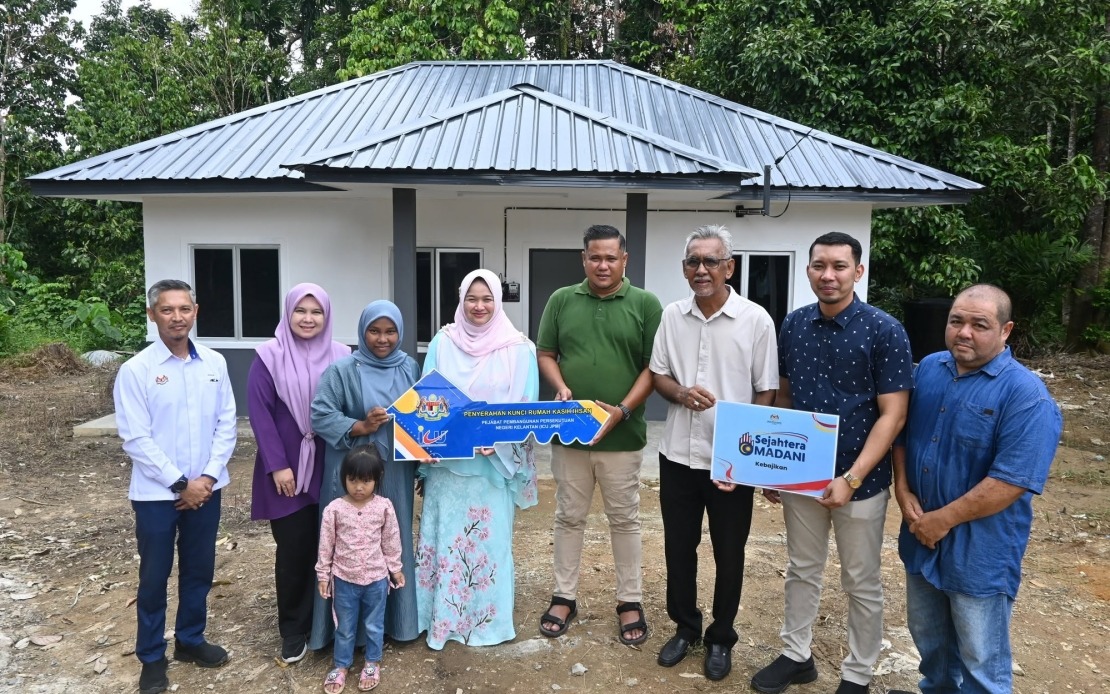
Prime Minister Datuk Seri Anwar Ibrahim's administration has deepened its commitment to residential welfare by distributing Rumah Kasih Ihsan homes to vulnerable families in Jeli, Kelantan, marking another milestone in the government's nationwide push to elevate living standards among economically disadvantaged communities. The handovers, facilitated through the Kelantan Implementation Coordination Unit (ICU) operating under the Prime Minister's Department (JPM), represent part of a coordinated strategy to address housing deficits in states where infrastructure challenges and poverty remain persistent barriers to dignified living.
The distribution ceremony, overseen by Dr Wan Nur Ibtisam Wan Ismail, the director of Kelantan ICU JPM, involved two households receiving tangible support through the government's housing initiative. Yusof Mohamed Nawawi of Kampung Renyut became the recipient of a letter of acceptance for the construction of an entirely new residential structure, providing him with the opportunity to transition from inadequate housing to a purpose-built, structurally sound dwelling. This arrangement offers not merely a replacement building but represents a deliberate intervention designed to eliminate the health, safety, and dignity risks associated with substandard accommodation.
The second beneficiary, Shamsul Bahri Che Musa, received full possession of a completed house that had been constructed as part of the same programme, allowing him immediate access to improved living conditions without further delay. Complementing the physical transfer of properties, both recipients were presented with food baskets, a gesture underscoring the government's holistic approach to welfare that extends beyond mere structural improvements to encompassing immediate material support. This layered assistance reflects recognition that housing insecurity often coincides with food insecurity and other dimensions of poverty.
The PMX Coordination Team, which orchestrated these handovers, operates as part of a broader institutional framework designed to accelerate the translation of government policy into tangible community outcomes. The involvement of multiple coordinating bodies signals the complexity of delivering housing solutions across Malaysia's diverse geographic and administrative landscape, where local knowledge, federal resources, and implementation capacity must converge effectively. The Kelantan ICU, as a dedicated unit within JPM, exemplifies how administrative restructuring can enhance programme delivery by embedding coordination functions directly within state-level governance structures.
Beyond the immediate beneficiaries, the Rumah Kasih Ihsan programme carries significant implications for how Malaysia approaches social welfare amid broader economic pressures. Housing security remains foundational to human development outcomes, influencing educational attainment, health status, employment stability, and social cohesion. When families exist in precarious living conditions—vulnerable to flooding, structural collapse, or disease transmission—their capacity to pursue economic mobility and contribute productively to their communities becomes severely constrained. The government's targeting of such households represents an acknowledgment that market-driven development alone cannot address housing poverty affecting Malaysia's most marginalised segments.
The philosophical framing offered by Kelantan ICU JPM—that meaningful development must be gauged by the direct benefit experienced by ordinary citizens rather than merely by aggregate economic indicators—resonates with broader global conversations about inclusive growth. This perspective directly challenges purely technocratic approaches to development that prioritise GDP growth or infrastructure completion metrics without examining whether such progress translates into improved human welfare. In the Malaysian context, where regional disparities between urban and rural areas, and between developed and underdeveloped states, remain pronounced, this welfare-centred framework becomes particularly pertinent.
The emphasis on housing as a foundation for dignity and hope rather than merely as shelter addresses the psychological and social dimensions of poverty that often receive insufficient policy attention. A secure home provides not only protection from the elements but also a stable base from which individuals and families can negotiate education, employment, healthcare, and social services. When households lack such stability, the cascading disadvantages—irregular school attendance, difficulty maintaining employment, inability to access credit or public services—compound across generations. The Rumah Kasih Ihsan initiative, by prioritising the provision of safe dwellings, interrupts these cycles by providing the prerequisite conditions for broader social participation.
Kelantan's selection as a focus area for this programme reflects the state's well-documented housing challenges, particularly in rural districts where infrastructure investment has historically lagged behind urban centres. Jeli specifically has faced periodic flooding and significant poverty incidence, making it a logical priority for targeted housing interventions. By concentrating resources on clearly-identified vulnerable populations in specific geographic areas, the government can achieve demonstration effects—visible improvements that build confidence in programme efficacy and create templates for replication in other disadvantaged regions.
The provision of acceptance letters for new construction, as distinct from handing over completed units, suggests a pipeline of ongoing development that extends beyond the immediate distribution event. This approach allows beneficiaries to participate in or at least anticipate the building process, potentially creating employment opportunities within local communities and ensuring that housing solutions remain contextually appropriate to local building practices and environmental conditions. When housing programmes are transparently implemented with community involvement, they generate trust and social capital that amplifies their developmental impact.
For Malaysian policymakers and regional observers, the Rumah Kasih Ihsan model offers insights into how targeted welfare programmes can be integrated into broader governance structures without creating parallel or redundant bureaucracies. The embedding of ICU functions within JPM itself, rather than creating standalone agencies, reflects institutional efficiency while maintaining political accountability through the Prime Minister's office. Such organisational choices significantly influence whether welfare programmes remain marginal policy initiatives or become embedded within central governance priorities.
Moving forward, the scale and sustainability of such housing initiatives will significantly shape Malaysia's trajectory in reducing poverty and regional inequality. While individual handovers generate positive media attention and tangible benefits for recipients, maintaining momentum across multiple states and ensuring quality construction standards require sustained funding, skilled workforce capacity, and robust monitoring mechanisms. The success of future phases will depend on whether the government can expand beneficiary numbers without compromising construction quality or implementation fidelity, challenges that have confronted similar large-scale housing programmes globally.
The Rumah Kasih Ihsan distribution in Jeli ultimately exemplifies how housing security functions as both an immediate welfare intervention and a long-term investment in human capital development. By providing families with safe, dignified accommodation, the government creates conditions through which individuals can more effectively pursue education, employment, and social advancement. As Malaysia continues navigating post-pandemic economic recovery while addressing persistent structural inequalities, programmes that directly address basic human needs remain essential complements to broader macroeconomic and sectoral policies. The visible commitment to improving living conditions in districts like Jeli signals that inclusive growth remains a stated policy objective, even as implementation challenges persist.

