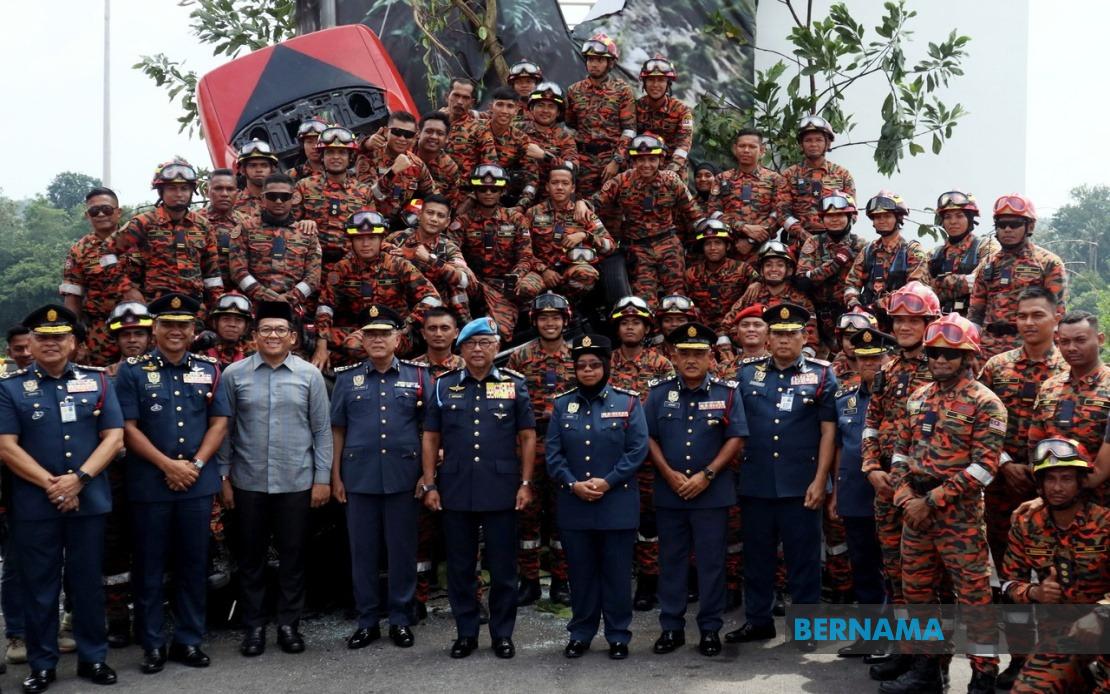
The Federal Government has committed RM278.9 million annually to advance the operational capacity of the Malaysian Fire and Rescue Department (JBPM), channeling the funds into a comprehensive portfolio of 86 development initiatives spread across the country. The spending plan, articulated under the First Rolling Plan of the 13th Malaysia Plan (13MP), represents a significant investment in emergency services infrastructure and reflects the government's recognition that fire and rescue capabilities form a critical pillar of public safety provision.
Housing and Local Government Deputy Minister Datuk Aiman Athirah Sabu disclosed the funding details during the inauguration of the Sungai Lembing Fire and Rescue Station (BBP) in Pahang, emphasizing that the allocation encompasses both foundational expansion and sustained development work. Of the 86 projects now underway, 27 constitute entirely new ventures while 59 represent continuations of earlier initiatives. This composition suggests a deliberate strategy balancing infrastructure creation with the consolidation of existing facilities, ensuring both geographical reach and operational excellence.
Pahang state has emerged as a focal point for JBPM development activity, with seven substantial facility projects currently in various stages of completion spanning both the 12th Malaysia Plan and the initial rolling phase of 13MP. The portfolio includes the acquisition and outfitting of the Gohtong Jaya station premises alongside its residential quarters, erection of the Benta facility, and the comprehensive development of Tioman's operational base. Simultaneously, established stations in Bentong and Kuantan are undergoing significant upgrades, while the Triang facility is being reconstructed from the ground. These layered commitments indicate recognition that fire and rescue infrastructure requires both new construction and systematic enhancement of aging assets to maintain responsiveness standards.
The newly opened Sungai Lembing BBP represents the tangible outcome of this strategic commitment. Built at a cost of RM6 million on a seven-acre parcel, the facility marks Pahang's 29th dedicated fire and rescue station and became operationally active on February 15. The station's establishment responds to the safety requirements of approximately 15,000 residents within Sungai Lembing and neighbouring communities, addressing a service gap in an area whose infrastructure had not previously supported dedicated emergency response capacity. The location-specific investment demonstrates how the broader 13MP funding allocation translates into communities gaining faster emergency response times and more reliable life-saving services.
Deputy Minister Aiman Athirah articulated an expansive vision for how such facilities should function within their local contexts. Rather than viewing fire and rescue stations as purely operational hubs responding to emergencies, she positioned them as community anchors capable of delivering sustained educational and awareness programming. This framing suggests the government intends JBPM facilities to serve as one-stop centres imparting fire safety knowledge, rescue training, and life-saving skills to civilian populations. The approach reflects evolving international practice in emergency services, where community engagement and preventative education increasingly complement reactive response capacity.
The Deputy Economy Minister and Paya Besar Member of Parliament Datuk Mohd Shahar Abdullah contextualized the Sungai Lembing investment within the broader revitalization agenda for this heritage mining town. Sungai Lembing, historically significant as a tin-mining centre, is undergoing multifaceted development aimed at positioning it as a modern heritage destination. The fire and rescue station's establishment intersects with initiatives including the PCCL Cinema restoration, ecotourism product development, a planned digital museum, tunnel upgrades, and pursuit of UNESCO World Heritage Site designation. This layering of safety infrastructure with cultural tourism and economic revitalization illustrates how modern development planning integrates emergency preparedness into place-making strategies.
Mohd Shahar emphasized that heritage town aspirations cannot be realized without robust safety frameworks. His remarks tacitly acknowledged that prospective visitors, whether domestic or international tourists, make destination decisions partly on the basis of safety perceptions and actual emergency service availability. The fire and rescue facility thereby becomes not merely a public service asset but also economic infrastructure supporting tourism development and heritage preservation goals. This multidimensional perspective suggests government planners view emergency services expansion as integral to achieving broader developmental objectives beyond immediate life safety.
The Sungai Lembing facility's establishment also reflects responsiveness to directives from the Sultan of Pahang Al-Sultan Abdullah Ri'ayatuddin Al-Mustafa Billah Shah, indicating that state-level institutional authority influenced the project's realization. The involvement of Pahang Menteri Besar Datuk Seri Wan Rosdy Wan Ismail and State Legislative Assembly Speaker Datuk Seri Mohd Sharkar Shamsuddin in the opening ceremony underscores how emergency services expansion engages multiple levels of governance and demonstrates political consensus around investment priorities.
For Malaysian and Southeast Asian observers, the RM278.9 million commitment signals sustained governmental attention to public safety infrastructure at a time when rapid urbanization and economic development often outpace emergency services capacity. The 13MP's allocation to JBPM contrasts with historical patterns where fire and rescue services in developing contexts sometimes operate with inadequate resources and aging facilities. The scope of the investment—86 simultaneous projects with meaningful new construction—suggests the government recognizes that emergency services cannot lag behind broader development trajectories without creating unacceptable public safety risks.
The regional significance extends to how Malaysia's approach to emergency services integration with heritage tourism and community development may influence peer nations' strategic planning. Southeast Asian governments increasingly grapple with balancing rapid economic growth, tourism expansion, and public safety provision. Malaysia's deliberate coupling of fire and rescue facility development with heritage town revitalization and ecotourism initiatives offers a model where emergency services become visible components of destination branding and community resilience rather than purely bureaucratic functions. This positioning potentially elevates the perceived importance of firefighting and rescue services within broader development narratives.

