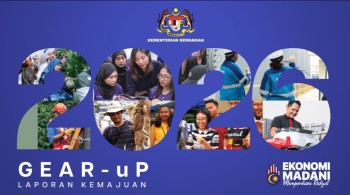
Malaysia's government-linked investment companies have dramatically accelerated their domestic capital deployment, channelling RM20.3 billion domestically in 2025—roughly triple the RM6.6 billion deployed in 2024—as the GEAR-uP initiative moves into its third year. This substantial increase signals a decisive shift in how Malaysia mobilises its sovereign wealth to drive economic transformation, with momentum expected to continue into the first quarter of 2026.
The Government-Linked Enterprises Activation and Reform Programme, launched in 2024 under the Ministry of Finance's stewardship, represents an ambitious five-year commitment to unlock RM120 billion in capital for socioeconomic development. Unlike passive investment strategies that generate returns divorced from broader national objectives, GEAR-uP explicitly channels wealth toward strategic economic goals. Prime Minister Datuk Seri Anwar Ibrahim, addressing the initiative's progress, framed this not merely as capital deployment but as national wealth mobilised with clear national purpose. He emphasised that whilst considerable progress has been made, the programme remains in relative infancy with significant work ahead.
The initiative is anchored by six heavyweight institutions controlling vast pools of Malaysian savings and investment capital: Khazanah Nasional Bhd, the Employees Provident Fund, Permodalan Nasional Bhd, Kumpulan Wang Persaraan (Diperbadankan), Lembaga Tabung Angkatan Tentera, and Lembaga Tabung Haji. Their coordinated action represents an unprecedented mobilisation of government-linked institutions toward integrated economic objectives, rather than siloed institutional mandates. This coordination addresses a longstanding challenge in Malaysian economic policy—ensuring that public capital works synergistically rather than competitively across institutional boundaries.
Amidst persistent global economic volatility, the programme reflects a deliberate strategic choice to invest in domestic stability and resilience. Rather than reacting defensively to external headwinds, Malaysia is leveraging its capital base to strengthen foundational capabilities and ensure economic gains reach ordinary citizens. The MADANI Economy framework underpins this approach, seeking to raise both the ceiling and floor of Malaysian prosperity simultaneously—a recognition that sustainable growth requires broad-based participation and opportunity distribution rather than concentration at the apex.
Concrete infrastructure investments demonstrate this philosophy in action. Google's Selangor data centre, backed by KWAP capital, will add 320 megawatts of capacity and generate an estimated 26,500 jobs through 2026 and 2027, whilst Empyreon Digital's phased Johor expansion follows. These projects exemplify how GEAR-uP bridges capital deployment with tangible employment creation and technological capability building. Similarly, Tenaga Nasional Bhd's grid investment—ascending from RM12 billion in 2025 toward RM15 billion by 2027—supports Malaysia's renewable energy transition targeting 70 per cent installed capacity by 2050, embedding climate commitments within economic development strategy.
Capital market development constitutes another pillar. GLIC-backed venture funds including Dana Impak, Dana Perintis, Dana Pemacu and Ekuinas systematically nurture companies through growth stages, whilst Khazanah's forthcoming Dana Ciptawan will inject RM200 million specifically for Bumiputera enterprises and mid-tier Malaysian firms. This ecosystem approach addresses a persistent Malaysian challenge: companies struggle transitioning from startup to scale-up phases, particularly when founders lack established networks or capital access. Government-linked companies themselves remain on track to achieve RM100 billion in additional market value by 2028, with the MY Value Up initiative extending comparable discipline and expectations across Malaysia's 88 largest listed companies. These cascading efforts aim to sustain the Capital Market Masterplan's ambitious target of RM5.8 to RM6.3 trillion in market capitalisation by 2030.
Building Bumiputera wealth represents a strategic focus reflecting historical economic imbalances. The programme targets ten company listings across 2026-2027, complemented by the 10 Bumiputera Champions Programme working to scale participating enterprises into larger players. Zakat Wakalah, the Islamic financial instrument channelling charitable resources toward entrepreneurship, is targeted to reach RM100 million by 2026, nearly quadrupling from RM28 million previously. These mechanisms address wealth creation and retention within communities historically underrepresented in Malaysia's corporate landscape, attempting to correct structural inequities through targeted capital provision and mentorship.
Transportation infrastructure undergoes parallel expansion. Malaysia Airports' five-year, RM11 billion upgrade programme targets expanded capacity at Kuala Lumpur International Airport toward over 100 million annual passengers, positioning the nation as a regional aviation hub. Such investments generate spillover benefits across hospitality, retail, and services sectors whilst enhancing Malaysia's attractiveness for regional and international business operations. Infrastructure modernisation of this scale typically accelerates productivity growth across dependent industries and improves competitiveness relative to neighbouring economies.
Finance Minister II Datuk Seri Amir Hamzah Azizan articulated GEAR-uP's underlying philosophy: capital should not merely transit through Malaysia but establish enduring capability and settlement. He noted that whilst 2025 saw deployment triple year-on-year and the GLIC portfolio achieved 8.0 per cent total shareholder returns, the programme's ultimate success metric extends beyond financial metrics. True measurement encompasses living wages adopted across portfolio companies, graduates placed in quality employment, Bumiputera enterprises achieving scale, and localised supply chains taking root. This reframing positions GEAR-uP as a vehicle for translating capital deployment into tangible improvements in employment quality, skills development, and wealth distribution.
The programme's design reflects lessons from Malaysia's 2023 reform efforts, which enabled the economy to weather subsequent external turbulence. Direction was established at GEAR-uP's 2024 inception; subsequent years have concentrated on disciplined execution. The next three years carry substantial implementation momentum, with most initiatives already operational and progressively reaching greater numbers of Malaysians. Government-linked institutions publicly committed to maintaining course, continuing deployment, and enabling what is being constructed to establish deep roots and flourish.
For Malaysian businesses and workers, GEAR-uP's expanded deployment carries meaningful implications. Enhanced capital availability for venture and growth-stage companies potentially widens entrepreneurial opportunity, particularly for Bumiputera founders. Infrastructure investments create employment across multiple tiers—from construction and engineering through operations and services. The emphasis on living wages and quality jobs addresses Malaysia's persistent challenge of wage stagnation relative to cost of living increases. Investors monitoring Malaysia's economic trajectory should note that government-linked capital is no longer peripheral to the economy but consciously positioned as a strategic lever driving industrial transformation, technological capability, and inclusive growth.
The fundamental question confronting GEAR-uP now is sustainability beyond government enthusiasm cycles and protection against institutional drift as initiatives mature. The programme's success hinges not merely on capital deployed but on whether the ecosystem it builds genuinely sustains competitive advantage, whether employment created persists, and whether wealth creation mechanisms benefit populations they target. These measurements will emerge over the next several years as the initial pipeline of investments mature and demonstrate whether GEAR-uP represents transformative economic engineering or substantially repackaged conventional development spending with updated terminology and coordination mechanisms.

