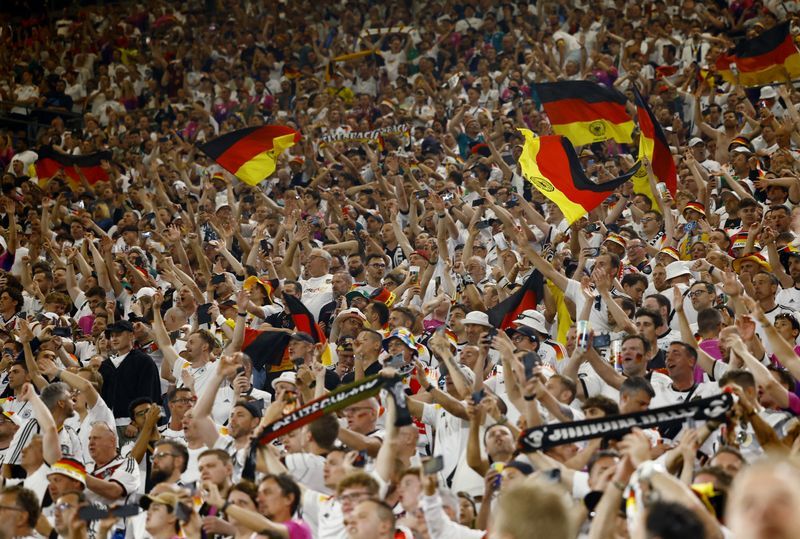
German law enforcement authorities have intensified scrutiny of ticket distribution practices surrounding last year's European Football Championship, conducting coordinated searches across multiple sites including the headquarters of the Deutsche Fußball-Bund (DFB), the national soccer association. The raids, executed on Wednesday, signal a serious investigation into what prosecutors allege were systematic breaches of ticketing protocols at the continental tournament, which took place across ten German cities.
According to reports from Bild newspaper, the investigation centres on the suspicious allocation of thousands of match tickets and hotel accommodations to select guests in the months before Euro 2024 commenced. Prosecutors from Bochum and the North Rhine-Westphalia state criminal office confirmed that searches were taking place at several locations throughout Germany, though their official statement made no direct reference to the DFB offices, leaving room for speculation about the full scope of the inquiry and which institutions remain under active investigation.
The case carries particular significance for German football governance, as it suggests potential corruption within the sporting establishment at a time when the nation had positioned itself as a host of a major European event. The allegations extend beyond simple administrative irregularities to encompass what appears to be a coordinated scheme of preferential ticket distribution, raising questions about transparency and integrity in how access to matches was controlled and granted.
Among those under investigation are both a German national and a French national, according to Bild's reporting. One suspect identified as a municipal employee based in Gelsenkirchen, which served as one of the tournament's host cities, allegedly received benefits totalling €2,400 ($2,736). These benefits reportedly included complimentary match tickets alongside subsidised accommodation and travel arrangements—a package that prosecutors contend was improperly furnished and circumvented standard allocation procedures.
The nature of these accusations highlights a broader vulnerability in major sporting events: the gap between official distribution channels and informal networks that can provide privileged access to scarce commodities like premium match seats. When thousands of tickets exist for a finite number of matches, the potential for favouritism and corrupt allocation becomes acute, particularly when officials responsible for ticketing maintain close proximity to political or municipal decision-makers.
For Malaysian and Southeast Asian observers, this case demonstrates that governance challenges affecting major tournaments are not confined to developing economies or regions with reputation for institutional weakness. Germany, regarded as a beacon of administrative efficiency and transparency, has nonetheless encountered serious accusations of systematic malfeasance in managing a flagship sporting event. This suggests that championship organisers everywhere must implement robust independent oversight mechanisms, regardless of the host nation's general reputation for integrity.
The investigation encompasses what prosecutors characterised as "unauthorised advantages, including attendance at an international football match," a formulation that suggests the inquiry may extend beyond simple ticketing to encompass broader hospitality provision. Hotel invitations and travel arrangements can carry substantial value, particularly for matches featuring prestigious teams or occurring in knockout stages, making such perquisites attractive incentives for corruption.
The timing of these raids, occurring in July 2024 while Euro 2024 had only recently concluded, indicates that investigative authorities moved with considerable speed upon receiving initial complaints or evidence of irregularity. This responsiveness contrasts sharply with some historical investigations into sporting events, where procedural delays have allowed potential suspects to establish alibis or witness memories to fade.
The DFB's initial silence on the matter left questions unanswered about the association's own role in the alleged infractions. Whether the organisation was merely a venue where searches occurred or whether officials within its structure face direct suspicion remained unclear from official statements. UEFA, the European football governing body that oversaw Euro 2024, similarly declined to comment, potentially suggesting that any investigation findings would require time to assess before public positioning could be determined.
For supporters of German football and policymakers assessing regulatory frameworks for future tournaments, this episode underscores the necessity of transparent ticket allocation systems with clear audit trails and independent verification. Major sporting events attract significant public interest and represent substantial financial investments by host nations, warranting protection through rigorous governance standards that apply uniformly to all stakeholders regardless of status or position.
The scandal's emergence also reflects the increasing sophistication of investigative journalism and law enforcement in identifying financial improprieties that might previously have escaped detection. Digital transaction records, hotel booking systems, and travel documentation create comprehensive evidence trails that contemporary authorities can pursue methodically, making large-scale corrupt schemes substantially more difficult to execute undetected than in earlier eras.

