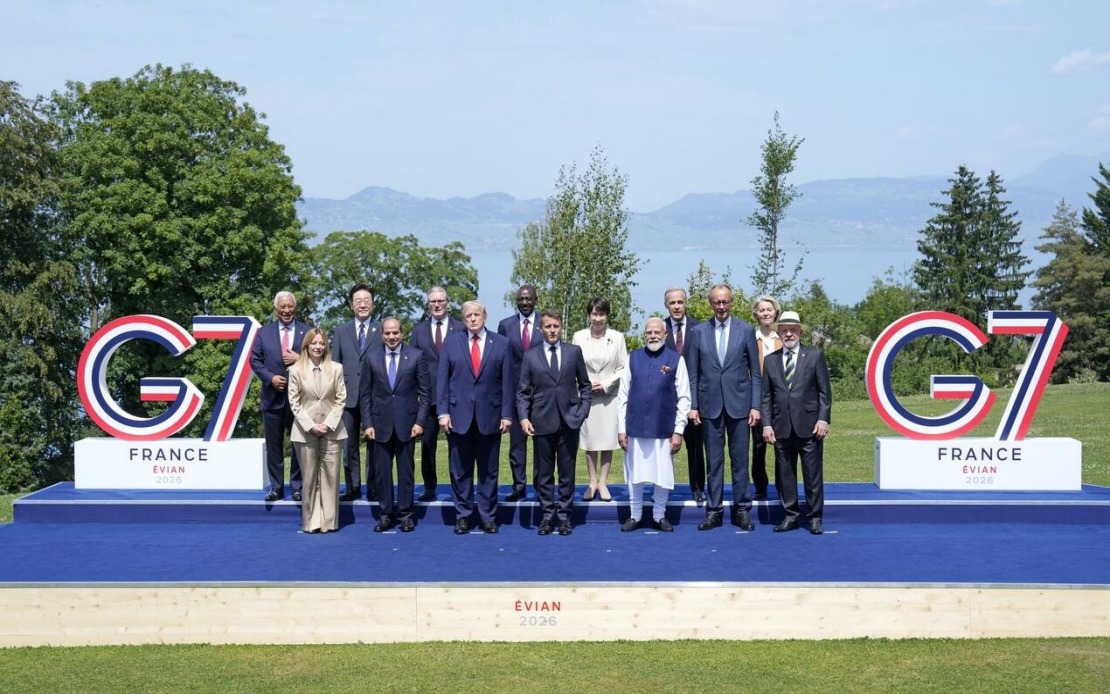
The world's leading industrialised democracies have reaffirmed their commitment to Ukraine's defence at their annual gathering in the French Alps, even as underlying disputes between Washington and its European allies threaten the traditionally harmonious tone of such gatherings. The summit in Evian-les-Bains, held on the shores of Lake Geneva near the Swiss border, produced explicit backing for sustained assistance to Kyiv alongside diplomatic overtures toward Moscow—a balancing act that underscores the competing impulses now defining Western strategy toward the ongoing conflict.
The convergence around Ukraine support proved noteworthy precisely because it transcended the widening fissures between the United States and European powers on multiple fronts. Trade disputes, disagreements over NATO contributions, and divergent approaches to geopolitical flashpoints have created tension within the alliance. Yet on this particular question, the seven nations—Britain, Canada, France, Germany, Italy, Japan and the United States, along with the European Union—found sufficient common ground to voice unified determination. According to Japanese officials present at the session, participants committed to pursuing a "just and lasting peace" through maintained pressure on the Kremlin, demonstrating that consensus remained possible despite the fractured nature of contemporary great-power relations.
Ukrainian President Volodymyr Zelenskyy's direct participation in the discussions proved instrumental in shaping the G7's approach. Speaking directly to the assembled leaders, Zelenskyy outlined his country's current battlefield position and strategic priorities, including the urgent need to strengthen air defences against Russian aerial bombardment. In subsequent social media commentary, Zelenskyy emphasised the dual track of his engagement strategy: simultaneously expanding military cooperation with European partners while advancing diplomatic channels toward ceasefire arrangements. This messaging reflected Kyiv's increasingly sophisticated understanding that Western support requires both visible military backing and credible peace-making initiatives to sustain public and political commitment over the long term.
Trump's public pronouncements during the summit represented a significant intervention in the discourse surrounding conflict resolution. The American president explicitly urged Russia to "make a deal," acknowledging the catastrophic human cost already exacted on both Ukrainian and Russian forces. His framing suggested a transactional approach: recognising mutual exhaustion as a potential catalyst for negotiation rather than waiting for a decisive military outcome. Trump indicated willingness to employ economic instruments—specifically the potential reimposition of sanctions relief that had been extended in connection with recent Iran negotiations—as leverage to incentivise Russian movement toward the bargaining table.
The president's reference to simultaneous diplomatic initiatives with Iran revealed his administration's broader strategic vision. Trump suggested that his recent achievements in opening the Strait of Hormuz and achieving preliminary agreements on ending hostilities in West Asia had freed American diplomatic capacity and credibility to address the Ukraine question with renewed focus. This approach reflects a conception of global affairs as a series of interconnected negotiations where success in one domain might facilitate progress elsewhere, though European leaders have expressed concerns about whether such a "move to the next crisis" mentality adequately accounts for Ukraine's long-term security requirements.
Japanese Prime Minister Sanae Takaichi articulated a perspective that captured European anxieties about both Russia and the broader Asian security environment. Beyond advocating for continued pressure on Moscow to take "positive and concrete action," Takaichi raised alarm about expanding military coordination between Russia and North Korea, as well as deepening defence ties between Russia and China. These observations pointed toward a wider strategic recalibration wherein traditional Western concerns about European security have become entangled with concerns about Asian power balances. For Southeast Asian nations like Malaysia, this expanded frame carries particular significance, as any major power realignment involving China and Russia carries implications for regional stability and the balance of influence in the Indo-Pacific.
The summit's agenda extended beyond Ukraine to encompass the broader Middle Eastern conflict between Iran and Israeli forces. The G7 and invited representatives from Egypt, Qatar, and the United Arab Emirates engaged in detailed discussions about managing the consequences of the nearly four-month-old confrontation and its potential spillover effects. Leaders welcomed the preliminary American-Iranian agreement to reopen crucial shipping lanes and end active hostilities, though they emphasised the necessity of finalising comprehensive arrangements. Takaichi stressed the critical importance of maintaining free navigation through the Strait of Hormuz—a concern that resonates acutely in Southeast Asia, where oil and goods bound for regional markets transit global shipping chokepoints vulnerable to disruption.
A significant portion of the summit focused on restructuring international development finance, reflecting recognition among the world's wealthy nations that traditional overseas aid mechanisms have become inadequate for addressing poverty and infrastructure deficits in developing countries. France, holding the G7 presidency this year, championed a pivot toward what officials termed "mutually beneficial partnerships" that simultaneously advance the strategic interests of donor nations and recipient countries. This framework acknowledges that purely altruistic development assistance faces domestic political constraints in donor countries, while recipient nations increasingly demand arrangements that strengthen their own economic sovereignty rather than perpetuating dependency relationships.
The expansion of the summit to include leaders from Brazil, Egypt, India, Qatar, South Korea, and the United Arab Emirates represented an implicit acknowledgment that the G7's traditional monopoly on shaping global rules and institutions has eroded. By incorporating major emerging economies and key regional powers into discussions on Ukraine, West Asia, and development finance, the French organisers sought to build broader coalitions around specific outcomes rather than relying solely on the historical authority of the industrialised democracies. This inclusivity carries particular significance for Asian nations outside the summits, as it signals subtle shifts in how global governance conversations are being conducted.
The joint declaration on development finance reform emphasised mobilising private capital alongside public investment to address long-term infrastructure and economic needs in developing regions. This approach reflects frustration with the limitations of government-to-government aid flows and represents a recognition that achieving sustainable development requires market-based mechanisms aligned with commercial incentives. For Southeast Asian economies navigating between traditional Western partners and rising Chinese influence in infrastructure investment, this declaration suggests a renewed Western commitment to competitive engagement in regional development—though whether such commitments translate into concrete financing mechanisms competitive with Asian alternatives remains an open question.
The consensus on Ukraine achieved at Evian-les-Bains must be read against the backdrop of transatlantic tensions that have created genuine uncertainty about the durability of Western unity. Trump's rhetoric about Greenland, his past questioning of NATO's value, and his seemingly ad-hoc approach to alliance management have generated anxiety among European capitals about American staying power. The agreement on Ukraine support therefore represents a deliberate choice by American leadership to demonstrate commitment to traditional alliance partnerships, even while pushing for faster diplomatic resolution than some European leaders consider prudent. Whether this represents a sustained reorientation or a temporary convergence remains unclear.
For regional observers in Southeast Asia, the summit's outcomes carry implications extending beyond the immediate conflicts under discussion. The strengthening of G7-plus mechanisms, the emphasis on development finance reform, and the visible (if strained) persistence of Western coalition-building all affect the broader environment within which regional nations must position themselves. Malaysia and other ASEAN countries will likely find themselves courted by multiple great powers seeking support for competing visions of international order, development finance, and strategic alignment in the years ahead.