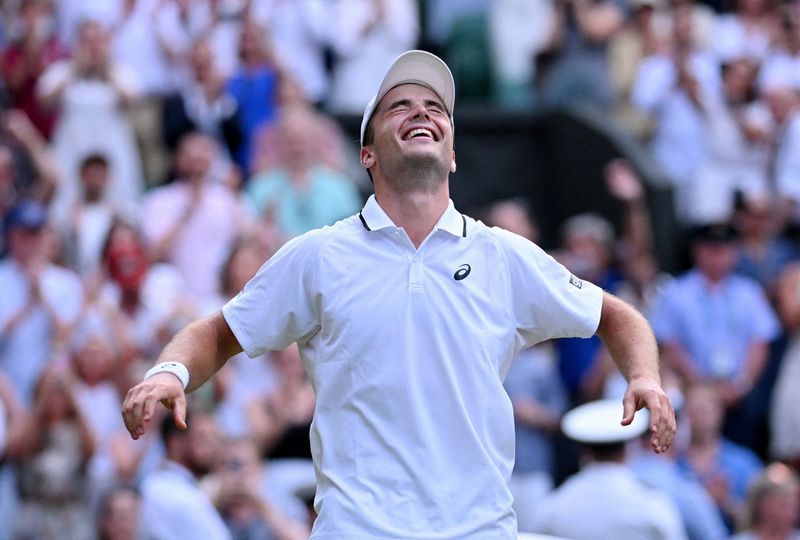
In a narrative so improbable it would strain credibility on screen, 23-year-old Arthur Fery has transformed his Wimbledon journey from the stuff of sporting fantasy into tangible reality. Growing up within sight of Centre Court, ranked a mere 114th in the world, and carrying the slim credentials of a wildcard with just two previous Grand Slam match victories to his name, the young Briton has already defied expectation by advancing to Friday's semi-final against Alexander Zverev, the second-seeded French Open champion. Should Fery prevail in that encounter, he would face an even more remarkable destiny: a final appearance on his 24th birthday with a genuine opportunity to replicate Goran Ivanisevic's singular achievement of claiming the Wimbledon singles title as a wildcard entry in 2001. His victory over ninth seed Flavio Cobolli on Wednesday—a commanding 6-4, 7-6(4), 6-0 performance on a sweltering Centre Court—established him as only the fifth British man in professional tennis history to reach a Wimbledon semi-final, a distinction that underscores both his personal triumph and the relative scarcity of such moments for British men's tennis.
The trajectory of Fery's tournament run has captured the imagination of the establishment in ways that transcend the typical sporting narrative. Queen Camilla watched from the Royal Box during his quarter-final dispatching of Cobolli, subsequently offering her congratulations at the match's conclusion. Earlier in the competition, Princess Kate provided courtside support during his victory against Otto Virtanen. Even Roger Federer, the eight-time Wimbledon champion whose legacy towers over the sport, registered his approval with a nod during Fery's thrilling five-set encounter against Grigor Dimitrov in the round of 16. When Fery reflected on his interaction with the Queen, he revealed a composed professionalism befitting someone far more accustomed to the pressures of elite tennis. "The queen, she was waiting for me at the end of the match. She congratulated me. I told her how much of an honour it was for me to play in front of her. She just said, 'Congratulations, keep going'," he recounted to reporters.
Against Cobolli, Fery presented a strikingly different figure from his physical dimensions might suggest. Standing merely 5 feet 9 inches, he competed with a presence suggesting considerably greater stature, executing returns from positions of seeming impossibility and constructing a defensive shield that appeared impenetrable as he channelled the crowd's energy into an almost suffocating tactical performance. His composed demeanor throughout the ordeal reflected an internal equilibrium that distinguishes genuinely prepared competitors from those merely swept along by circumstance. The explosive nature of his tennis on Wednesday—the precision of his groundstrokes, the intelligence of his court positioning, the mental resilience demonstrated across three sets—provided substantive evidence that this run represents something more than fortunate bracket luck or opportunistic pathways.
Fery's measured responses to the inevitable barrage of media questioning reveal an athlete consciously managing the psychological dimensions of sudden prominence. While observers eager for hyperbolic soundbites might have expected effusive declarations or breathless proclamations of disbelief, Fery instead offered pragmatic assessments of his circumstances. "It's good that I don't have two weeks before my next match. They keep coming fast. So that's good," he observed, articulating a preference for the momentum-sustaining nature of rapid fixtures over the paralysing effects of extended preparation periods. His reference to remaining "in my bubble and just carrying on" demonstrates a deliberate psychological strategy: maintaining focus on immediate competition rather than permitting the weight of accumulated achievement to disturb tactical concentration. This disciplined mindset likely reflects the influence of his unconventional career pathway, one that prioritised structured development over premature professional commitment.
Fery's educational trajectory distinguished him from the typical professional tennis circuit trajectory. Rather than pursuing the customary path of childhood tournaments leading directly into adult competition, he opted for the American university route, studying science, technology and society at Stanford University while simultaneously developing his competitive capacities. His emergence as the top-ranked collegiate player in the United States demonstrated that elite tennis development need not follow the established European model of early specialisation and constant tournament exposure. This alternative pathway cultivated not merely technical proficiency but also the intellectual and psychological infrastructure that appears to underpin his present composure when confronted with unprecedented circumstances. The deliberation inherent in choosing Stanford rather than the grinding junior circuit suggests parents and player alike possessed the perspective necessary to prioritise long-term development over short-term competitive gratification.
Amidst the broader context of British tennis' recent troubles at the Championships, Fery's emergence has acquired symbolic significance beyond his individual performance. The home nation's contingent entered the tournament in disarray, with 15 of its 19 singles competitors eliminated during the opening round—a disheartening attrition rate reflecting the challenging circumstances facing British tennis development in recent years. Into this void of national disappointment has stepped Fery, the unlikely standard-bearer now shouldering expectations that previously seemed dispersed across a wider cohort of performers. His status as the sole remaining British representative in the latter stages of the competition has transformed him, despite his relatively low ranking, into the focal point of national sporting attention. This concentration of expectation, rather than diminishing his performance, appears to have energised his competitive instincts.
The French sporting authorities may harbour certain regrets regarding Fery's current allegiance, given his biographical origins and family connections to French tennis traditions. Born in Sevres, the Parisian suburb proximate to Roland Garros, Fery inherited decidedly French credentials through both parental lineage: his father Loic operates as a multi-millionaire hedge fund manager with ownership of French football club Lorient, whilst his mother Olivia competed as a professional player. During his junior competitive years, Fery briefly represented France, establishing technical eligibility for that federation. Yet the question of national allegiance resolved itself with remarkable clarity in Fery's own estimation. His childhood relocation to London, attendance at King's College in Wimbledon, progression through the British tennis development system, and residential establishment all contributed to a sense of belonging sufficiently robust that he described the decision regarding national representation as one requiring "no decision to make."
Fery's father, speaking to the French sports daily L'Equipe, articulated the family's understanding of his son's authentic connection to British identity and specifically to Wimbledon as a place of formation. "He's a true Wimbledon boy," Loic Fery observed. "It's like someone who grew up in Boulogne playing at Roland Garros. He went to school five minutes from here. He's always lived here." This characterisation captures an essential distinction: while genetic and genealogical connections to France remain indisputable, Fery's formative experiences, educational institutions, residential geography, and cultural socialisation all anchored him firmly within British tennis culture and specifically within the Wimbledon community. The contrast drawn with a hypothetical Boulogne-based player competing at Roland Garros elegantly illustrates the difference between ancestral heritage and authentic belonging born from lived experience.
As Fery contemplates his encounter with Zverev, he confronts a considerably more formidable examination than the serviceable but ultimately overpowered Cobolli presented. Zverev's ranking, experience, and accomplishments—most notably his French Open title—establish him within an entirely different stratum of competitive capability. The step up in quality will test whether Fery's recent performances represent the emergence of a genuinely elite competitor capable of sustaining performance across multiple rounds against top-tier opponents, or whether they constitute an extended purple patch facilitated by favourable circumstances and lower-ranked opposition. Nevertheless, the psychological infrastructure Fery has constructed throughout his journey—the studied calmness, the resistance to emotional overwhelm, the maintenance of focus amid unprecedented acclaim—suggests he approaches this examination with the mental resources necessary to compete with genuine efficacy.
The broader implications of Fery's run extend beyond individual accomplishment to encompass questions about British tennis' future trajectory and the efficacy of alternative developmental pathways. His success challenges certain orthodoxies about optimal preparation for elite competition, demonstrating that unconventional routes through American universities need not disadvantage aspirants relative to those pursuing continuous tournament exposure from adolescence. For Malaysian tennis observers and Southeast Asian competitors more broadly, Fery's example offers instructive perspectives on how disciplined developmental frameworks, parental guidance emphasising long-term perspective, and intellectual cultivation alongside athletic development can produce competitors capable of contending at sport's highest levels. The prospect of an improbable Wimbledon triumph, though Friday's semi-final presents daunting obstacles, would constitute a remarkable vindication of his chosen path and potentially inspire reconsideration of conventional wisdom regarding professional tennis preparation and development methodologies.

