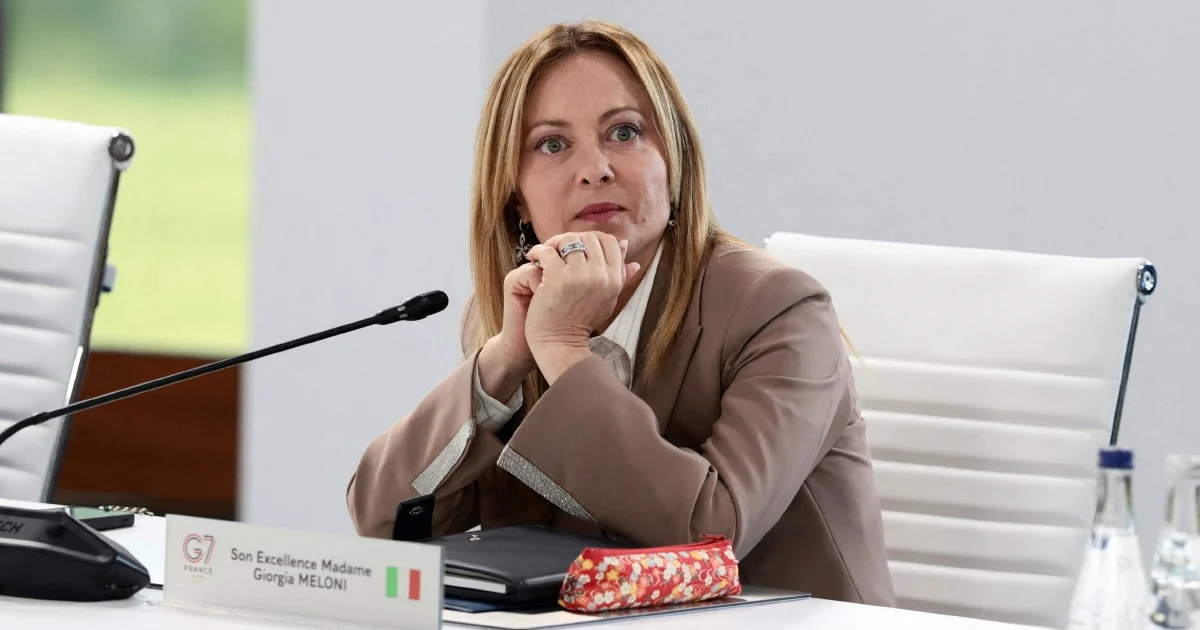
When Donald Trump was sworn in for his second term as United States president in 2025, Italian Prime Minister Giorgia Meloni stood apart from her European counterparts, enjoying the singular honour of an invitation to the presidential inauguration in Washington. That gesture seemed to signal the arrival of a new chapter in transatlantic relations, one in which Rome would occupy a uniquely favourable position in the Trump administration's foreign policy architecture. Few analysts anticipated that the relationship would unravel so swiftly, or that Meloni would emerge as one of the American president's most pointed critics within just months.
Meloni's initial proximity to Trump appeared to reflect a natural ideological alignment. Both leaders represented a nationalist strain within their respective political systems, sceptical of multilateral frameworks that they viewed as constraining national sovereignty. The Italian premier's conservative coalition government had itself broken with the liberal consensus that dominated much of Western European politics, positioning her as a kindred spirit to the American president's populist agenda. Her presence at Trump's inauguration symbolised this connection and suggested Rome might leverage special access to American policymaking to advance its interests within both Europe and the Mediterranean region.
The foundation for this relationship seemed solid on issues ranging from immigration policy to scepticism toward international institutions. Meloni had built her political career challenging the European Union's immigration directives and defending Italian sovereignty against what she characterized as unwarranted Brussels intrusion. Trump's America First philosophy and his administration's moves to withdraw from international commitments appeared complementary to these priorities. European observers noted that Italy, long regarded as a secondary player in transatlantic relations, could finally punch above its weight through this connection.
However, the honeymoon period proved extraordinarily brief. Disagreements emerged rapidly on multiple fronts, exposing the shallow foundation upon which the relationship had been constructed. Trump's approach to global trade policy, particularly his imposition of tariffs and his treatment of allied nations, soon created friction between Washington and Rome. Italy's economy, heavily dependent on export markets within Europe and globally, faced potential disruption from American protectionist measures that paid little regard to traditional alliance structures.
Meloni's public criticism of Trump represents a fundamental recalibration of Italian foreign policy within a matter of months. The Italian leader has spoken out forcefully on issues where the American president's positions contradict European interests and values. This shift reflects both pragmatic calculations about Italy's economic welfare and a broader reassessment of what alignment with Trump actually delivers for European nations. Unlike some European leaders who maintained low profiles or cautious statements, Meloni chose a more direct confrontational approach.
The transformation is particularly significant because it undermines a central premise of Trump's return to office: that he could rebuild the Western alliance through bilateral relationships with like-minded nationalist leaders. If a prime minister who received special treatment and a coveted inauguration invitation now finds herself in public disagreement with the president, the entire strategy appears vulnerable. It suggests that ideological affinity and nationalist credentials prove insufficient glue for sustained alliance cohesion when fundamental economic interests diverge.
For Malaysia and other Southeast Asian nations, Meloni's pivot carries important lessons about engaging with American administrations focused on unpredictable, personalised diplomacy. The assumption that bilateral access translates into policy influence often proves erroneous when structural economic conflicts exist. European leaders are discovering that Trump's transactional approach to international relations means that special access cannot substitute for clear-eyed assessment of where divergences will inevitably emerge.
The timing and nature of Meloni's criticism also reflects growing European recognition that America under Trump cannot be relied upon to uphold traditional multilateral commitments. Rather than attempt to preserve transatlantic unity through accommodation and silence, she has chosen to voice disagreement publicly, positioning Italy as defending European interests. This represents a subtle but significant recalibration toward European solidarity, even as her government remains ideologically distinct from many continental partners.
Italian observers note that Meloni faces domestic political pressure to demonstrate that she is protecting national interests against American overreach. Italian voters, particularly those in industrial and manufacturing sectors vulnerable to trade disruption, expect their government to push back against policies perceived as damaging to the national economy. The shift from Trump confidante to Trump critic thus serves legitimate domestic political functions beyond questions of transatlantic relations.
Looking forward, Meloni's transformation suggests that the Trump administration's strategy of building alliances through bilateral relationships with nationalist leaders may prove unstable. When economic interests collide with ideological affinity, governments typically prioritise the former. This dynamic could reshape European-American relations throughout Trump's second term, potentially pushing even traditionally aligned leaders toward defending their regional bloc's interests more assertively.
The evolution of Meloni's stance also demonstrates that European leaders, despite their divisions and weakness relative to Washington, retain capacity to publicly challenge American policies when stakes are sufficiently high. Whether this translates into coordinated European resistance or remains limited to individual national statements will substantially influence the broader trajectory of transatlantic relations and the formation of international coalitions on critical issues ranging from trade to security.

