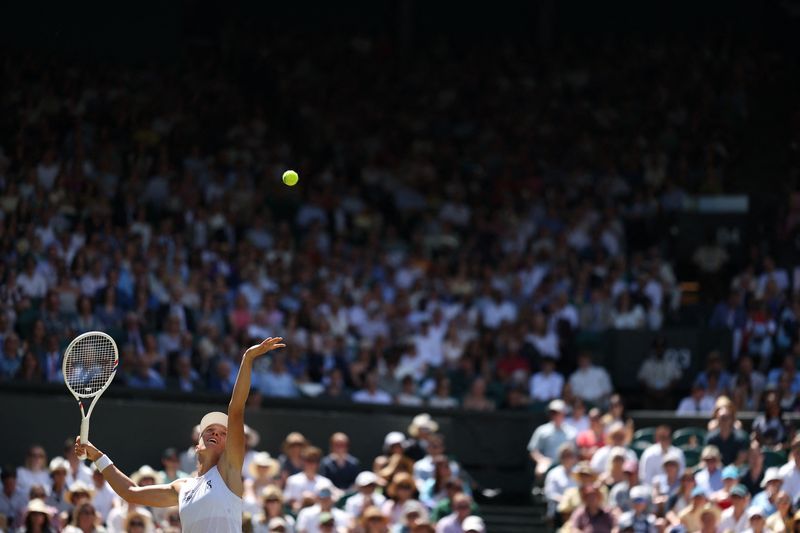
Alexandra Eala has delivered one of the most significant results of her young career, eliminating defending champion Iga Swiatek in a thrilling Centre Court encounter at Wimbledon on Saturday. The rising Filipino player claimed a 7-6(9) 6-2 victory in the third round, sending the Polish third seed tumbling out of the tournament in dramatic fashion and propelling herself into the second week of a Grand Slam for the first time.
Swiatek arrived at the All England Club with questions swirling about her form and consistency. Although her 2023 Wimbledon triumph resolved long-standing doubts about her ability to compete effectively on grass—traditionally her weakest surface—the 25-year-old had stumbled during the build-up, suffering an early exit at Bad Homburg. Her path through the draw had steadied with impressive victories over Taylor Townsend and Karolina Pliskova, yet she would face a formidable opponent in Eala, whose baseline aggression and all-court improvement have made her an increasingly dangerous competitor at the highest level.
The opening set unfolded as a captivating display of power tennis, with neither player yielding ground easily. Eala's left-handed baseline shot-making proved particularly effective in testing Swiatek, and the tension built as the set reached a tiebreaker. The champion was visibly frustrated during changeovers, gesturing sharply toward her support team and even striking a chair with her racket, while Eala—visibly emotional but determined—fed off the crowd's enthusiastic support on the iconic Centre Court. The Filipina eventually secured the dramatic opener at 9-7 in the tiebreaker, a momentum-shifting moment that shifted the psychological balance of the match.
Swiatek's composure frayed further in the second set. Eala seized the initiative immediately, applying relentless pressure on the Pole's serve and storming to a 3-0 lead with a double break. While Swiatek briefly showed signs of resistance by retrieving one break, Eala's powerful ball-striking and composure held firm. The decisive moment came when Eala's forehand winner sealed the victory, sending her into the fourth round with a place in the second week of a Grand Slam tournament secured.
The result proved particularly sweet for Eala given their recent history. She had shocked Swiatek in Miami the previous year before losing their clay court rematch in Madrid, where Swiatek's dominance on her preferred surface reasserted itself. Wimbledon's grass, however, presents a different dynamic that clearly favored Eala's attacking style and powerful groundstrokes. This reversal underscores how surface specialists can neutralize favored players when conditions align with their strengths.
Eala's emotional reaction at the conclusion of the match revealed the profound significance of her breakthrough. Speaking with visible emotion, she reflected on her improbable journey from provincial Philippines tennis courts to the world's most prestigious grass court. She recalled her childhood—training daily after school alongside her grandfather and brother, wearing ruffled socks and light-up shoes—and how distant such moments once seemed. For Eala, this achievement transcends the typical sporting milestone. Where champions like Serena Williams or Venus Williams might regard such victories as routine steps in their career progression, for Eala it represents the culmination of years of dedication and sacrifice from her family and support network.
Yet beneath the emotional gratitude lay a steely determination. Eala made clear that emotion would not translate into complacency. She acknowledged the magnitude of the occasion and the blessings that come with such opportunities, but her focus immediately shifted toward her next challenge. This mental toughness—the ability to celebrate achievement while maintaining competitive hunger—distinguishes players who deliver one-off upsets from those who build sustained success at the elite level. Eala's maturity in handling the pressure and her clear intention to capitalize on the opportunity suggest she possesses the psychological foundation necessary for deeper runs in major tournaments.
Eala's next opponent will be 2024 runner-up Jasmine Paolini, an Italian player who reached the Wimbledon final just last year. This presents another monumental challenge for the Filipino player, yet her performance against Swiatek demonstrates that Eala belongs in these conversations. The aggressive baseline tennis and powerful serve that overwhelmed Swiatek could prove equally troublesome for Paolini, though Paolini's experience in major tournament atmospheres and her proven ability to perform under pressure cannot be discounted.
The significance of Eala's breakthrough extends beyond individual sporting achievement. For Southeast Asian tennis, the result provides an inspiring narrative that transcends the sport itself. The region has produced accomplished players, but top-level Grand Slam victories remain relatively rare. Eala's emergence as a legitimate top-50 player and now as someone capable of defeating world-class opposition at the majors elevates the profile of tennis throughout Southeast Asia and particularly the Philippines. Young players across the region now have a contemporary role model competing at elite levels and delivering results against the sport's established champions.
Swiatek's elimination raises questions about the volatility of top-seeded players at Wimbledon, where grass court unpredictability can upset the hierarchy established on other surfaces. The Pole's continued struggles with consistency and her apparent discomfort throughout the match suggest she may require significant adjustments to her game or a more extended preparation period to genuinely threaten for the title again. Her early defeat stands in contrast to other recent Wimbledon champions who have successfully defended their crowns, indicating that despite her 2023 breakthrough, grass court tennis remains a relative weakness for her career trajectory.
Looking forward, Eala's victory at Wimbledon represents a watershed moment in her career development. Grand Slam performances carry disproportionate weight in professional tennis rankings and reputation-building, and advancing to the second week significantly elevates her profile among top coaches, sponsors, and potential future opponents. Whether she can sustain this level against Paolini remains uncertain, but she has already accomplished something remarkable—proving that dedicated talent from unexpected corners of the world can compete and triumph against the established elite when form, confidence, and opportunity align perfectly.

