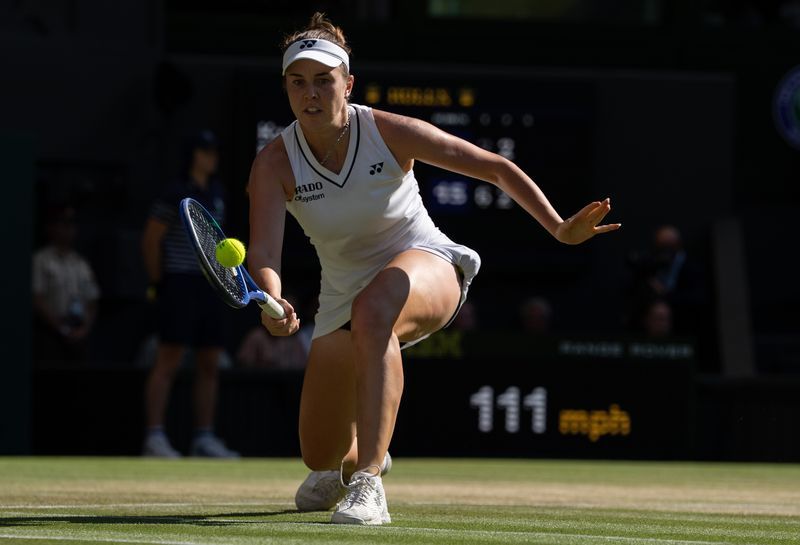
Linda Noskova's journey to the Wimbledon title reads like a masterclass in psychological resilience. The 21-year-old Czech player faced what could have been a career-defining collapse when she relinquished five match points while holding a dominant position in the second set against fellow Czech Karolina Muchova. Yet rather than succumb to the pressure that typically overwhelms younger players in their first Grand Slam final, Noskova demonstrated remarkable composure to ultimately prevail 6-2 5-7 6-3 on Centre Court, becoming the third Czech woman to claim the prestigious trophy in just four years.
The match appeared destined for a routine coronation when Noskova, seeded ninth, established a commanding 5-2 lead in the second set. The trajectory suggested only procedural formalities remained before she would hoist the Venus Rosewater Dish aloft. Yet Muchova's refusal to fade, combined with the mounting pressure that seized Noskova's serving arm, transformed the encounter entirely. Three match points evaporated as Muchova held serve at 2-5, and when Noskova's nerves forced a double-fault at 5-3, the psychological tide turned decisively. By the moment Muchova clawed back five consecutive games to force a third set, Noskova appeared emotionally shattered, covering her ears against the crowd noise as she retreated to her chair.
The turning point came during an otherwise routine comfort break. Walking off court, Noskova's gaze fell upon the trophies waiting for presentation. In that moment of crystalline clarity, she experienced an almost meditative reorientation. The Venus Rosewater Dish—the larger trophy reserved for champions—became a focal point for renewed determination. This simple visual anchor proved transformative. Speaking afterward with remarkable candour, Noskova revealed her mental reset: "I was just telling myself that the match is starting over. I just splashed some cold water on me, started over again. What really helped me was looking at the trophies. I was like, I'm not going to take the small one, I'm taking the big one. I have been so close. This will probably be the heartbreak of my life. I'm taking this one no matter what."
When she returned to the court, Noskova's demeanour had fundamentally shifted. Holding serve to commence the third set proved pivotal—a small victory that psychologically reframed the narrative. She would later emphasise how crucial that game proved: "Let's say I'm brave enough to say that the third set would not have been the same if maybe I would have lost the first game." With her confidence rekindled, her technical proficiency returned in visible waves. Her groundstrokes regained their timing, her footwork accelerated, and when match points arrived again at 5-3 more than an hour after her first opportunity, Noskova seized the moment decisively.
Noskova's triumph extends beyond tennis significance into the broader narrative of Czech sporting achievement. At 21, she becomes the youngest women's champion since her countrywoman Petra Kvitova claimed the first of her two titles in 2011, and the third Czech woman to win the women's singles in four years—a remarkable concentration of excellence from a nation of under 11 million people. For Malaysian and Southeast Asian observers, the Czech success story offers instructive parallels about how smaller nations can develop exceptional sporting talent through long-term institutional investment and cultural support systems.
What distinguishes Noskova beyond her serve-and-volley prowess is her maturity extending far beyond the baseline. The introspective 21-year-old, who wears a distinctive nose ring that reflects her individualistic approach, carries a gravitas unusual in contemporary professional tennis. Two years before her Wimbledon triumph, her mother Ivana succumbed to cancer—a personal tragedy that fundamentally shaped her worldview and resilience. Throughout her career, Noskova has impressed observers with a philosophical approach to life's challenges, suggesting someone genuinely concerned with matters transcending tournament rankings and prize money.
Her off-court interests reveal a conscientious individual grappling with global responsibility. The previous year, Noskova devoted part of her off-season to volunteering in Zanzibar, working with a charity at a local school. That experience catalysed profound personal growth: "When I came back, I was definitely more appreciative of everything that I have." These are not the typical utterances of a professional athlete focused exclusively on sporting conquest, but rather reflect someone wrestling with meaningful questions about resource distribution, privilege, and purpose.
Growing up in a Czech forest village, Noskova developed deep environmental consciousness and expresses serious concern about ecological sustainability. She has already articulated post-tennis career aspirations involving nature conservation and volunteering. During her semi-final triumph over Ukrainian Marta Kostyuk on Thursday, she spoke characteristically: "I'm very much like a nature lover, I want to do some volunteering with nature in the next months or years. I have always been very active during whatever crisis." This combination of activism and introspection suggests a player who views tennis as one chapter in a longer narrative of contributing meaningfully to society.
The significance of her Wimbledon victory transcends sporting achievement. Noskova's ability to mentally compartmentalise catastrophic disappointment and harness it toward ultimate triumph offers lessons applicable far beyond the tennis court. Her psychological breakthrough—recognising that one match point lost need not define an entire match, that mental reset proved achievable, and that visualising aspirational outcomes could galvanise performance—demonstrates sophisticated emotional intelligence in a player barely into adulthood. The image of a 21-year-old stopping mid-tournament to contemplate which trophy she would claim reflects either remarkable confidence or perhaps something more profound: a fundamental conviction in one's capacity to reshape outcomes through determined will.
For regional tennis enthusiasts and sports analysts observing from Southeast Asia, Noskova's triumph underscores how psychological fortitude, comprehensive life philosophy, and technical excellence combine to produce champions. Her victory against Muchova—a fellow Czech and personal friend—added poignancy, as both women represented their nation's tennis dominance. The match's narrative arc, from apparent disaster to triumphant recovery, suggests that Grand Slam success increasingly demands not merely physical superiority but profound psychological maturity. Noskova's journey to the Venus Rosewater Dish demonstrates that resilience, grounded in genuine values extending beyond competitive sport, remains the ultimate differentiator among the world's elite athletes.
Reflecting on her achievement immediately after victory, Noskova conveyed genuine gratitude tempered by realistic perspective: "It was all worth it, so I will definitely never forget this week, these two weeks." Her measured tone avoided hyperbolic celebration, instead suggesting someone acutely aware of the effort invested, sacrifices made, and emotional terrain traversed. This equilibrium—celebrating achievement while maintaining broader life perspective—perhaps best encapsulates what Noskova's Wimbledon triumph represents: not merely a tennis victory, but a demonstration of how comprehensive personal development creates champions capable of thriving across contexts far exceeding competitive sport.

