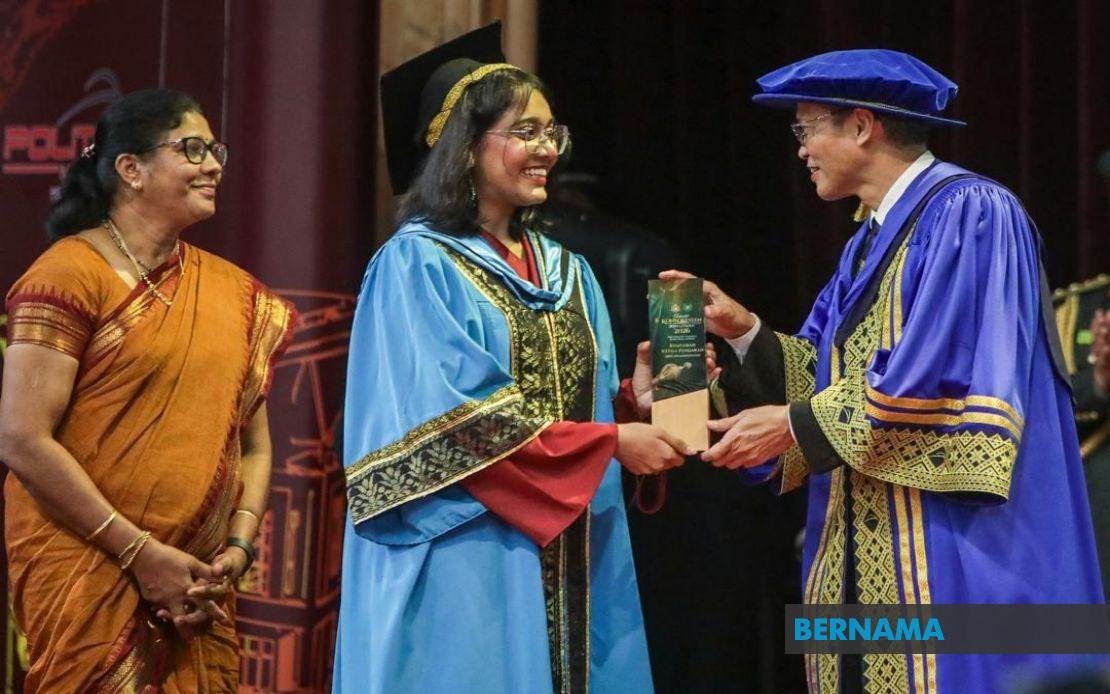
Teerti Ganapathi Rao's journey through higher education stands as a testament to personal fortitude amid adversity. The 22-year-old student from Politeknik Tuanku Syed Sirajuddin (PTSS) in Arau, Perlis, faced one of life's most challenging moments while pursuing her Diploma in Digital Technology through the Department of Information and Communication Technology (JTMK). During her Semester Two examinations in 2023, her father passed away—a loss that could have derailed many students from their academic path. Yet Teerti persevered, ultimately graduating with distinction and receiving recognition at the 2026 Northern Zone Polytechnic and Community College Convocation Ceremony, graced by the Raja of Perlis, Tuanku Syed Sirajuddin Jamalullail.
The recognition came in the form of two prestigious awards: the Director-General's Award and the Academic and Co-Curricular Excellence Award. These honours reflect not merely her academic performance, quantified in a cumulative grade point average of 3.61, but also her capacity to balance scholarly excellence with meaningful engagement in campus life. When informed of her selection, Teerti expressed genuine surprise and gratitude, acknowledging that she had not anticipated receiving such recognition given the emotional turmoil she had navigated during her studies. This humility, combined with her achievements, paints a fuller picture of her character than examination scores alone could convey.
Teerti attributes much of her strength to the enduring influence of her late father's wisdom and encouragement. As the youngest of four siblings, she initially harboured doubts about her educational trajectory. She had considered pursuing only a foundation programme rather than committing to a full diploma qualification. However, her father consistently urged her to complete the diploma course, offering both practical and emotional support through his steady counsel. Even after his passing, those words of encouragement continued to guide her through moments of doubt and exhaustion, serving as an internal compass when external circumstances grew difficult. This dynamic illustrates how parental investment in education can transcend the immediate family unit and create lasting motivation that sustains a student through crisis.
During her three years at PTSS, Teerti demonstrated consistent academic performance and leadership capacity. She secured the Head of Department's Award for Semesters One, Three, and Four—notably excluding Semester Two, the semester in which her father died, suggesting she had managed her grief while maintaining reasonable academic standards even during that pivotal period. Beyond the classroom, she served actively as a member of the Student Representative Council (MPP), an extracurricular commitment that developed her leadership capabilities and enhanced her communication and teamwork proficiencies. These co-curricular involvements are increasingly important in Malaysian polytechnic education, where institutions seek to produce graduates equipped not only with technical knowledge but also with the interpersonal skills demanded by modern workplaces.
Teerti's academic work extended beyond routine coursework into applied research and regional collaboration. She represented PTSS at a collaborative programme and seminar paper presentation held at Universiti Putra Indonesia, exposing herself to international academic networks and research environments. Her final-year project demonstrated practical innovation: the Koop Printing System, designed to enhance the operational efficiency of cooperative printing service management. This capstone project exemplifies the polytechnic sector's emphasis on applied learning and problem-solving that directly addresses industry needs—a philosophy that distinguishes Malaysia's polytechnic system from traditional university programmes and aligns with national skills development priorities.
Language proficiency represents another dimension of Teerti's intellectual development. Beyond Bahasa Melayu and English—the functional languages of Malaysian education and professional life—she has achieved proficiency in Mandarin, Tamil, and Telugu. She possesses basic competency in French, Japanese, and Korean. This multilingual capacity holds particular significance in the Malaysian context, where demographic diversity and regional economic integration create genuine advantages for professionals who can communicate across linguistic and cultural boundaries. In the context of information technology careers, where global collaboration and international teams are increasingly common, such linguistic versatility becomes a competitive asset.
Teerti's trajectory in digital technology began not through formal channels but through personal discovery. At age 16, she was introduced to computers and coding through friendships forged in online gaming communities—a reminder that technological passion and professional direction can emerge from unexpected social contexts. She recognizes that the IT field presents considerable intellectual challenges, yet her experience suggests that methodical learning and genuine conceptual understanding can transform apparent obstacles into manageable learning opportunities. This philosophical approach—emphasizing process over innate talent, and understanding over rote memorization—reflects a maturity in her thinking about education that extends beyond conventional academic achievement.
Looking forward, Teerti has submitted applications to pursue a Bachelor's degree in Information Technology, with Universiti Malaya as her first choice institution. Her educational ambitions do not conclude with an undergraduate degree; she aspires to continue to doctoral level, specifically pursuing a Doctor of Philosophy qualification. This upward trajectory, from diploma through bachelor's to PhD, mirrors pathways increasingly common in Malaysia's higher education landscape, where polytechnic graduates demonstrate capacity and motivation to advance through consecutive qualification levels. Her career planning reflects both individual determination and alignment with Malaysia's broader ambitions to develop a knowledge-based economy requiring highly trained specialists.
The convocation ceremony in which Teerti received her awards was part of a larger event spanning from August 3 to August 9, 2026, recognizing 6,104 graduates from polytechnics and community colleges across the northern region encompassing Perlis, Kedah, and Penang. This scale of graduation activity underscores the significant role of Malaysia's polytechnic sector in workforce development across the northern zone. These institutions serve not merely as educational providers but as regional economic engines, producing skilled professionals who populate both local and national labour markets. Teerti's success, while individually meaningful, is also emblematic of the sector's broader contribution to national human capital development.
Her story resonates particularly with Malaysian audiences navigating the intersection of personal tragedy and educational aspiration. Many students from diverse socioeconomic backgrounds face unexpected family crises during their studies, yet few achieve the level of academic recognition that Teerti attained. Her example demonstrates that resilience, when coupled with institutional support and personal determination, can transform potential setbacks into narratives of achievement. The awards she received validate not only her academic competence but also her character and capacity to contribute meaningfully to professional communities. As Malaysia continues to position itself as a regional education hub and knowledge economy, graduates like Teerti—multilingual, technically skilled, internationally engaged, and personally resilient—represent the calibre of talent the nation is developing for both domestic needs and regional competitiveness.

