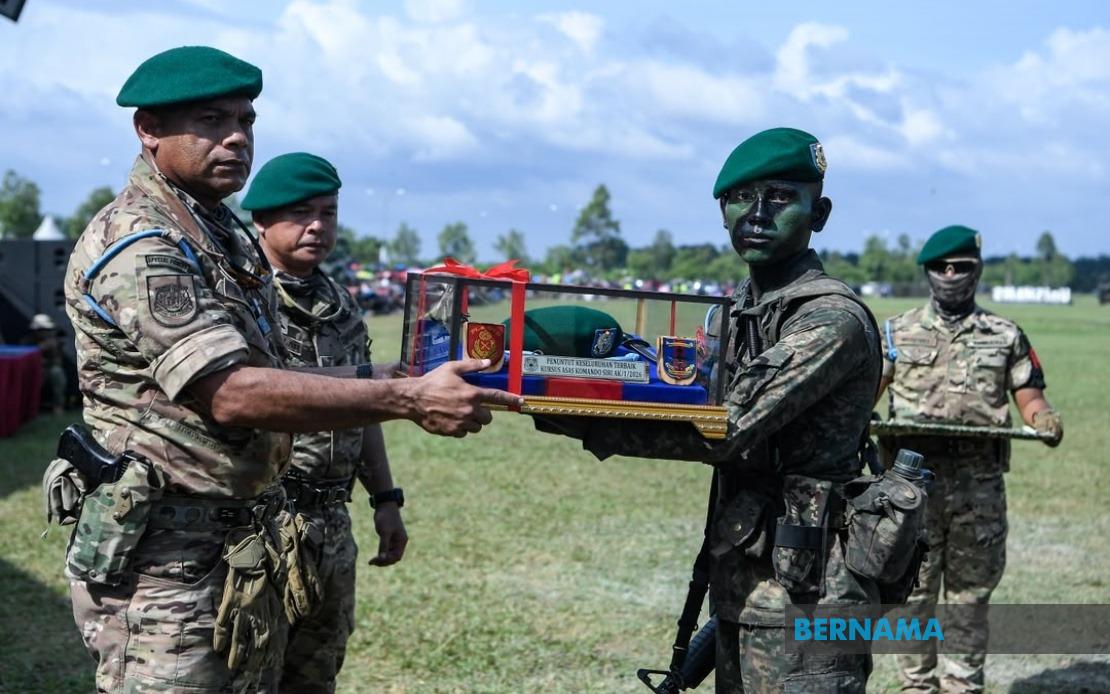
Second Lieutenant Muhammad Fadli Jamalluddin has emerged as the standout trainee from the most recent intake of Malaysia's Basic Commando Course, capping a remarkable personal journey that included an earlier setback that could easily have derailed his military ambitions. The 24-year-old officer from Ampang, Kuala Lumpur, was formally recognised as Best Overall Trainee at the closing ceremony held today at Universiti Sultan Abdul Halim Mu'adzam Shah in Kuala Ketil, following successful completion of the demanding Basic Commando Course Series AK/1/26. His achievement marks a striking testament to the value placed on persistence and mental fortitude within Malaysia's military establishment, qualities that go well beyond mere physical conditioning in the rigorous world of special operations training.
What makes Muhammad Fadli's recognition particularly significant is the context of his journey to this point. He had previously failed to complete the Basic Commando Course Series 3/2024, an experience that tested not only his professional credentials but his personal resolve. Rather than accepting this setback as final, he chose to reapply and push through the course again, demonstrating the exact calibre of determination that military instructors seek to cultivate. The Malaysian armed forces have long placed emphasis on psychological resilience as much as physical prowess, and Muhammad Fadli's willingness to return after an initial failure aligns squarely with this institutional philosophy.
The officer's path to a military career began well before his formal training, rooted in aspirations formed during his secondary school years. He pursued tertiary education at the National Defence University of Malaysia (UPNM), following which he was commissioned into the Royal Malay Regiment in 2024. Rather than settling into a conventional officer posting, he subsequently sought to join the 21st Special Service Group (21 GGK), Malaysia's elite commando unit, recognising that such a career move would represent both the most challenging and most professionally rewarding trajectory available to him. This deliberate choice reflects a deeper understanding of what constitutes meaningful achievement within military hierarchies.
During the most recent course iteration, Muhammad Fadli encountered another critical test that nearly repeated his earlier disappointment. In the eighth week of the three-month programme, he failed one of the pivotal training exercises, an outcome that placed him on the brink of being required to restart the entire course from the beginning. The psychological impact of this moment proved profound; he recounted openly weeping upon learning of the failure, particularly given that he had already endured over 100 kilometres of gruelling endurance marches preceding this particular exercise. The point of near-elimination came when he was most physically and mentally fatigued, a deliberate aspect of commando training designed to assess performance under extreme duress.
Critically, those around him advised against continuing. The extreme physical and mental demands of the course, combined with the prospect of repeating the full programme, prompted counselling from colleagues to withdraw. However, Muhammad Fadli refused to accept this counsel, maintaining conviction that failure represented not a terminal condition but rather an opportunity to demonstrate the adaptability and determination essential in special operations personnel. This mindset—viewing setbacks as reframing opportunities rather than endpoints—represents precisely the psychological profile that advanced military training seeks to develop and identify.
Beyond the professional dimensions of his achievement, Muhammad Fadli's motivation has been deeply personal. He is the third of five siblings, and he has emphasised that his determination to meet the course's challenges has been substantially driven by a desire to make his father proud. This familial dimension carries particular poignancy given that his father suffered a stroke more than a year ago, rendering him unable to attend the closing ceremony at which his son received the Best Overall Trainee award. Muhammad Fadli expressed hope that this accomplishment might provide his father with renewed strength during his recovery, illustrating how military achievement becomes interwoven with family dynamics and personal circumstance.
The Basic Commando Course Series AK/1/26 represents one of the Malaysian armed forces' most demanding training programmes, deliberately structured to push participants to the absolute limits of physical endurance and mental resilience. The three-month curriculum incorporates intensive land and sea training components, with the latter aspect presenting particular challenges for personnel unaccustomed to maritime operations. Muhammad Fadli's acknowledgement that the course demanded not only raw physical strength but also cognitive sharpness reflects a mature understanding of what modern special operations require. He noted that planning and decision-making constitute core competencies alongside the more visible dimensions of physical fitness, highlighting how contemporary military operations demand officers capable of executing complex tactical judgments under pressure.
The educational credentials Muhammad Fadli brings to the role further contextualise his selection as Best Overall Trainee. He holds a Bachelor's degree in Global Policing and Intelligence with Honours, suggesting that his preparation for commando operations included theoretical grounding in intelligence matters and security operations. This academic foundation, combined with his demonstrated resilience and physical capability, positions him well for the sophisticated operational roles that officers in elite units are expected to undertake. The Malaysian armed forces' progression toward more technologically advanced and intelligence-driven special operations is reflected in the educational requirements now being imposed on officer candidates.
The cohort that completed the course alongside Muhammad Fadli comprised five officers and thirty-three personnel of other ranks, representing a total of thirty-eight successful completions from what is invariably a larger initial intake. This passage rate underscores the genuinely demanding nature of commando training, where attrition is substantial and expected. The formal presentation of the Best Overall Trainee award by Colonel Nordin Abu, Commandant of the Special Warfare Training Centre (PULPAK), represents institutional recognition of Muhammad Fadli's standing out even among this highly selected group.
For Malaysian readers and the broader Southeast Asian military community, Muhammad Fadli's journey carries several instructive implications. First, it demonstrates the institutional commitment to identifying and developing personnel who combine physical capability with psychological resilience and intellectual capacity. Second, it illustrates how contemporary military establishments view failure not as disqualifying but as potentially instructive, provided candidates demonstrate the determination to learn and improve. Third, his achievement underscores the continuing importance of elite commando forces within Malaysia's defence architecture, and the ongoing investment in training pipelines that can produce high-calibre special operations personnel.
The recognition of Muhammad Fadli also signals something broader about professional military culture in Malaysia during a period when the armed forces are navigating evolving security challenges and technological transformation. The emphasis placed on rewarding not merely technical competence but also demonstrated resilience, adaptive thinking, and commitment to excellence reflects institutional values that extend well beyond any single training cohort. As Malaysia's military continues to professionalise and modernise in response to regional security dynamics, the identification and development of officers like Muhammad Fadli—who combine formal education, demonstrated determination, and emotional intelligence—becomes increasingly central to institutional effectiveness and operational capability.

