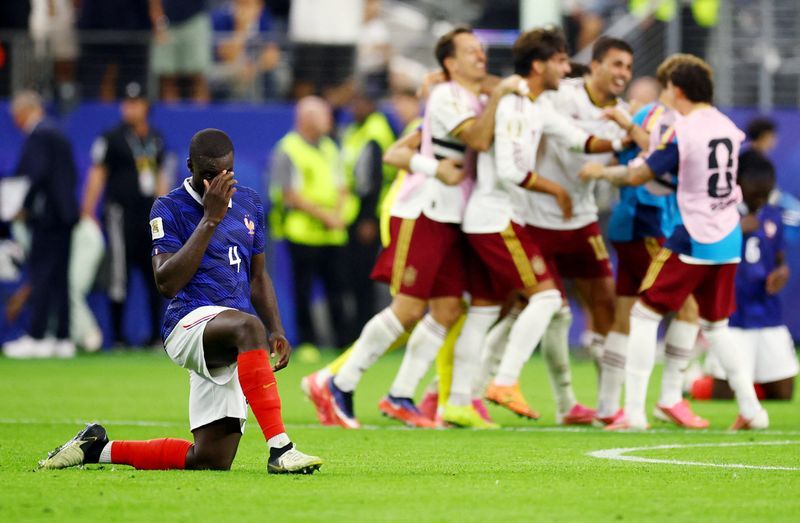
The tournament's most heavily backed contenders collapsed under pressure on Tuesday evening in Arlington, Texas, as Spain inflicted a crushing 2-0 semi-final defeat that ended France's World Cup aspirations in spectacular and humiliating fashion. Unlike the 2022 final against Argentina, where France had recovered from an abysmal opening performance to mount a stirring comeback, there was to be no redemptive narrative this time. This was instead a complete and utter dismantling by a Spanish side that proved decisively superior in every meaningful department, leaving France as little more than spectators in what amounted to a football tutorial.
The scale of the underperformance rendered the pre-tournament assessments of France's credentials almost laughable in retrospect. The wider football world had installed Didier Deschamps' squad as the overwhelming favourites, yet they encountered their first genuine test and crumbled entirely, failing to register even a credible attacking threat. Deschamps himself, typically measured in his post-match observations, was compelled to acknowledge the harsh reality: France had been second best in every technical aspect that matters, and that accountability lay squarely with his management and players. The deflating admission underscored how comprehensively Spain had outthought, outplayed, and outmaneuvered their opponents.
Spain's tactical approach centred on a deliberate manipulation of tempo, forcing France into a frustratingly sluggish rhythm that blunted their attacking momentum entirely. Rayan Cherki, introduced as a second-half substitute, later reflected that the French camp had acknowledged Spain's principal strength—their ability to decelerate the game's pace—yet had fatally failed to devise effective counter-strategies. This represented a fundamental coaching and preparation failure, suggesting that despite weeks of preparation, France had simply not adequately studied or planned for how to overcome this particular challenge. The contrast with Spain's clarity of purpose and execution could hardly have been starker.
Lamine Yamal emerged as the youthful embodiment of Spanish confidence, his teenage bravado about France being the ones who should fear the opposition proving prescient. Yamal and his teammates had clearly identified exactly how to neutralize France's presumed advantages, and they executed their game plan with ruthless precision. The midfield battle proved decisive, with Rodri controlling proceedings with such authoritative command that he effectively dictated the entire tempo and direction of play, gliding through the French lines as if they simply were not present.
The symbolic heart of France's debacle belonged to Michael Olise, the playmaker thrust into the Ballon d'Or conversation and positioned as the creative orchestrator who would unlock Spain's defensive structure. Instead, Olise appeared utterly bewildered by the Dallas Stadium environment, starved of space and tactical options while repeatedly surrendering possession. The statistics told a damning story: twenty turnovers and not a single successful dribble, a catastrophic return from a player entrusted with France's creative responsibilities. Rodri, by contrast, was his tactical opposite, demonstrating the vast gulf between a midfielder operating at his apex and one operating hopelessly below required standard.
Olise's collapse was merely emblematic of a broader disintegration across France's attacking contingent. Ousmane Dembele contributed virtually nothing of consequence, while Bradley Barcola and his substitute Desire Doue proved equally impotent, leaving France's forward line—widely regarded as among the tournament's most formidable—appearing strangely toothless and incapable of threatening Spain's goalkeeper. Even Kylian Mbappe, the generational talent upon whom so much responsibility rested, never found his moment of magic. The most memorable roar from the crowd came not from any French attacking flourish but from the appearance of David and Victoria Beckham on the stadium's giant screen, a telling commentary on the evening's entertainment value.
France's vulnerability became apparent from kickoff against the first opponent willing and capable of genuinely testing them at this tournament. Deschamps' double pivot quickly unraveled under sustained pressure, with Adrien Rabiot's early yellow card neutering his usual aggressive presence while Aurelien Tchouameni, lacking both rhythm and conditioning after missing the previous two matches through hamstring injury, proved unable to maintain defensive equilibrium against Spain's surging midfield. This exposed defensive fragility, combined with Spain's clinical finishing, made the outcome inevitable rather than merely likely.
Spain's two goals arrived from costly French errors—first a penalty converted by Mikel Oyarzabal after twenty-two minutes, then Pedro Porro's strike approaching the hour mark—representing the ruthless efficiency of a team prepared to punish mistakes immediately and decisively. There would be no French resurgence, no dramatic levelling, no last-gasp heroics. At the final whistle, Mbappe stood isolated on the pitch while teammates either collapsed to their knees or buried their faces in their hands. The endless pre-match rhetoric about cohesion and unity suddenly felt hollow and distant.
The defeat carries implications extending far beyond a single tournament elimination. For Malaysia and Southeast Asian football enthusiasts who follow elite international competition, the result underscores that tournament favouritism counts for remarkably little when tactical preparation proves inadequate and individual players underperform simultaneously. Spain's methodical dismantling of France demonstrates that superior ball retention, controlled tempo manipulation, and midfield dominance remain the fundamental currency of modern football at the highest level. France failed catastrophically on all three fronts, and paid the ultimate price for their collective underestimation of an opponent they had assumed they would overcome through mere superiority of individual talent rather than tactical discipline and comprehensive match execution.

