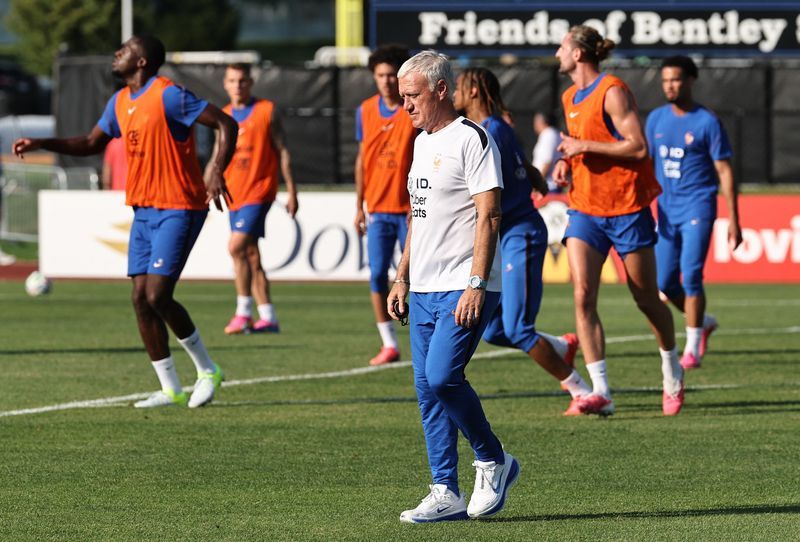
France enters Tuesday's World Cup knockout encounter against Sweden as heavy favourites, buoyed by an attacking display that has left opponents in tatters during the group stage. Having topped Group I with a flawless record and 10 goals scored across victories against Senegal, Iraq and Norway, Didier Deschamps' squad possesses firepower that few international sides can rival. The combination of Kylian Mbappe's devastating pace, Ousmane Dembele's hat-trick heroics and Michael Olise's creative brilliance has established France as among the tournament's most fearsome attacking units, yet tactical refinements remain necessary before facing the Swedes.
Deschamps recognises that while his team's offensive capabilities have proven near irresistible, vulnerabilities on the left flank demand attention. Theo Hernandez's unconvincing performances at left back have prompted the coach to consider reshuffling his defensive line, with Lucas Digne poised to replace the Milan defender. This adjustment prioritises defensive solidity and more composed delivery from wide areas, addressing concerns that have occasionally surfaced during the group stage.
The tactical shift will extend beyond the back line. Bradley Barcola is expected to displace Desire Doue on the left of France's attack, as Deschamps seeks to inject more directness and explosive pace into transitions. Rather than fundamentally altering France's approach, this change aims to establish greater coherence along the left flank whilst maintaining the devastating right-sided axis anchored by Olise and Mbappe. The return of William Saliba to central defence will additionally provide the backline with stabilising influence at a critical juncture.
Sweden arrive as pragmatic rather than flamboyant opponents. Having finished second in Group F behind the Netherlands, they demonstrated both surprising capability and significant frailty. Their emphatic 5-1 demolition of Tunisia showcased attacking potential, yet subsequent encounters exposed defensive limitations. The Dutch inflicted an identical 5-1 thrashing, whilst Japan managed to salvage a 1-1 draw, suggesting that Sweden's inconsistency could prove vulnerable against France's relentless attacking machine. Nevertheless, their physical robustness and tactical organisation cannot be dismissed, particularly given knockout football's unforgiving nature.
Former England international Gary Lineker, speaking to French sports daily L'Equipe, articulated the consensus view with characteristic bluntness. Acknowledging that Sweden possess capable forwards in Alexander Isak, Viktor Gyokeres and Anthony Elanga, Lineker nevertheless contended that France's attacking depth remains incomparable. The possession of four genuine world-class forwards provides Deschamps with substitution options—including Barcola, Doue, Rayan Cherki, Jean-Philippe Mateta and Marcus Thuram—that no rival nation can match in terms of quality and versatility.
France's knockout record provides additional confidence heading into Tuesday's encounter. Beyond their defeat to Argentina in the 2022 final, Deschamps' side has not lost a World Cup knockout match since 2014, suggesting a culture of composure and resilience when stakes escalate beyond group-stage mathematics. This psychological dimension should not be underestimated, as knockout football frequently rewards experience and tactical discipline alongside individual talent.
However, the transition from group stage to knockout football presents a fundamentally different examination. During the initial phase, France's overwhelming attacking prowess permitted occasional defensive complacency, safe in the knowledge that superior goal-scoring capability would ultimately prevail. Sweden, by contrast, will almost certainly adopt a defensive approach, sitting deep and seeking to capitalise on set-piece opportunities whilst remaining alert to counter-attacking possibilities. This tactical approach exposes a potential France weakness: their defensive vulnerabilities, occasionally visible when facing organised opponents at speed.
Indeed, concerns about France's backline were momentarily highlighted during Friday's match against Norway's second-string squad, when swift transitions momentarily unsettled Deschamps' defensive arrangement. Should Sweden succeed in compressing space and executing disciplined pressing, they might create opportunities to trouble a France side occasionally susceptible to counter-attacks. Yet such scenarios would require near-perfect execution from the Swedes, who cannot afford the lackadaisical defending that characterised their opening group match against Tunisia.
The reality facing Sweden is decidedly bleak. France's attacking personnel possess the capability to accumulate goals at a rate that renders the Swedes' own offensive contributions virtually irrelevant. Even should Isak or Gyokeres manage to find the back of the net, they would likely require two or three strikes to genuinely threaten France's progression. This mathematical imbalance, combined with France's superior technical proficiency and tactical flexibility, suggests that Tuesday's contest may be decided long before full-time.
Victory for France would propel them into the Round of 16 against either Germany or Paraguay, offering tantalising prospects for a side seemingly capable of scoring goals against any opposition. The challenge facing Deschamps now concerns not whether his team will progress—this appears virtually inevitable—but whether the defensive adjustments implemented can provide sufficient stability whilst permitting the attack to operate with characteristic freedom. Should France successfully address their left-flank concerns without compromising their attacking output, they will represent a formidable obstacle for any remaining opponent.

