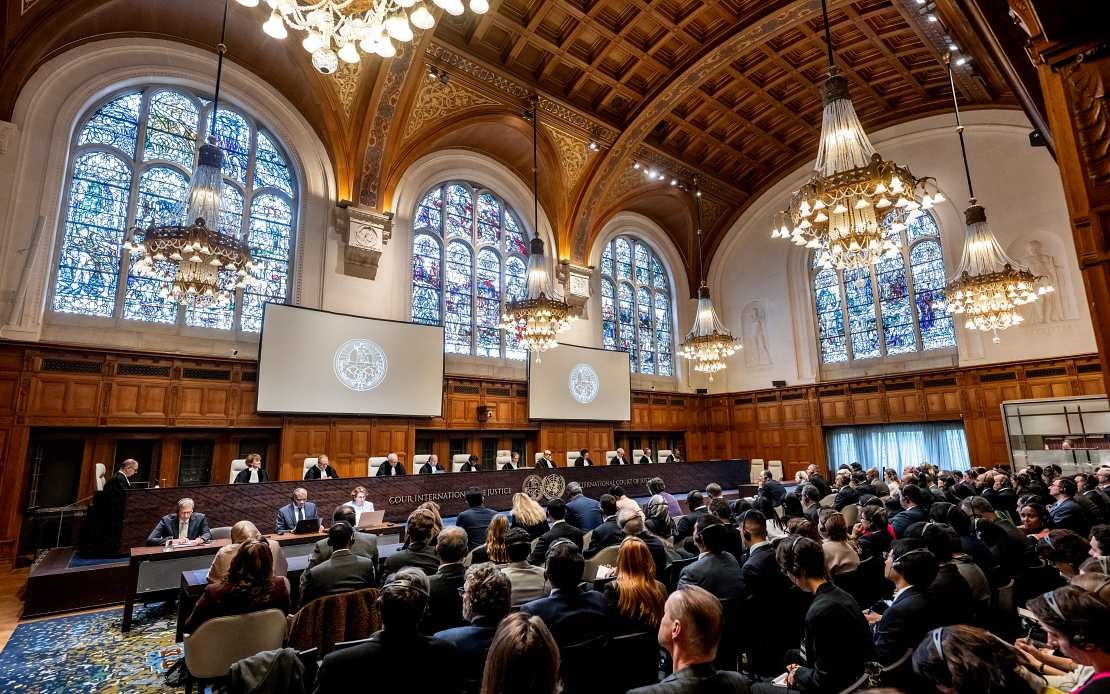
France has made clear its unwavering commitment to the International Criminal Court, pushing back against recent criticism from Washington that frames the institution as a threat to national sovereignty. Speaking on Thursday, Foreign Ministry spokesman Pascal Confavreux articulated Paris's position with precision, emphasizing that the ICC's mandate focuses exclusively on prosecuting individuals accused of the most severe international crimes, not governments themselves. This distinction, Confavreux argued, fundamentally undermines American claims that the court represents an existential challenge to state autonomy.
The French government's reassertion of support arrives in the wake of pointed remarks from US Secretary of State Marco Rubio, who has launched a concerted campaign against the tribunal. Rubio has indicated that the United States intends to encourage other nations to withdraw their membership, effectively orchestrating a coordinated effort to weaken the institution. Beyond rhetorical criticism, the State Department has gone further by initiating a formal policy framework explicitly designed to curtail what Washington characterizes as the ICC's encroachment on American sovereignty.
French officials made clear that attacks and intimidation directed at ICC personnel constitute unacceptable violations of international norms. The statement carried particular weight given recent incidents in which court officials and staff members have faced threats and harassment linked to their investigations and prosecutions. By highlighting this dimension, Paris sought to elevate the conversation beyond abstract legal arguments to concrete matters of institutional security and the safety of those working within the system.
The International Criminal Court, headquartered in The Hague, was formally established in 2002 as a permanent venue for prosecuting individuals charged with humanity's gravest offences: genocide, war crimes, crimes against humanity, and the crime of aggression. Its creation represented a significant advancement in international humanitarian law, embodying the principle that individuals—not states—bear responsibility for mass atrocities. The court operates independently through a sophisticated prosecutorial apparatus and judicial structure designed to ensure due process while maintaining rigorous standards of evidence and accountability.
The American stance reflects a longstanding tension within Washington's relationship to multilateral institutions. The United States has never ratified the Rome Statute that established the ICC, maintaining instead that its own legal system provides adequate protections and accountability mechanisms. This position stems partly from concerns about the court's jurisdiction and partly from broader American skepticism toward mechanisms that could theoretically constrain US military personnel or political leaders, though in practice the ICC has focused primarily on situations in developing nations or conflict zones.
France's position carries particular significance within the European context, where support for the ICC constitutes a cornerstone of the European Union's commitment to rules-based international order and transitional justice. By reaffirming its backing for the institution, Paris signaled to other European governments that maintaining confidence in the court remains central to European foreign policy, despite American pressure to the contrary. This distinction between the transatlantic partners underscores deeper disagreements about how international law should be structured and who should bear responsibility for major violations.
The timing of France's statement reflects growing uncertainty within the international system about the durability of institutions established after World War II. As major powers challenge the legitimacy and effectiveness of multilateral bodies, smaller nations and civil society organizations increasingly wonder whether these institutions can survive sustained opposition from powerful states. For Southeast Asian countries with their own experiences of conflict and unresolved human rights questions, the fate of the ICC carries implications regarding potential future accountability mechanisms and the international community's commitment to justice.
France's insistence that the ICC prosecutes individuals rather than governments addresses a core misunderstanding that animates American criticism. This distinction proves crucial for understanding the institution's actual operational scope. The court can only move against state actors if those individuals face charges as private persons, and it operates according to strict principles of complementarity, meaning it only intervenes when national courts prove unwilling or unable to prosecute. This framework theoretically protects states while ensuring that perpetrators of mass atrocities face justice somewhere within the international system.
Looking ahead, the confrontation between Washington and Paris over the ICC may force allied nations to make difficult choices about their institutional allegiances. Countries that maintain close security relationships with the United States while also supporting the ICC could face pressure to choose sides. The developing world, which has historically viewed the court as potentially biased toward investigating situations in Africa and the Global South, may find its skepticism validated by the American challenge to the institution's legitimacy, even as human rights advocates insist that institutional reform rather than withdrawal remains the appropriate response.
For Malaysia and other Southeast Asian nations, the Franco-American dispute over the ICC presents a strategic puzzle. Most nations in the region have not ratified the Rome Statute, reflecting concerns about sovereignty and the court's potential jurisdiction. However, the principle of individual accountability for mass atrocities resonates with the region's painful history. The collapse of international commitment to the ICC could have subtle but significant consequences for how the international community addresses future crises, whether in the South China Sea, Myanmar, or elsewhere, making the outcome of the current dispute about far more than abstract institutional politics.

