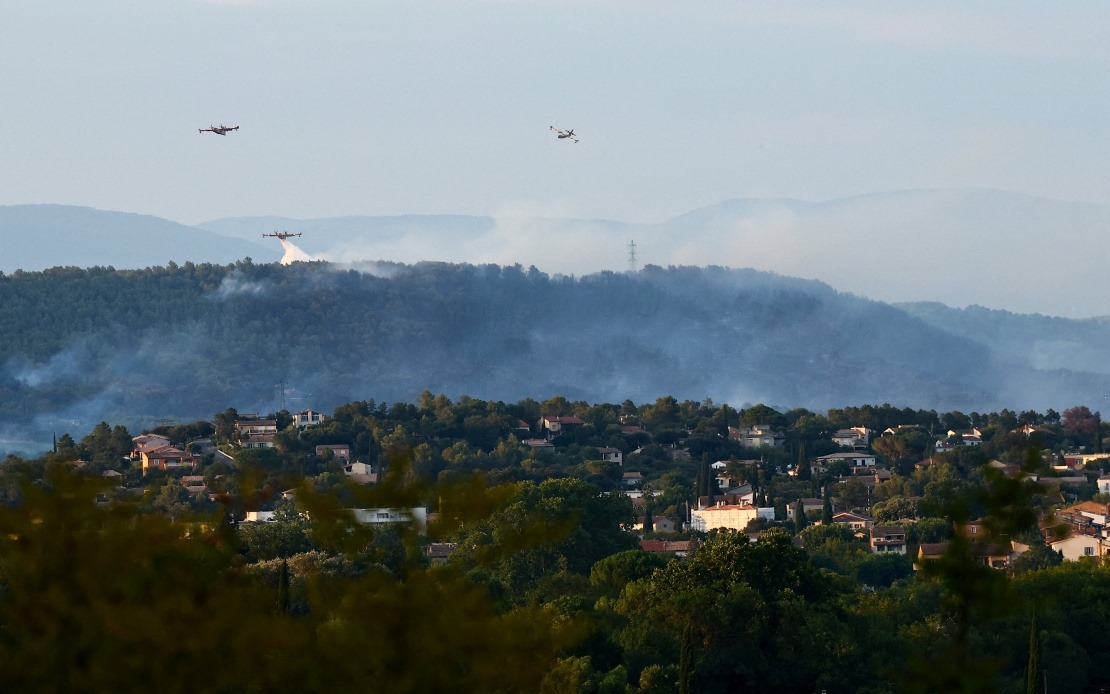
France is confronting an environmental catastrophe that has defined much of 2026, with French Interior Minister Laurent Nunez confirming that nearly 40,000 hectares of forest and vegetation have been incinerated since the year began. The scale of destruction underscores the vulnerability of even developed European nations to the intensifying impacts of climate-driven extreme weather, a cautionary pattern increasingly relevant to Southeast Asian countries facing their own fire seasons.
The minister's disclosure on Monday revealed figures substantially exceeding those recorded in the previous year, a troubling trajectory that reflects both the severity of individual fire events and their growing frequency. Nunez emphasized that fresh blazes continue to emerge across the French landscape with alarming regularity, preventing authorities from achieving sustained containment despite mobilizing substantial firefighting resources. This perpetual ignition cycle mirrors the conditions that plague Indonesia and other regional nations during their peak fire seasons, where new hotspots repeatedly overwhelm suppression efforts.
The extraordinary heat conditions gripping France have emerged as the primary catalyst for the wildfire outbreak. Temperatures have climbed toward 40 degrees Celsius across much of the country, with certain localities experiencing even more punishing conditions that create ideal circumstances for rapid fire propagation through dried vegetation. This thermal environment has proven sufficiently severe that France's meteorological service felt compelled to issue weather warnings spanning 72 of the nation's 96 departments—a record threshold that signalled the magnitude of the crisis.
President Emmanuel Macron has characterized the 2026 wildfire season as unprecedented in scope since the conclusion of the Second World War, a statement carrying considerable weight given France's detailed historical records and the comparative data available across decades. Such a designation elevates current conditions beyond typical summer fire activity into the category of genuinely exceptional climatic events, with implications extending far beyond immediate property damage and environmental degradation. For Malaysia and other tropical nations, such unprecedented designations serve as reminders that historical patterns no longer provide reliable guides for future fire risk assessment.
The concentration of meteorological warnings in 72 departments represents a measurable escalation in the geographical footprint of hazardous conditions. This widespread distribution of extreme heat across French territory indicates that fire risk has transitioned from being a localized or regional phenomenon to becoming a national emergency affecting disparate population centers simultaneously. Such simultaneous regional crises strain emergency response infrastructure in ways that sequential or isolated incidents do not, forcing difficult decisions about resource allocation across competing priorities.
The implications of France's wildfire crisis extend beyond national boundaries within Europe and carry broader significance for understanding climate vulnerability patterns. A nation possessing advanced fire management systems, significant financial resources, and modern firefighting technology is nonetheless struggling to contain large-scale wildfires fueled by heat conditions beyond historical norms. This reality challenges assumptions that wealth and infrastructure alone suffice to manage climate-intensified fire risks, a lesson particularly relevant for emerging economies in Southeast Asia investing in fire management capabilities.
The escalating trajectory of burnt hectares year-on-year suggests that the region may be entering a new climatic regime where fire seasons become more severe and potentially longer in duration. Without substantial intervention in the form of global emissions reductions or regional adaptation strategies, French authorities face the prospect of managing increasingly destructive fire seasons as routine occurrences rather than rare emergencies. This prospect mirrors concerns voiced by environmental scientists regarding fire regimes in Southeast Asia, where projections suggest expanding fire seasons under various climate scenarios.
For Malaysian observers, the French experience offers valuable perspective on the limitations of reactive fire management approaches when underlying climatic conditions shift fundamentally. Contemporary fire seasons across Southeast Asia have already demonstrated the ability to overwhelm regional response capacity, as evidenced by transboundary haze events affecting multiple nations simultaneously. France's struggle to contain nearly 40,000 hectares of burning vegetation illustrates that even wealthy developed nations require not only tactical firefighting improvements but also strategic investments in climate adaptation and emissions reduction.
The daily emergence of new fire ignitions across French territory underscores a critical challenge that resonates with Southeast Asian experiences: when atmospheric and ground conditions become sufficiently conducive to ignition and rapid fire spread, suppression efforts transition from eliminating discrete events to attempting damage mitigation across a continuously expanding disaster landscape. Managing such conditions demands not merely more firefighters or equipment but fundamentally different approaches to land management, vegetation monitoring, and early warning systems capable of anticipating mass ignition scenarios before they materialize at catastrophic scale.

