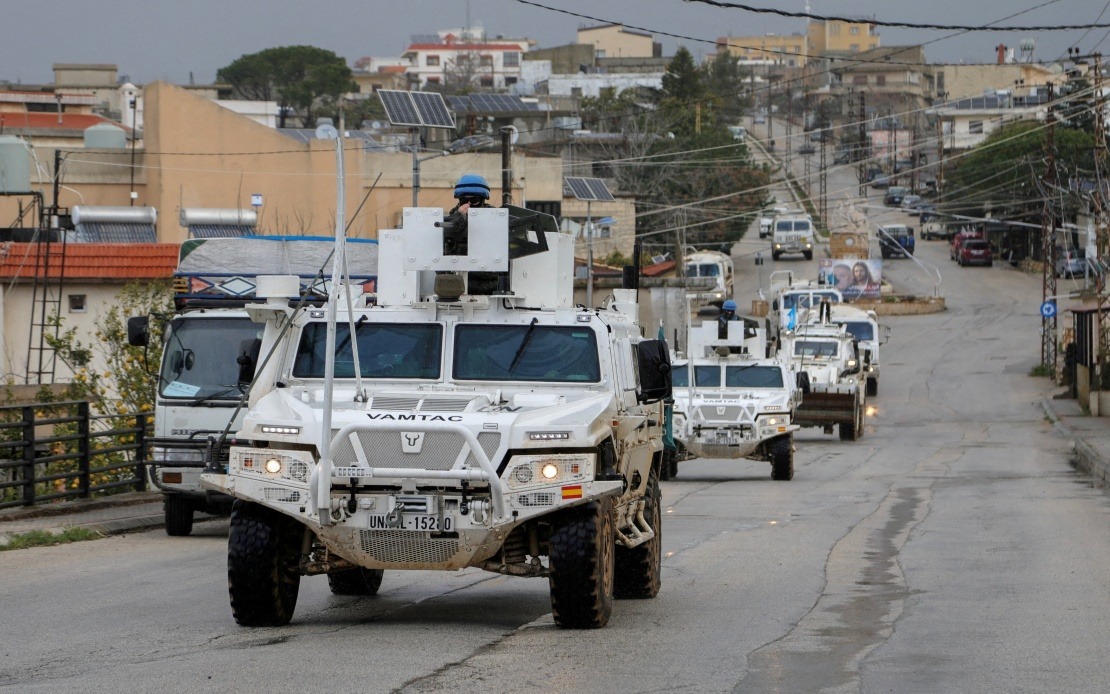
France and Italy have committed to assembling a multinational coalition to stabilise Lebanon after the United Nations Interim Force in Lebanon concludes its three-decade mission at year's end. The agreement emerged from discussions between French President Emmanuel Macron and visiting Italian Prime Minister Giorgia Meloni in Antibes on Thursday, signalling a coordinated European approach to one of the Middle East's most fragile states. Both leaders emphasised the necessity of maintaining international engagement beyond UNIFIL's departure, framing the coalition as essential to preventing Lebanon's deterioration into further regional instability.
Macron articulated the coalition's dual purpose during the joint press conference: strengthening Lebanese state institutions whilst ensuring the country does not become a flashpoint for wider regional conflict. The French President stressed that any post-UNIFIL arrangement would operate under strict coordination with both the European Union and the United Nations, avoiding unilateral action and maintaining legitimacy through multilateral frameworks. This emphasis on institutional coordination reflects European sensitivities about military deployments in the Eastern Mediterranean and broader Middle Eastern affairs, where perceptions of external interference remain contested.
Meloni reinforced the urgency of the initiative by highlighting the dangers of an extended security vacuum in Lebanon. Her language—characterising the alternative scenario as "extremely dangerous"—underscores genuine European anxiety about potential power consolidation by non-state actors and destabilising forces during any transition period. Italy's active participation alongside France signals broader EU commitment, moving beyond symbolic gestures to concrete military and political involvement. This Franco-Italian leadership demonstrates that smaller European powers can shape regional strategy when aligned strategically.
The timing of this announcement reflects growing awareness that UNIFIL's scheduled December 31 withdrawal creates an urgent policy challenge. Under United Nations Security Council Resolution 2790, the peacekeeping operation's formal mandate expires at year's end, with a mandated drawdown window of twelve months thereafter. This compressed timeline means planning must commence immediately to prevent operational gaps. The decision to pre-emptively establish successor arrangements rather than awaiting UNIFIL's actual departure demonstrates strategic foresight, though it also raises questions about whether a new coalition can replicate UNIFIL's accumulated institutional knowledge and regional legitimacy.
For Malaysia and Southeast Asian observers, this European initiative carries significant implications. Lebanon's instability has historically rippled across regions with substantial diaspora populations and economic networks. The Lebanese financial crisis already drives emigration pressures affecting Southeast Asian labour markets and remittance flows. A deteriorating security situation could intensify regional displacement, trafficking, and irregular migration patterns that Malaysia and neighbouring countries would necessarily confront. European coalition success in stabilising Lebanon directly affects Southeast Asian interests in regional security and migration management.
The coalition's likely composition remains undefined, though France and Italy's leadership suggests involvement from other European Union members and potentially NATO allies. The conspicuous coordination with UN structures reflects diplomatic lessons learned from previous interventions where parallel security arrangements created institutional confusion. By anchoring the coalition within existing UN frameworks rather than establishing autonomous mechanisms, the initiative seeks legitimacy grounded in international law rather than perceived great-power interests. This approach may prove more palatable to Arab states and countries like Malaysia that scrutinise external military presences through post-colonial lenses.
Lebanese capacity-building features prominently in both leaders' rhetoric, with emphasis on strengthening the Lebanese Armed Forces rather than imposing external security solutions. This principle—supporting state institutions rather than substituting for them—represents a significant shift from earlier international interventions that sometimes marginalised host governments. Should the coalition prioritise genuine Lebanese institutional development, it could establish a model for international stabilisation efforts that preserves sovereign agency. Conversely, if capacity-building becomes secondary to force projection concerns, the coalition risks repeating historical patterns where external security arrangements inadvertently weaken recipient institutions.
The prevention of Lebanese territory becoming "a source of further regional tensions" directly addresses concerns about Hezbollah consolidation, Iranian influence expansion, and Israeli security preoccupations. The coalition's success ultimately depends on managing these deeply entrenched regional dynamics, which existing UNIFIL deployments have only partially constrained. European coalitions traditionally lack the strategic leverage of regional actors, suggesting that effective post-UNIFIL stability requires buy-in from Saudi Arabia, the United Arab Emirates, Egypt, and Israel—actors with direct regional interests. Whether France and Italy can broker such consensus remains the critical uncertainty underlying this initiative.
Financial dimensions of sustaining a multinational coalition remain unspecified, though UNIFIL's annual operational costs exceed $600 million. European nations, facing competing fiscal pressures from Ukraine assistance and domestic challenges, may struggle to fund indefinite Lebanese operations. This budgetary reality could constrain both the coalition's scale and duration, potentially creating sustainability questions that undermine medium-term stabilisation objectives. Malaysia's regional partners should monitor whether European commitment translates into adequate resource allocation or remains largely declaratory.
The initiative reflects broader European recalibration of Middle Eastern strategy following years of reduced engagement. France's historical involvement in Lebanon, rooted in colonial administration and ongoing cultural ties, provides some institutional memory and diplomatic channels. Italy's participation adds Mediterranean perspective and naval capabilities potentially relevant to maritime security aspects. However, neither nation commands the regional influence wielded by actual Middle Eastern powers, suggesting the coalition functions as a supporting mechanism rather than primary stabilisation vehicle.
Operationally, the coalition must navigate complex Lebanese politics, where sectarian power-sharing arrangements constrain government authority. UNIFIL's relative neutrality across sectarian lines has permitted its presence; a new coalition composed primarily of Western Christian-majority nations may encounter different political dynamics. Managing perceptions of religious or civilisational bias will prove diplomatically delicate, particularly if coalition activities inadvertently advantage certain Lebanese factions over others. This political complexity distinguishes Lebanon from simpler security stabilisation scenarios.
For Malaysia's foreign policy perspective, this European initiative underscores how regional conflicts increasingly demand multinational responses transcending traditional bilateral relationships. Southeast Asian nations maintain interests in Lebanon's stability through economic networks, diaspora communities, and broader commitment to international law principles. Supporting multilateral coalition approaches rather than unilateral interventions aligns with Malaysia's traditional diplomatic preferences. However, ensuring that such coalitions genuinely pursue sustainable state-building rather than resource extraction or strategic positioning requires sustained Malaysian diplomatic engagement with both European capitals and Lebanese authorities.

