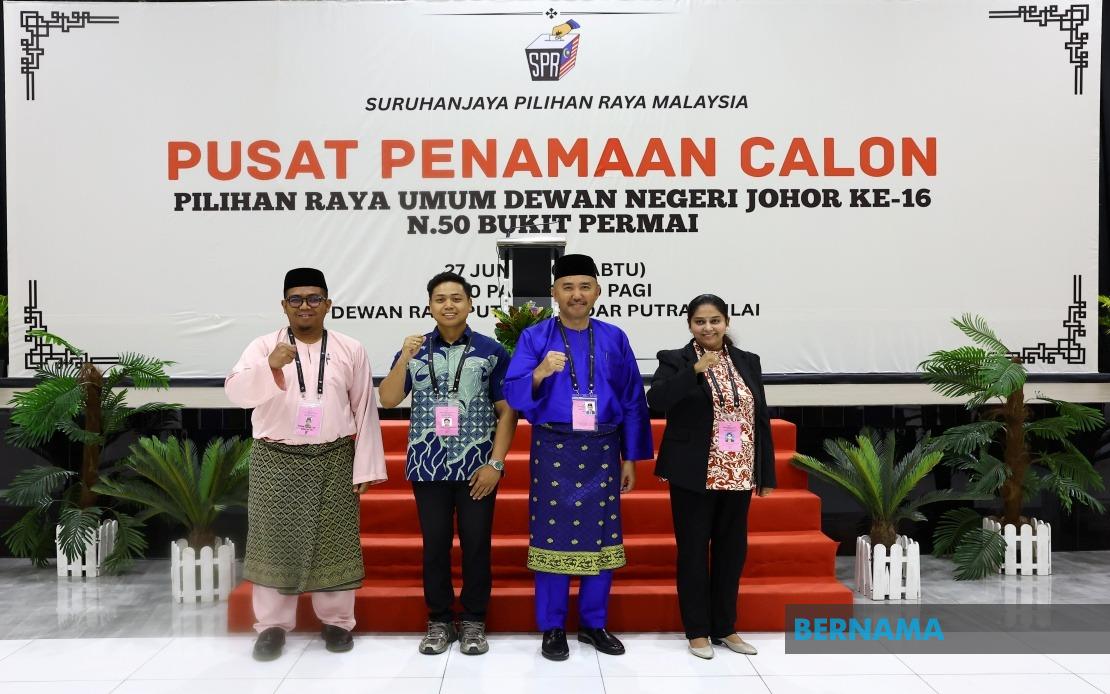
Datuk Mohd Jafni Md Shukor, the incumbent state assemblyman for Bukit Permai, will contest the seat in a closely watched four-way battle during Johor's 16th state election, according to nomination papers filed with the returning officer on Thursday. The Barisan Nasional representative faces a competitive race against three opposition and independent candidates, signalling a potentially fragmented contest that could reshape the political landscape in this Batu Pahat constituency.
The candidate lineup reflects the increasingly crowded nature of Malaysian state politics, where traditional two-sided contests have given way to multi-cornered affairs that complicate vote calculations. Mohamad Shafwan Ani represents Pakatan Harapan's challenge to the ruling coalition, while M. Lina Manoh stands for Perikatan Nasional, and Muhammad Aidil Riduan Mohd Yusof contests under the banner of Parti Bersama Malaysia. Returning officer Afzan Azhari confirmed all four nominations at the centre in Bandar Putra following the close of filing at 10 am.
Jafni's previous victory in 2022 provided some comfort to BN strategists. The incumbent secured the seat with a comfortable 4,755-vote majority despite facing a similarly divided opposition, demonstrating his ability to retain support across the constituency's diverse communities. That performance suggested a solid grassroots operation and personal popularity that could prove decisive if opposition votes split among multiple candidates rather than consolidating behind a single challenger.
Pakatan Harapan's participation underscores the coalition's determination to contest nationwide despite recent setbacks. The presence of Johor DAP chairman Teo Nie Ching at the nomination centre accompanying Shafwan indicated strong organisational backing for the PH candidate, reflecting the coalition's investment in maintaining electoral presence across Malaysia's second-largest state. PH has struggled in Johor following the 2022 state election, making contests like Bukit Permai opportunities to rebuild momentum and demonstrate continued relevance to voters.
Perikatan Nasional's decision to field Lina Manoh signals the coalition's continued effort to establish foothold in peninsular Malaysia. While PN has concentrated resources on Sabah and Sarawak, contesting in states like Johor allows the coalition to maintain a national profile and test electoral viability in heartland constituencies. However, PN's presence in multi-cornered contests often fragments the anti-government vote, potentially benefiting the incumbent rather than providing a decisive alternative.
The emergence of Parti Bersama Malaysia as a contestant reflects Malaysia's expanding political space, where newer parties seek to establish themselves through state-level participation. Bersama's involvement in Bukit Permai adds another layer of unpredictability to voting patterns, particularly if the party attracts protest votes from those dissatisfied with traditional opposition choices. The party's ability to capture meaningful support remains uncertain, but its presence complicates the strategic calculus for all major contenders.
Voters in Bukit Permai face a genuine choice among four distinct political orientations. Those backing the federal government have Jafni as the establishment candidate, while PH offers an alternative progressively-minded opposition voice. PN represents a different conservative choice, and Bersama appeals to those seeking a non-aligned option. This diversity could energise voter engagement or produce lower turnout if constituencies feel overwhelmed by choices.
The election commission has structured the voting timeline to facilitate maximum participation. Early voting is scheduled for July 7, allowing those unable to vote on the main day to cast ballots beforehand. Polling day on July 11 will determine which candidate secures the seat and what message Johor voters send about their political preferences heading into what could be a closely balanced state assembly. The timing follows announcements of the dissolution of the state assembly, making this election the definitive test of support across the state's 56 constituencies.
For Bukit Permai specifically, the outcome could hinge on how effectively each camp mobilises supporters and whether any candidate emerges as the clear consensus choice among voters. Jafni's previous performance provides baseline data, but the addition of Bersama and the organised presence of PH create genuine uncertainty. Perikatan Nasional's performance in previous contests in the constituency will influence whether the party can retain or expand its vote share. In a four-way split, relatively modest margins could determine victory, making ground operations and voter contact critical factors in the final fortnight before polling.
The Bukit Permai contest exemplifies broader patterns across Malaysian electoral politics, where coalition stability and voter consolidation have become increasingly challenging. Rather than seeing definitive mandates, constituencies are fragmenting into multiple camps that require candidates to build carefully calibrated support bases. For Jafni and his challengers, the path to victory runs through understanding the precise grievances and aspirations of Bukit Permai's diverse communities and articulating responses that resonate across demographic groups. The four-cornered contest will test not only the incumbent's record but also the broader appeal and organisational capacity of the three opposition and independent alternatives.

