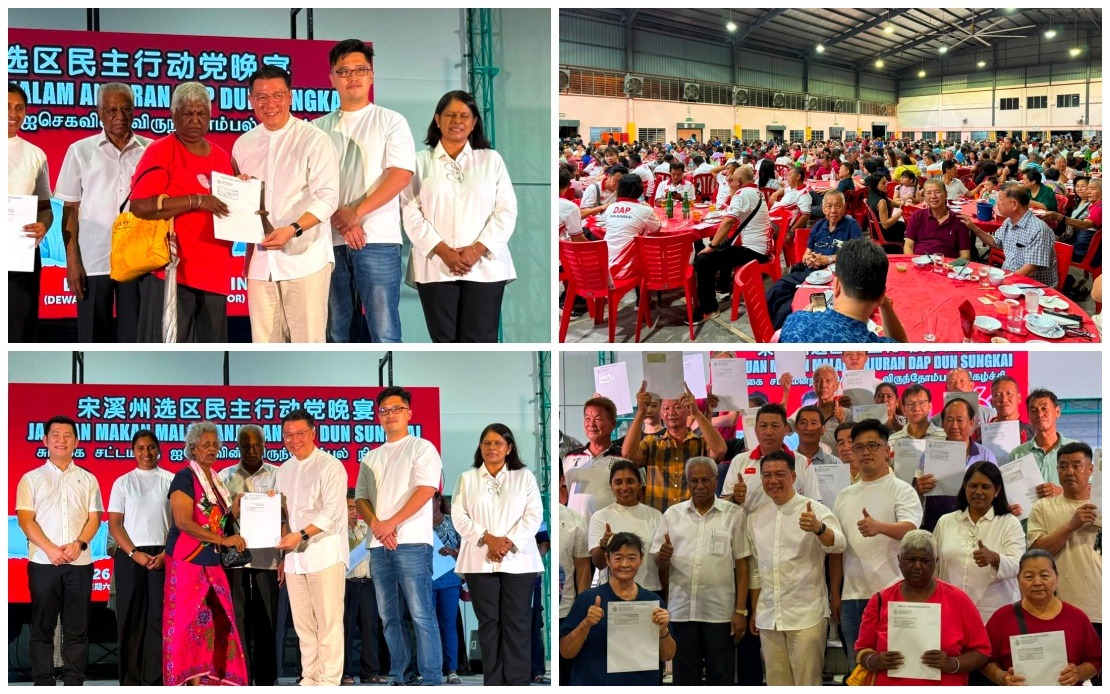
Housing and Local Government Minister Nga Kor Ming has announced the resolution of a four-decade settlement crisis in Sungkai and Kuala Bikam, with 120 squatter families now receiving formal land grants. The presentation took place during a DAP Sungkai divisional dinner in Ipoh on August 8, attended by over 1,200 community members, underscoring the scale of the issue and its importance to local residents. For generations, these families had occupied land without formal ownership, living in precarious conditions with minimal security and few property rights.
The granting of these titles represents a watershed moment for communities that have endured decades of uncertainty about their housing security. The families involved span multiple generations, with some members spending their entire lives without the certainty of permanent shelter or the ability to pass property to heirs. The delay in resolution reflects broader challenges in Malaysia's approach to squatter resettlement, where bureaucratic processes, land ownership complexities, and competing claims often stall progress for years. This case demonstrates that with political will and administrative focus, such entrenched problems can finally be addressed.
Nga Kor Ming framed the resolution within the MADANI Government's broader development philosophy, emphasizing that the initiative reflects the administration's commitment to inclusive growth across ethnic and socioeconomic lines. He stressed that the land grants symbolize not merely a property transfer but a pathway toward generational stability and dignity for recipients. This framing carries significance in Malaysian politics, where development initiatives targeting specific communities can become focal points of broader narratives about equitable governance. By highlighting the resolution's cross-ethnic implications, Nga sought to position the government as responsive to vulnerable populations regardless of background.
The minister pointed to complementary investments in Indian community welfare as evidence of systemic commitment. The government has allocated RM20 million specifically for Indian settlements, RM50 million for Tamil vernacular schools, and increased funding for the Malaysian Indian Transformation Unit to RM150 million. These figures, substantial in themselves, suggest a coordinated policy approach rather than ad-hoc responses to individual grievances. Such allocations address education, community infrastructure, and economic development simultaneously, reflecting an understanding that housing security alone cannot lift communities out of marginalization without parallel investments in human capital and institutional support.
The resolution also credits Sungkai assemblyman Datuk A. Sivanesan, whose constituency encompasses the affected areas. His role as state chairman overseeing human resources, health, and Indian community affairs positions him at the intersection of multiple policy domains relevant to this population's needs. Sivanesan's involvement illustrates how state-level representatives often bridge gaps between federal policy and local implementation, translating broad government directives into concrete outcomes for constituents. The recognition of civil service contributions further suggests that persistent bureaucratic effort, rather than dramatic announcements, ultimately delivers results on issues of this complexity.
Nga's remarks about performance versus perception carry particular weight in contemporary Malaysian politics. His appeal for voters to assess government achievements objectively rather than respond to emotional or communal messaging reflects tensions within the broader political landscape. He explicitly called for rejecting what he termed outdated, divisive politics in favor of development-focused governance. This rhetorical pivot suggests awareness that housing and welfare initiatives alone may not alter public perception if political opposition successfully frames them as insufficient or motivated by electoral calculations. The challenge for the government lies in translating material improvements into sustained political support.
The timing of the announcement, during a DAP party event marking its 60th anniversary in Sungkai, intertwines the resolution with party politics and community mobilization. DAP's presence in these coalitional politics reflects the complexity of Malaysian governance, where federal and state administrations may comprise different parties with overlapping jurisdictions. The large attendance at the dinner indicates strong community engagement with both the issue and the political actors involved. For the DAP, highlighting successful resolution of longstanding grievances strengthens its narrative of effective governance within the MADANI coalition framework established under Prime Minister Datuk Seri Anwar Ibrahim.
The 40-year duration of the dispute raises questions about why resolution took so long despite multiple political transitions and governments. Land disputes in Malaysia frequently involve layered complications: competing claims from traditional landholders, administrative boundaries spanning federal and state jurisdiction, inadequate documentation, and limited budgets for resettlement. The families affected likely exhausted multiple channels seeking redress before achieving success through the current administration's intervention. This history illustrates that marginalized communities' persistence in pursuing legitimate claims can eventually yield results, though the timeline imposes substantial costs in instability and lost opportunity.
For broader Southeast Asian context, the Sungkai resolution offers lessons about informal settlement management. Many countries in the region grapple with ballooning urban populations occupying land without legal status. Malaysia's approach, when it functions effectively, involves eventually formalizing these settlements through property grants and integration into municipal planning frameworks. This contrasts with harder-line demolition or relocation strategies that displace communities without permanent alternative housing. The success here demonstrates that formalization pathways, though slow, can deliver outcomes superior to conflict-based approaches.
The resolution also touches on education and social mobility. Children born to these families can now inherit property, establish credit histories, and build permanent housing investments. These foundational assets facilitate educational investment and economic advancement across generations. Without such security, families typically face constraints on schooling, entrepreneurship, and wealth accumulation. The land grants thus serve as catalysts for intergenerational mobility, though their full benefits will only manifest over decades of subsequent development and investment by the recipients themselves.
Looking forward, the Sungkai precedent may create expectations for similar resolution of other longstanding settlement disputes across Malaysia. State governments and federal agencies may face pressure to identify and address comparable cases, extending comparable resources and political attention. However, replication faces obstacles including varying complexity across different disputes, limited government budgets, and competing development priorities. Policymakers will need to establish clear criteria and timelines for addressing remaining settlement cases to manage expectations and allocate resources efficiently.
The broader significance lies in demonstrating that entrenched structural problems affecting vulnerable populations remain amenable to resolution through administrative action and political commitment. While 40 years represents an unacceptably long timeframe, the ultimate provision of security and dignity to 120 families reflects the principle that no Malaysian should remain permanently marginalized by institutional failure. The MADANI Government's framing of this resolution as alignment with its development philosophy suggests that inclusive growth remains central to the administration's identity, even as implementation challenges continue.

